
Bratislava and the Little Carpathians — castles, vineyards and the Danube
Bratislava Castle, the Devín ruins above the Danube and the vineyards of the Little Carpathians fit into a comfortable five-day motorhome trip. The sights lie close together, so one base is enough and the drives between castles, vineyards and towns take a morning at most. Trnava with its early Baroque cathedral and Skalica with its Romanesque rotunda sit right on the way home, so they fit into the plan without a detour. The season runs from April to October — the castles are open, the wine year is under way in the Little Carpathians and the campsites around Bratislava are in operation.
Itinerary
The drive to Bratislava and an evening by the Danube
From Prague you take the D1 via Brno and then the D2 via Břeclav, so at a sensible pace you reach Bratislava in the afternoon with time left over to settle calmly into a campsite. Then leave the vehicle where it stands and ride into the centre on public transport — the city core is covered by the paid PAAS parking zones and with a longer vehicle you will only make life hard for yourself there. The evening belongs to the Danube embankment and the old town below the castle hill. Plan your dates so that a castle day does not fall on a Monday: Devín is closed on Mondays all year round, and Červený Kameň outside the main season.
Bratislava Castle and Devín above the confluence
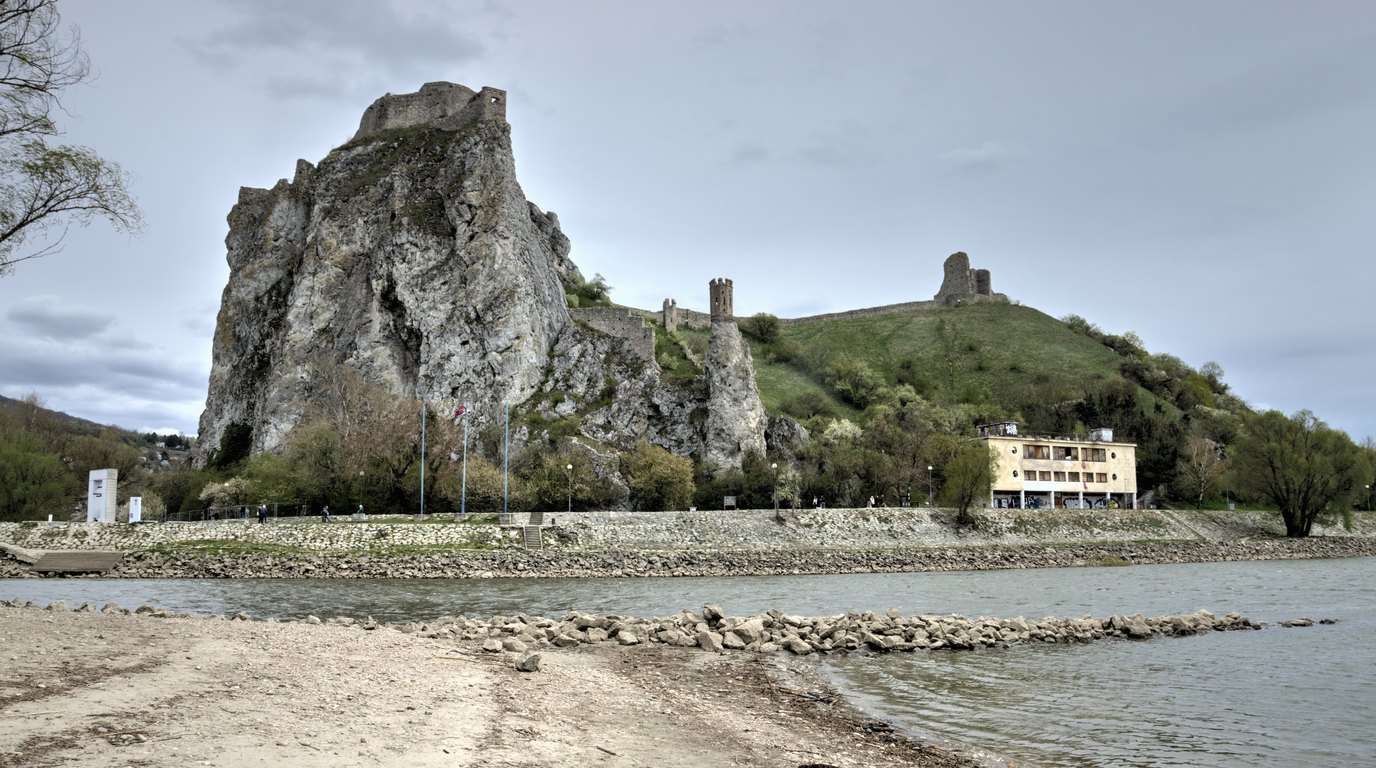
Bratislava Castle with its four corner towers can be seen from all over the city; the Royal Palace houses the History Museum of the Slovak National Museum, there is a Baroque garden on the western terrace, and from the castle hill you look out over the Danube and the tower blocks of Petržalka. The afternoon belongs to Devín, on its rock above the confluence of the Danube and the Morava — a Great Moravian fortified settlement that Napoleon's army blew up in 1809. The lower and middle castle are open to visitors, with the foundations of Roman buildings and a deep castle well, and above it all the Maiden Tower juts from a lone crag. From April to October it opens at ten and an adult pays eight euros.
Červený Kameň and the vineyards around Modra
Červený Kameň Castle above the village of Častá is no ordinary medieval ruin: between 1535 and 1557 the Fuggers of Augsburg built it as a fortress with four corner bastions and vast cellars, and only the Pálffys turned it into a stately Renaissance residence. Today the Slovak National Museum has its furniture collection here and in the main season tours set off every hour on the hour; outside it the opening hours are shorter and the tours fewer, so check the times in advance. In the afternoon drive down to Modra, the centre of the Little Carpathian Wine Route, which is also famous for its Modra ceramics. Arrange a tasting at a winery ahead of time and agree within your crew on who will be driving.
Trnava, the Slovak Rome
Trnava is nicknamed the Slovak Rome because of the number of church towers crowded inside its preserved walls. The main destination is the Cathedral of St John the Baptist: it was built between 1629 and 1637 at the behest of the palatine Mikuláš Esterházy for the university of the day, the builders were the Italians Antonio and Pietro Spazza, and the wooden main altar inside is one of the largest in Europe. Beneath the church there are also catacombs with tombs. You will spend the rest of the day strolling along the walls and around the squares, and towards evening you move north towards the Záhorie region, so that the last day is within easy reach.
The rotunda in Skalica and the way home
Skalica lies right on the border with Moravia and its oldest building is the eleventh-century Rotunda of St George; inside are wall paintings of St George from the end of the fifteenth century and an exhibition of the Záhorie Museum, open from May to September. Skalica also means trdelník — the Skalica trdelník was the first Slovak food to carry a European Union protected geographical indication, and only the one from the Skalica district may bear the name. In the afternoon you head home across South Moravia, so the last coffee stop works out somewhere in South Moravia.
Practical motorhome information
Up to 3.5 t: in Slovakia you need an electronic motorway vignette registered to the number plate (eznamka.sk) — in 2026 a one-day vignette costs €8.10, a ten-day one €10.80, a thirty-day one €17.10 and an annual one €90; for this trip the ten-day vignette is enough. A trailer is charged separately only when the maximum permissible weight of the whole outfit is over 3.5 tonnes. The same division applies in the Czech Republic: up to 3.5 t an electronic motorway vignette, which you need for both the D1 and the D2 you take to reach Slovakia. Over 3.5 t: heavier vehicles pay no vignette in either country and fall under distance-based tolling — in Slovakia through emyto.sk (operated by SkyToll), in the Czech Republic through the Mýto CZ system; the vehicle has to be registered and the on-board unit collected before you first enter the tolled network. There is no toll tunnel, mountain road or ferry on the route, so the main items in the budget are admission fees and parking in Bratislava.
Camping Zlaté piesky, Bratislava (Senecká cesta 2) — the only year-round campsite on the route, by the lake on the edge of the city, with pitches with an electric hook-up; from the Zlaté piesky stop both a tram and a bus run into the centre · Kemping Slnečné jazerá, Senec — the Juh and Sever caravan sections with an electric hook-up, water and a waste dump point, in operation from June to the end of September; from this base you have both Bratislava and Trnava within reach · Camping Park Karpaty, Kuchyňa — dedicated motorhome pitches with electricity and water hook-ups and with a dump point, on the western slope of the Little Carpathians; the operator opens it only in the main summer season · ATC Šaštín, Šaštín-Stráže — a simple campsite by the lake with pitches for caravans and motorhomes and with electric hook-ups, open through the summer; it comes in handy for the last night before Skalica
Slovakia does not permit wild camping or overnight stays outside designated places, and the ridge of the Little Carpathians is a protected landscape area on top of that, so plan your nights into campsites. During the day it is easier: below Devín there is a car park right by the castle entrance and Červený Kameň has a large car park in front of the gate. Do not drive into the historic centres of Trnava and Skalica with a longer vehicle — the streets are narrow and parking is limited, so leave the motorhome by the walls and walk in.
The best-equipped service point on the route is at Camping Park Karpaty in Kuchyňa: the motorhome pitches there have electricity and water hook-ups and a waste dump point, so you can empty and refill the tanks in one place. The second sure thing is Kemping Slnečné jazerá in Senec, where water and a dump point are by the caravan section. Both campsites, however, only run in the warm part of the year — if you set off in April or October, you are left with the year-round campsite at Zlaté piesky in Bratislava, and it is better to check the service facilities there by phone in advance.
Stops along the route
You may also like
The map and GPX contain separate planning waypoints, not a driving route. Follow the itinerary for access to attractions and campsites.
Adria Twin
The Twin is a camper van on a Fiat Ducato chassis — depending on the version it measures 5.4 to 6.4 metres and is 2.05 metres wide, so you will get through the lanes below Červený Kameň and park it by the walls in Trnava and Skalica, where there is no point squeezing in with a long vehicle. Its maximum permissible weight keeps it in the up-to-3.5-tonne category, so in Slovakia and in the Czech Republic alike an electronic motorway vignette is all you need and you do not have to deal with an on-board tolling unit.
Get road trip ideas by email
Leave us your email and we will send motorhome inspiration and stock updates.
Adria Karavany · https://www.adriakaravany.cz/en/vylety/bratislava-a-male-karpaty/