
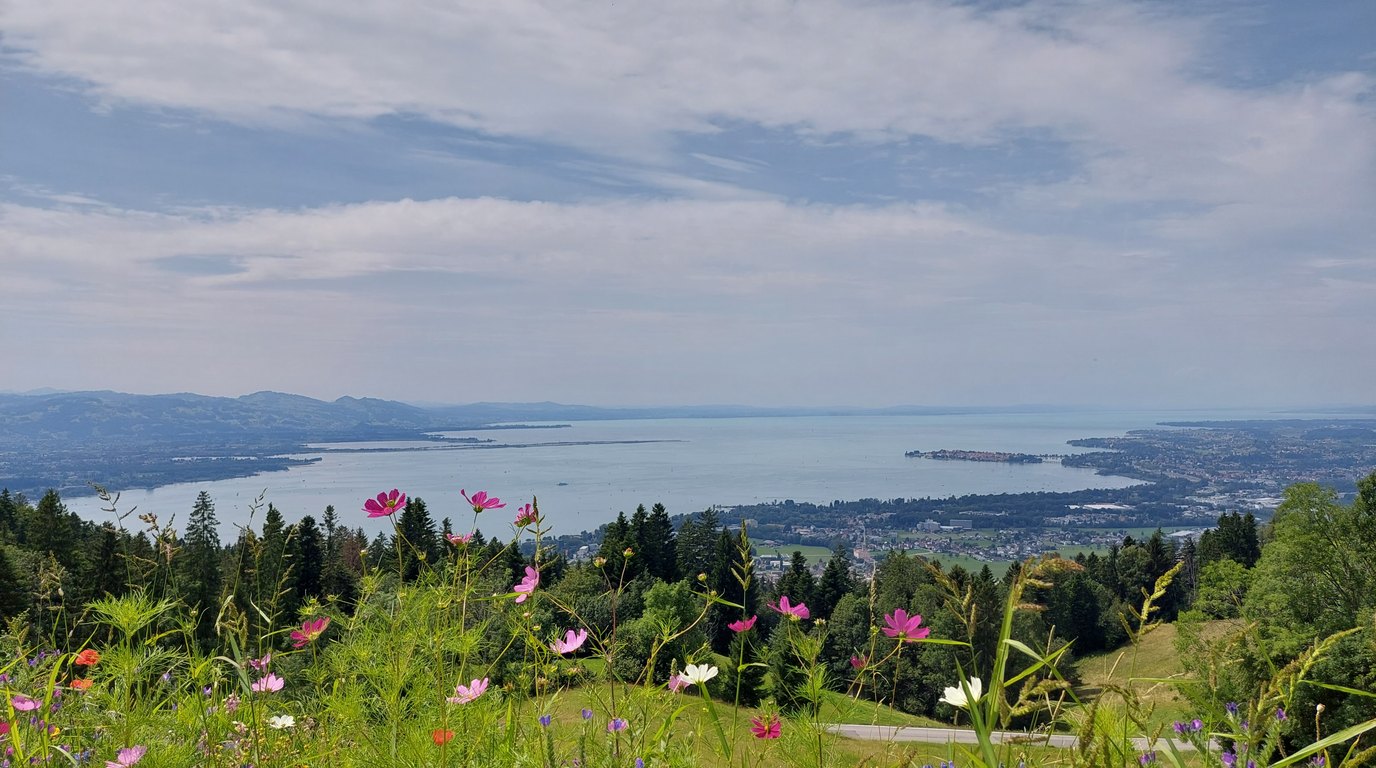
Vorarlberg and Lake Constance
Austria's westernmost corner combines swimming in Lake Constance with the cheese villages of the Bregenzerwald and hairpins up to the Arlberg. Vorarlberg is a small province, so the hops between the lake, the wooded valleys and the mountain cable cars stay short and you spend most of your time in one place rather than behind the wheel. Eight days are enough to cross the region from the water all the way up to Lech and still get home unhurried. It works best from June to September, when the cable cars are running and the higher roads are open.
Itinerary
Across Bavaria to Lake Constance
You set off via Rozvadov towards Nuremberg, Munich and on to Lindau, where the German motorway network ends right at Lake Constance. It is a full day of motorway driving, so break it up with at least two longer stops. You cross the Austrian border at Hörbranz and Bregenz lies immediately beyond it. Leave the town for the morning and in the evening drive straight down to the lake.
Bregenz and the Pfänder
A cable car that has run up here since 1927, with fully glazed cabins from the mid-1990s, carries you from the lakeshore to just below the summit of the Pfänder (1,062 m), and in good visibility you can see Austria, Germany, Switzerland and Liechtenstein from up there. At the top there is an alpine wildlife park with ibex, red deer and wild boar, along with several easy ridge paths you can take back down. In the town itself, the Oberstadt with the onion dome of the Martinsturm and the concrete cube of the Kunsthaus by Peter Zumthor are worth a stroll. From late July to late August the Bregenzer Festspiele festival plays on the lake stage.
The Rhine Delta and the lakeshore
Between Hard, Fußach, Höchst and Gaißau the Rhine flows into Lake Constance and forms the largest wetland on the whole lake; it has been listed under the Ramsar Convention since 1982. More than three hundred bird species have been counted here and they are watched from viewing platforms and from the dykes between the polders. You may walk only on the marked paths — entering the reed beds and the protected meadows is forbidden. The afternoon can be spent on one of the permitted beaches; the water here is shallow and warms up quickly.
Bregenzerwald: Schwarzenberg and Bezau
The valley of the Bregenzer Ache takes you up to Schwarzenberg, a village of farmhouses clad in wooden shingles with a museum devoted to the painter Angelika Kauffmann, who painted an altarpiece and medallions of the apostles for the local church. From here runs the Käsestraße — a network of farmers, cheesemakers, inns and shops where you can taste mountain and alpine cheese straight from the producer. In Bezau a cable car lifts you up to Baumgarten and the meadows above the valley, and in season the museum narrow-gauge railway Wälderbähnle runs here.
The Rappenloch gorge near Dornbirn
South-east of Dornbirn the river Dornbirner Ach cuts into the first limestone massif of the Alps and creates the Rappenloch gorge. After the landslide of March 2020 a new bridge leads here, opened in June 2023, so the route is passable again. Above the gorge follows the small reservoir of Staufensee and beyond it the Alploch gorge; the two sections can be joined into a comfortable circuit. The hairpin road continues higher still to the Walser settlement of Ebnit, tucked away in a closed valley.
Montafon and the Golm
You move south into the Montafon valley. Above Vandans, in the hamlet of Latschau, the Golmerbahn cable car starts and pulls you up to the Golm with a view of the Rätikon peaks opposite. At the top there is the Golmi's Forschungspfad nature trail, a rope park and the Alpine Coaster toboggan run, so you can easily spend the whole day here. You cannot reach the Bielerhöhe from here by road — on the Montafon side the Silvretta-Hochalpenstraße is closed between Partenen and the Vermuntsee because of safety works, and reopening is planned only for 2030.
Over the Flexenpass to Lech
From Bludenz the Klostertal climbs to Stuben, and there you turn off onto the Flexenpass — a road running through avalanche galleries carved into the rock face, one of the most spectacular stretches in Vorarlberg. Beyond Zürs the Lech basin opens up; in summer the ski resort is a quiet mountain village at 1,444 m with a network of waymarked paths. You can return the same way, and in the summer months the continuation north down the Lech valley is open as well. For the night, drop back down into the Ill valley so that you are close to the motorway in the morning.
The journey home
You head back along the same corridor via Lindau, Munich and Nuremberg to Rozvadov. It is another full day of driving, so set off early and allow yourself two proper breaks. If you have time to spare, you can stop for an hour on the way in Lindau's island old town with its harbour and lighthouse.
Practical motorhome information
Up to 3.5 t: in Austria you need a vignette — ASFINAG sells both the digital and the sticker version, with the ten-day one costing roughly €12.80, the two-month one €32 and the annual one €106.80. Above 3.5 t the vignette does not apply; instead you must carry a GO-Box on-board unit and you pay by the kilometre driven. The journey through Germany is free of charge for vehicles up to 3.5 t, and the German toll for vehicles over 3.5 t does not apply to motorhomes — they are exempt from it. The Pfändertunnel on the A14 near Bregenz carries no special toll, the vignette covers it. What you do pay for is the Arlberg road tunnel on the S16 between Langen and St. Anton, where a single trip up to 3.5 t costs around €13; if you drive to Lech over the Flexenpass, you avoid the tunnel altogether.
Seecamping Bregenz, Bregenz — right on the shore of Lake Constance, separated from the water only by a footpath; the season runs roughly from mid-May to mid-September · Camping Austria (the Köb family), Au im Bregenzerwald — open all year round, accepts motorhomes and caravans, a good base for the Bregenzerwald and the Käsestraße; it is a dog-free site · Panorama Camping Sonnenberg, Nüziders near Bludenz — a seasonal site open roughly from mid-May to the end of September, with large pitches and water connections at the pitch; the Montafon and the Arlberg are both close from here · Alpencamping Nenzing, Nenzing — a year-round site in the Walgau on the way into the Montafon, with pitches for motorhomes
Overnighting outside campsites is restricted in Vorarlberg and completely ruled out in the protected areas of the Rhine Delta; in the car parks by the lake follow the signs, as parking overnight is usually banned there. So count on sleeping at a campsite, and in high season — above all during the Bregenz festival, when the town and the campsites around it are full — secure your place in advance; the exception is Seecamping Bregenz, which takes no reservations at all and fills its pitches on a first-come, first-served basis. The valley roads in the Bregenzerwald, the turn-off to Ebnit and the Flexenpass are narrow and winding, so with a longer vehicle watch the width signs, expect oncoming traffic and use the passing places.
Sort out fresh water and emptying the cassette at the campsites: Alpencamping Nenzing and Camping Austria in Au im Bregenzerwald are open all year, so they also work outside the main season, when Seecamping Bregenz and Panorama Camping Sonnenberg are closed. Camping Austria additionally offers gas bottle exchange — useful if you are away for longer and do not want to deal with gas along the way.
Stops along the route
You may also like
The map and GPX contain separate planning waypoints, not a driving route. Follow the itinerary for access to attractions and campsites.
Adria Compact
The Adria Compact is an agile semi-integrated motorhome with a slim body — you notice it straight away on the narrow roads of the Bregenzerwald, in the hairpins up to Ebnit and in the galleries of the Flexenpass. Inside it still gives you a full living space with organised storage throughout the vehicle, so there is somewhere to stow the gear for swimming in Lake Constance.
Get road trip ideas by email
Leave us your email and we will send motorhome inspiration and stock updates.
Adria Karavany · https://www.adriakaravany.cz/en/vylety/vorarlbersko-a-bodamske-jezero/