
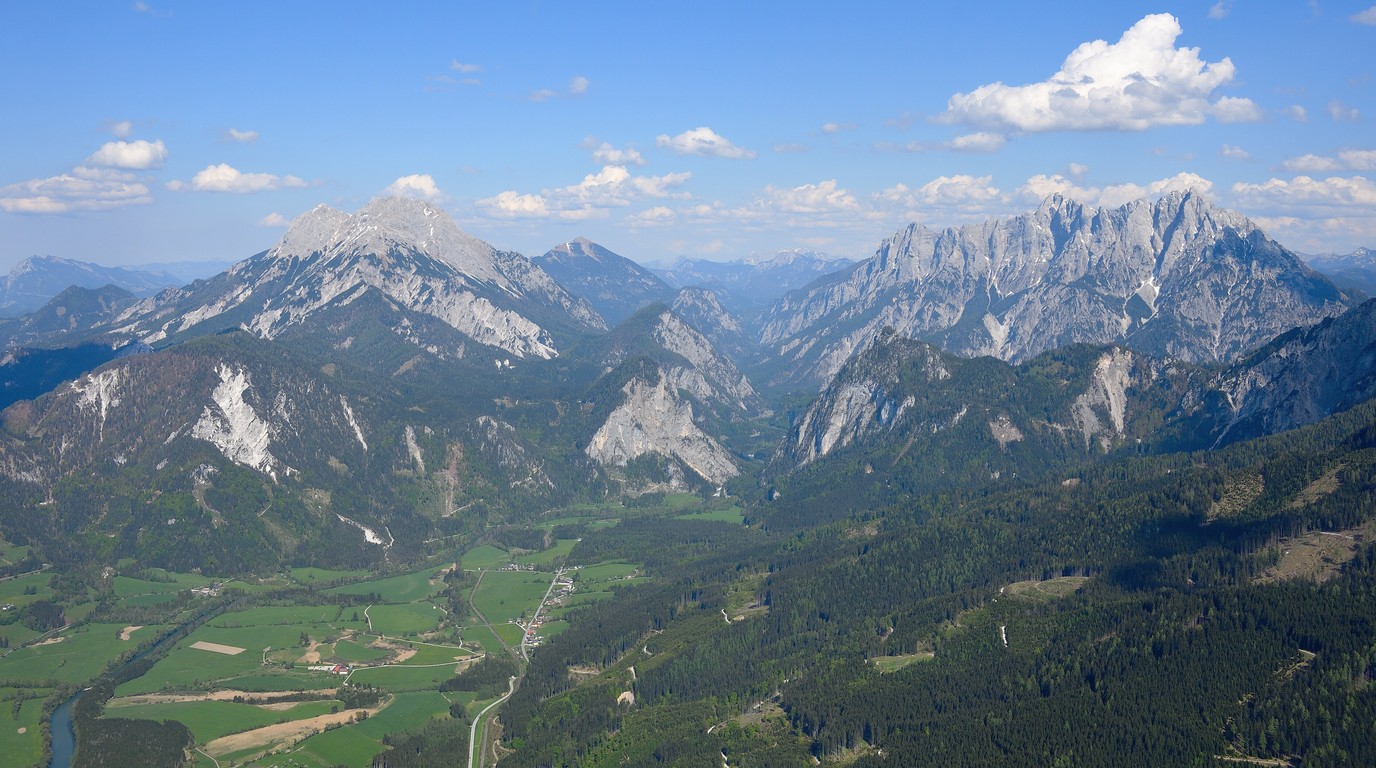
Styria and the Gesäuse — Austria's green heart
Seven days across Styria: the Enns gorge in Gesäuse National Park, the world's largest monastery library at Admont and vineyards above Gamlitz. The route holds a single north-to-south axis, so the landscape and the theme change every day — from wild water to baroque halls, from an ore mountain to a UNESCO-listed city and finally into the wine hills above the Slovenian border. Seven days is the minimum that fits in the drive out and back and still leaves time to stay somewhere two nights in a row.
Itinerary
Into the Enns valley and Admont Abbey
The route runs via Linz and the A9 Pyhrn motorway into the Enns valley, where the open basin gradually closes in between limestone walls. Your first destination is the Benedictine abbey of Admont, founded in 1074, and its library hall, described as the largest monastery library in the world. Check the opening times in advance: outside summer the museum and library are open from Wednesday to Sunday until roughly half past three, from June to September from Tuesday to Sunday until five, and on Monday they are closed.
Gesäuse National Park
Styria's only national park was established in 2002 and protects the stretch where the Enns has cut its way through the Ennstal Alps; the highest peak, the Hochtor, rises to 2,369 metres. Waymarked trails lead from the riverbank right up above the tree line, and the park's information points are in Gstatterboden and at the Weidendom, a structure woven from living willow rods. If you want the water close up, you can run the Enns with one of the local rafting agencies. A quieter base than the main valley is the village of Johnsbach, which holds the Bergsteigerdorf title.
Erzberg, Eisenerz and on to Graz
The Steirischer Erzberg is the largest open-pit mine in Central Europe and iron ore has been mined here for more than 1,300 years; its terraced pyramid is visible from all around. You can choose a ride in the giant Hauly mining truck, a descent into the underground galleries, or both — tours run daily from 8:30 to 15:00 and the visitor centre keeps its main season from May to October. Outside the main season, book your slot in advance. In the afternoon you carry on via Leoben to Graz.
Graz: the Schlossberg and the old town
The historic centre of Graz is a UNESCO World Heritage Site and the best way to take it in is from above. You can ride up the Schlossberg on the funicular, running since 1894, or in the lift cut into the rock, or climb the winding Kriegssteig with its roughly 260 steps. The Uhrturm clock tower, already recorded in 1265, confuses visitors with its long hour hand and short minute hand. Down in the town the Landeszeughaus is worth a stop, with some 32,000 pieces of historic armour and weapons; it is open from April to October.
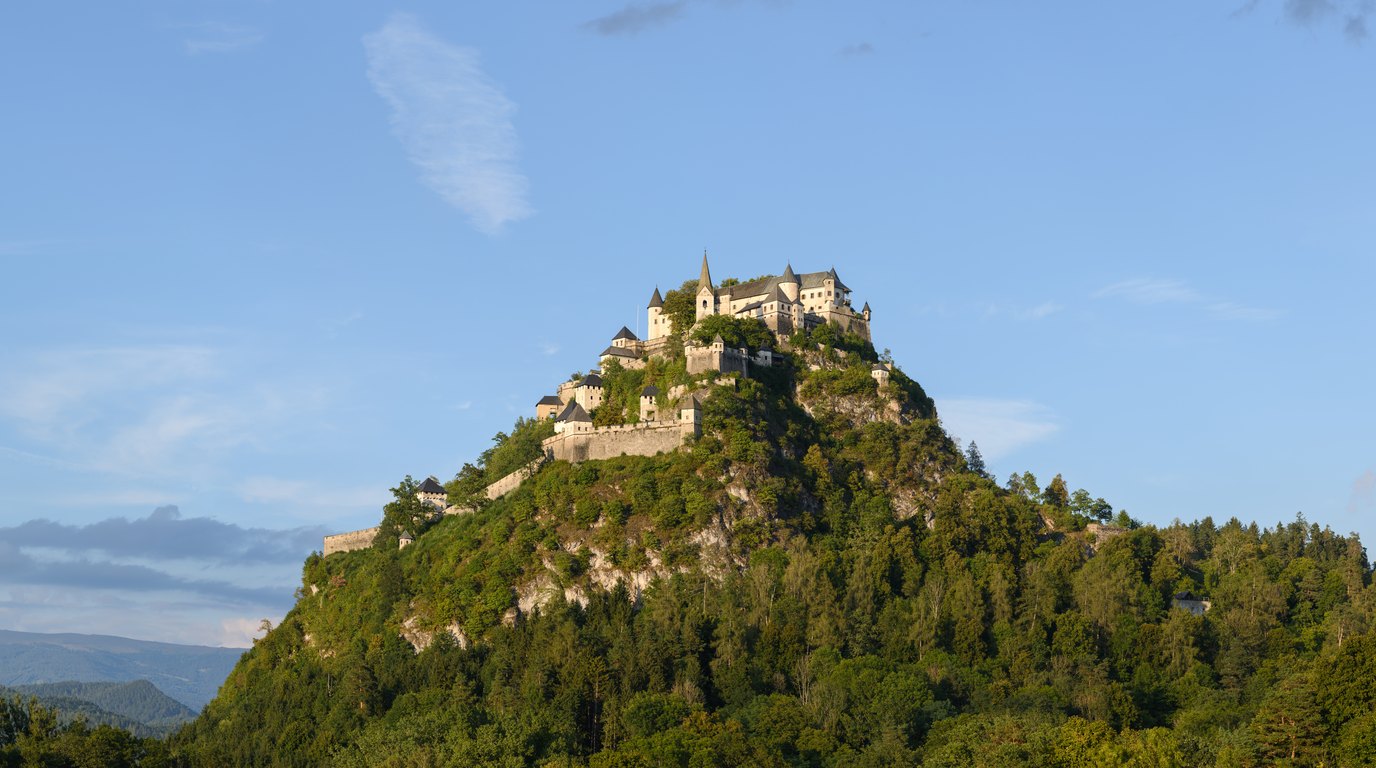
Riegersburg Castle and the Zotter chocolate factory
Riegersburg stands on a volcanic rock 482 metres high and has the reputation of a castle that was never taken. You leave the motorhome down in the village — an inclined lift runs up from the visitor centre, or you can take the historic footpath, which takes you about twenty to thirty minutes. Inside there are three museums, on the history of the castle, on the witch trials and on weapons, and in season there are birds-of-prey displays. In Bergl below the castle you will find the Zotter chocolate factory with its visitor tour, open from Monday to Saturday.
The South Styrian Wine Road
From Ehrenhausen you continue through Gamlitz and Leutschach along the ridges, where the roads trace the border with Slovenia. The lanes here are narrow, twisting and climb steeply between the vineyards, so it pays to drive slowly and to stay out of the tightest turnings down to individual wineries. Above the vines, wooden clappers known as klapotetz rattle away to keep birds off the ripening grapes; in the villages the buschenschanks open, seasonal wine taverns serving home-made cured meat and cheese. For the night it is worth dropping back down to Leibnitz, which shortens the next morning's start.
The journey home
The last day belongs to the return leg and it is the longest continuous drive of the whole trip. Set off early in the morning, break the drive with several stops and leave yourself a margin for the queues around Vienna. If you would rather not drive all day in one go, you can add an extra night in South Moravia and get home the following day.
Practical motorhome information
Up to 3.5 t, which covers most motorhomes, the Austrian vignette is enough: in 2026 the ten-day one costs €12.80, the two-month one €32.00 and the annual one €106.80, while the one-day vignette at €9.60 exists only in digital form. Above 3.5 t the vignette does not apply — the vehicle has to carry a GO-Box on-board unit and the toll is calculated from the kilometres driven, the number of axles and the emission class. This route also crosses two sections with a separate route toll on the A9 Pyhrn motorway: the Bosruck tunnel and the Gleinalm tunnel. Up to 3.5 t, one trip through the Bosruck costs €7.00 and through the Gleinalm €12.00 (rates valid from January 2026); for vehicles over 3.5 t the charge is deducted through the GO-Box. The Bosruck can be avoided on the old road over the Pyhrnpass and the Gleinalm through the Mur valley via Bruck an der Mur — both detours carry no extra charge, but they are slower.
Campingplatz Forstgarten, Gstatterboden (municipality of Admont) — right inside the national park, open roughly from the beginning of May to the end of October · Campingplatz Landhotel Mooswirt, Mooslandl near the village of Landl — open all year round at the eastern end of the Gesäuse · 1. Reisemobil-Stellplatz Graz, Martinhofstraße in the Straßgang district — pitches reserved for motorhomes on the southern edge of Graz, open all year round · Camping Resort Riegersburg, municipality of Riegersburg — below the castle rock, season roughly from the end of March to the beginning of November · Camp Sulmsee, Leibnitz — by the lake on the northern edge of the South Styrian wine region, opens at the end of April
Austria has no single nationwide rule for overnighting outside campsites — each federal province sets its own conditions, and in protected areas nature conservation regulations apply on top of them. In Gesäuse National Park and in the vineyard hills of southern Styria, plan your nights at a campsite or at a marked motorhome pitch; the network along the whole axis is dense enough for that to work without improvising. In Graz you sort out your night on the edge of the city and travel into the centre by public transport, because there is no way to park a motorhome in the historic core.
The safest option is to fill up and empty at the campsites along the route. Forstgarten in Gstatterboden has a disposal point for waste water and for chemical toilets (emptying the cassette carries a one-off fee) and Camp Sulmsee near Leibnitz runs its own grey-water station. Between the Gesäuse and Graz it is worth doing the service before you reach the city — Graz itself has few places reserved for motorhomes and in high season they tend to be full.
Stops along the route
You may also like
The map and GPX contain separate planning waypoints, not a driving route. Follow the itinerary for access to attractions and campsites.
Adria Compact
The Adria Compact is a low-profile motorhome under seven metres long and just 212 centimetres wide, which is exactly what you need on the narrow hairpins of the South Styrian Wine Road, in the lanes of Riegersburg and on the approach roads into the Gesäuse. It also stays in the category up to 3.5 tonnes, so an ordinary category B licence is all you need to drive it there.
Get road trip ideas by email
Leave us your email and we will send motorhome inspiration and stock updates.
Adria Karavany · https://www.adriakaravany.cz/en/vylety/styrsko-a-gesause/