
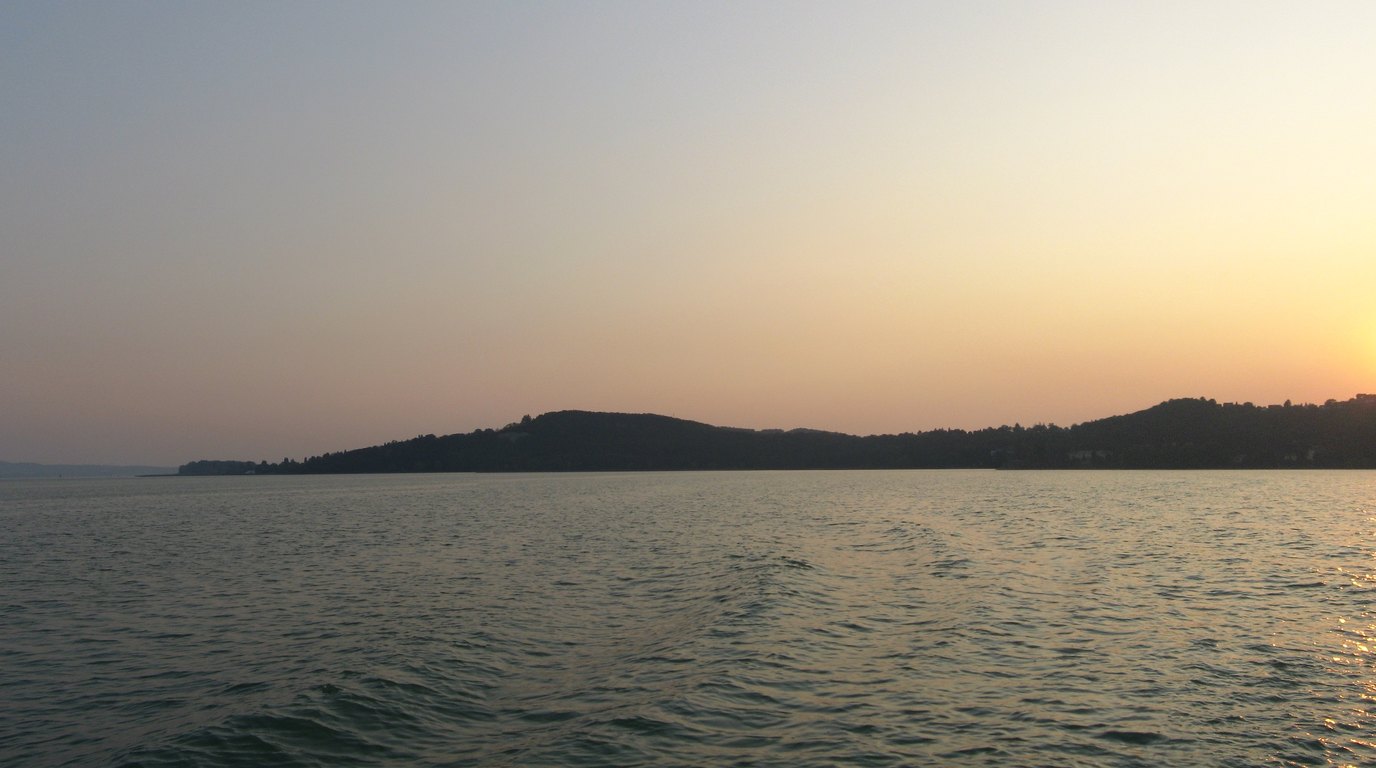
Lake Balaton — the north shore and thermal lakes
Lake Balaton's north shore blends swimming, vineyards on volcanic hills and the thermal lake at Hévíz into one calm family holiday. The hops between stops are short, so you can walk up to a castle in the morning, swim in the afternoon and spend the evening at a wine cellar looking out over the water. The route runs from Balatonfüred and Tihany through the vineyards of Badacsony to Keszthely and ends at a thermal lake you can still bathe in come September.
Itinerary
Driving down to the north shore
The easiest route runs via Brno, Bratislava and Győr and drops down to Balaton through Veszprém. It is the longest drive of the whole trip, so set off early in the morning and plan a proper break roughly halfway — past Bratislava or near Győr. That way you reach Balatonfüred in the afternoon, with time to set up the motorhome and take a first swim.
Balatonfüred: the promenade, the spring and the harbour
Balatonfüred is the oldest spa town on Lake Balaton and the whole of it can be walked. The Tagore Promenade follows the water in the shade of mature plane trees, on Gyógy tér a neoclassical pump room stands over the Kossuth mineral spring, and pleasure boats set off from the harbour. In the afternoon it pays to hire bikes — a waymarked cycle route runs right around the lake and the north shore is its prettiest stretch.
Tihany: the abbey, the Inner Lake and lavender
The Tihany peninsula is the most striking point on the north shore, and the Benedictine abbey founded in 1055 stands on the very best spot of it. From the church a loop trail leads down to the Inner Lake and up to Echo Hill, where you can see the full width of Balaton. The Lavender House visitor centre sits by the Inner Lake; the lavender fields themselves, below Csúcs-hegy, flower in the first half of summer. The peninsula has been a protected landscape area since 1952, so please keep to the marked paths.
Badacsony: vineyards and basalt columns
Badacsony is a volcanic witness hill that drops towards Balaton in steep basalt columns, and vineyards of the local wine region cover its whole slope. The road up to the Kisfaludy House is narrow and steep — with a motorhome it is more comfortable to leave it down in the village and ride up by mountain taxi or electric minibus. The real basalt organ is not here, though: you will find it on neighbouring Szent György-hegy, where a nature trail with seven information stations leads up beneath the tall basalt columns; the loop takes about two hours.
Szigliget Castle above the Tapolca Basin
The ruined castle of Szigliget stands on Várhegy hill directly above the village, and from it you can see the whole Tapolca Basin with its other volcanic peaks — Badacsony, Csobánc and Gulács. You walk up from the village on a short but steep climb, and most of the path has no shade, so save it for the morning or early evening. In the afternoon move on to the western end of the route, to the pair of Keszthely and Hévíz.
Festetics Palace and the thermal lake at Hévíz
Festetics Palace in Keszthely is one of the three largest aristocratic residences in Hungary, and the library in its late-18th-century wing is the only large aristocratic library preserved in the country. The afternoon belongs to Hévíz: the thermal lake is fed by an underground spring at around 40 °C, its water is replaced roughly every three and a half days, and in summer the surface stays between 33 and 35 °C. You can bathe in the wooden floating bath house or out in the open. This is medicinal water with a recommended bathing time — follow the instructions given by the spa.
The journey home
The way back follows the same route through Veszprém, Győr and Bratislava and takes the whole day, so set off right after breakfast. If you want to bring wine home, stop at the cellars in Badacsony or at the market in Keszthely — both lie in the direction you are heading. You will be back in the Czech Republic in the evening.
Practical motorhome information
Hungary runs on an electronic motorway vignette (e-matrica), bought in advance for the registration number. A motorhome up to 3.5 t with no more than seven seats falls into category D1 — a ten-day vignette comes to roughly 6,900 HUF, a monthly one around 11,200 HUF. Vehicles over 3.5 t belong to category D2 (ten-day roughly 10,100 HUF, monthly around 15,800 HUF) and since 2026 the e-matrica is enough for them as well, so the HU-GO on-board unit is no longer needed. Main road 71 along the entire north shore is toll-free; you only need the vignette for the motorway approach (M1, M15, M7). Crossing Slovakia: up to 3.5 t a ten-day e-vignette costs €10.80, over 3.5 t you pay electronic toll by the kilometre through a SkyToll on-board unit. The paid attractions on the route are the spa admission in Hévíz and the mountain taxi ride up Badacsony; both are paid on the spot.
Camping & Bungalows Füred, Balatonfüred (Széchenyi u. 24) — the largest campsite on the north shore, its own beach, pitches with 6–16 A electricity, season roughly 22 April to 27 September · Camping Napfény, Révfülöp (Halász u. 5) — right by the beach, pitches of 70–150 m², a good base for the Káli Basin, season roughly 30 April to 27 September · Camping Strand-Holiday, Balatonakali (Balaton u. 8) — a very long beach, pitches of 70–100 m² including some by the water, season roughly 17 April to 11 October · Castrum Camping Hévíz, Hévíz — 200 numbered pitches separated by hedges, 6–10 A hook-ups, open from 1 March to 30 November · Castrum Camping Keszthely, Keszthely — 126 pitches for caravans and motorhomes, open roughly from 1 May to 30 September
In Hungary camping or sleeping in a motorhome outside campsites is not allowed, and around Balaton it is enforced, so always plan your overnight stops at a campsite. There are few dedicated motorhome parking areas around the lake, but the network of campsites is dense and the gaps between them are short, so you never have to double back far for a bed. In July and August book waterside pitches in advance — capacity on the shore is limited. During the day you park at the paid car parks by the beaches and the harbours.
The most reliable service point on the route is Castrum Camping Hévíz: it has a disposal point for grey and black water and for chemical toilets, and some of the pitches have a water and waste connection right on them. The Balatontourist campsites in Füred, Révfülöp and Balatonakali offer the same facilities, but they only open in the second half of April and close at the end of September (Balatonakali in early October). If you travel in early May or at the end of the season, count on Hévíz — it is the one campsite on the route that stays open outside the main season. You refill water at the pitch itself or at the service point, so there is no need to carry jerrycans.
Stops along the route
You may also like
The map and GPX contain separate planning waypoints, not a driving route. Follow the itinerary for access to attractions and campsites.
Adria Coral XL
The trip opens and closes with a long full-day drive, while between the stops on the north shore you only cover short hops — the Coral XL handles both: comfortable motorway cruising and a whole week parked up at a campsite by the water. The family layout with bunk beds and the large rear garage suit Balaton, where most of your mileage will be on a bike along the shoreline cycle path anyway.
Get road trip ideas by email
Leave us your email and we will send motorhome inspiration and stock updates.
Adria Karavany · https://www.adriakaravany.cz/en/vylety/balaton-severni-breh-a-termaly/