
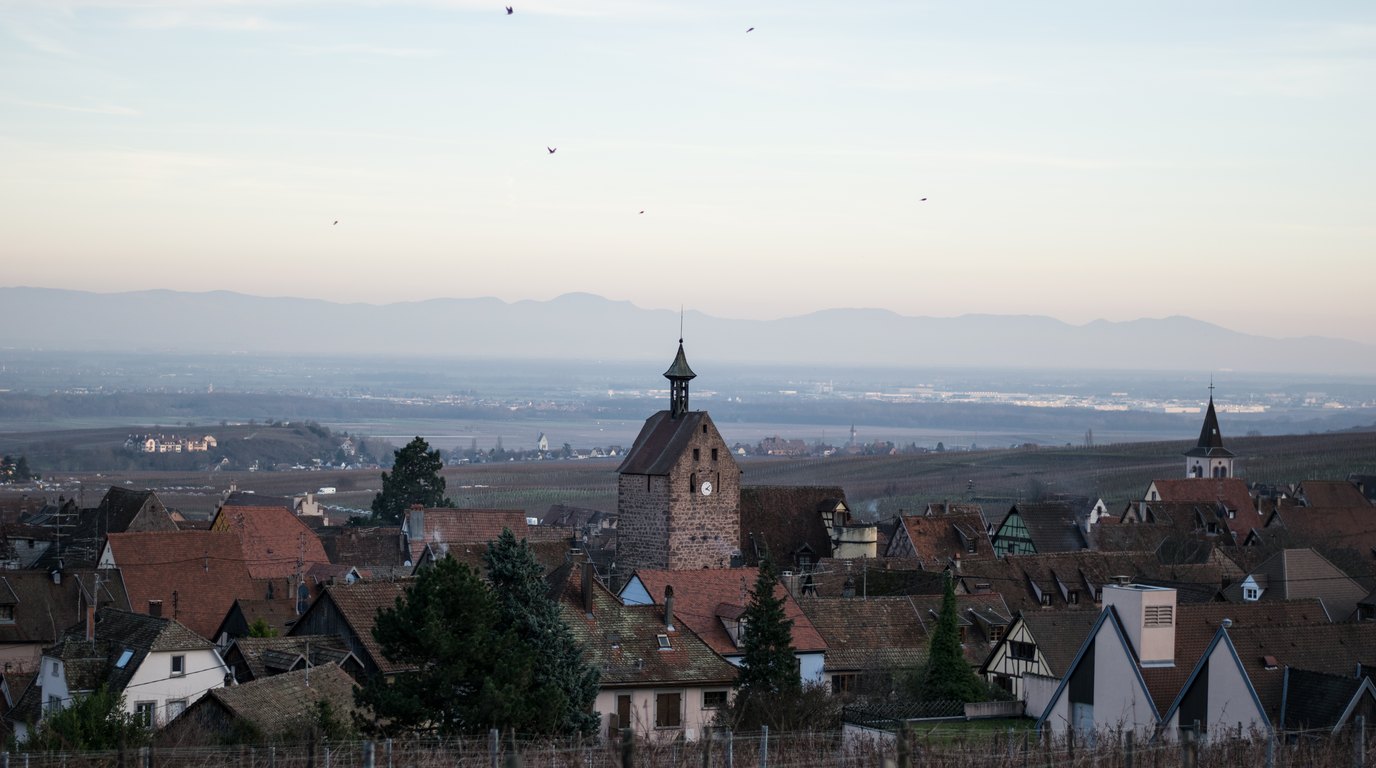
Alsace and the Vosges — wine route and half-timbered towns
The Alsace Wine Route links half-timbered villages, Haut-Kœnigsbourg castle and the Route des Crêtes ridge road across the Vosges. Eight days are enough to move on just a short hop each morning and spend the rest of the time on foot among the vineyards and in the cellars. The villages along the route sit so close together that there is barely any driving with a motorhome — the only demanding day behind the wheel is the climb onto the Vosges ridge.
Itinerary
Transfer to Alsace
The route from Prague runs via Nuremberg and Karlsruhe on German motorways. You cross the Rhine at Strasbourg and Alsace begins right behind the bridge. It is a long day behind the wheel, so set the whole first day aside for it and plan nothing else. Overnight at a campsite in Strasbourg.
Strasbourg and Petite France
The Notre-Dame cathedral has an astronomical clock with figures of the apostles in its south transept; the parade runs once a day around noon, but check the exact time and the admission on the spot. Petite France is the old tanners' quarter, where half-timbered houses lean over the arms of the river Ill; from the terrace of the Vauban dam you can see the whole complex of the Covered Bridges at once. A boat tour suits the afternoon, taking you past the European institutions as well.
The northern section of the wine route
The wine route starts at Marlenheim and its first part belongs to Obernai, Barr and Andlau. Obernai has a completely preserved market square with a Renaissance town hall, the Well of Six Buckets and a belfry. Above Ottrott, on a rocky spur, stands the pilgrimage monastery of Mont Sainte-Odile with a view over the Rhine plain — the road up is steep and winding and the car park at the monastery serves only for the duration of the visit.
Haut-Kœnigsbourg and Sélestat
Haut-Kœnigsbourg castle stands on a wooded ridge above the vineyards, and what you see today is largely a reconstruction from the beginning of the 20th century commissioned by Emperor Wilhelm II. From the great bastion it looks out over the whole plain, over the Black Forest and, in good visibility, reportedly as far as the Alps. In Sélestat below the castle there is the Humanist Library, whose collection is inscribed in the UNESCO Memory of the World programme.
Riquewihr, Hunawihr and Kaysersberg
Riquewihr came through the wars without major damage, so its 16th-century half-timbered houses and town walls stand in their original form. In Hunawihr among the vineyards there is NaturOparC, a centre that helped bring nesting storks back to Alsace. Kaysersberg below the castle ruin is the birthplace of Albert Schweitzer and at the same time the most convenient stop of the day for a motorhome.
Colmar and Eguisheim
Colmar is the natural centre of the wine route. The Petite Venise quarter along the river Lauch and the Marché Couvert covered market are the most photographed parts of the town, but its main trump card is the Unterlinden museum — the Isenheim Altarpiece by Matthias Grünewald. The afternoon leaves time for Eguisheim, a small town built in concentric rings around a former castle.
Route des Crêtes across the Vosges ridge
The ridge road was built during the First World War as a supply route for the French army and today it is a scenic drive along the crest of the Vosges. On the way you pass the Col de la Schlucht pass, the glacial lake Lac Blanc and Markstein, and the highest point is the Grand Ballon. At the southern end stands the Hartmannswillerkopf memorial, one of the main battlefields of the Vosges front. The road is narrow and winding and the pull-offs at the viewpoints are small — with a longer vehicle expect that you will not fit into some of them, and do not try turning around anywhere.
The way back to Prague
The return journey copies the approach route via Karlsruhe and Nuremberg and can be managed in a single day. It pays to set off early in the morning while the German motorways are still quiet. If you want to split the day, you can make an afternoon stop in Nuremberg.
Practical motorhome information
Up to 3.5 t (most motorhomes sold here): in Czechia a motorway vignette is enough, in Germany a motorhome pays nothing at all, and in France you pay at toll gates according to the vehicle class — a motorhome up to 3.5 t and under three metres high falls into class 2, a taller vehicle into class 3. Over 3.5 t: in Czechia electronic tolling with an on-board unit, in Germany motorhomes are exempt from the toll for vehicles over 3.5 t (it applies only to vehicles designed to carry goods), and in France the vehicle falls into class 3. On the Alsace route itself, however, you will hardly meet a toll gate: the Alsatian A35 motorway from Mulhouse via Colmar and Sélestat to Strasbourg is free along its whole length and the approach from Czechia runs through Germany. Do count on Strasbourg, though — the city has a ZFE low-emission zone. An attempt to abolish low-emission zones by law in 2026 was struck down by the Constitutional Council, so the zone still applies. You order the Crit'Air sticker for a Czech-registered vehicle in advance at certificat-air.gouv.fr (around five euros including postage abroad) and it arrives by post, so allow several weeks for it. Motorhomes registered in the VASP category in the vehicle documents have an exemption in the Eurométropole, but it has to be applied for in advance at derogations-zfe.strasbourg.eu.
Camping de Strasbourg (CityKamp), Strasbourg — Montagne Verte district, open all year round, into the centre by tram or by bike · Camping de l'Ill – Colmar, Horbourg-Wihr near Colmar, a cycle path leads into the centre · Camping de Riquewihr, Riquewihr — right on the Route des Vins below the vineyards · Camping du Haut-Kœnigsbourg, Lièpvre in the Val d'Argent valley — seasonal, open roughly from the end of March to the end of September · Camping Le Parc de la Fecht, Munster — by the river Fecht, a good base below the Route des Crêtes
Alsace has a dense network of municipal motorhome stopovers (aires de camping-car) — paid, with a limited length of stay and usually on the edge of the village; large ones are at Kaysersberg, Riquewihr and in the villages below Haut-Kœnigsbourg, that is Orschwiller, Châtenois and Saint-Hippolyte. Overnighting outside them is restricted by municipal by-laws both in the vineyards and in the Ballons des Vosges regional park, so count on staying at official sites. The historic centres of Strasbourg, Colmar, Riquewihr and Eguisheim can neither be driven through nor parked in with a motorhome — the vehicle stays at the campsite or at the municipal stopover and you go into the centre on foot, by bike or by public transport.
The best equipped stopover on the whole route is in Kaysersberg on Place de l'Erlenbad: an asphalt and gravel area with dozens of places, a waste disposal point, drinking water and sorted waste, open all year round and payable by card or in cash (from January to the end of March only the parking and the disposal point are in operation, and on Advent weekends part of the area is reserved for coaches). Camping de l'Ill in Horbourg-Wihr near Colmar has a service point too — it sits outside the campsite grounds, so you can use it when passing through as well. Camping de Riquewihr has its own service point with water and a disposal point from roughly April to the end of October.
Stops along the route
You may also like
The map and GPX contain separate planning waypoints, not a driving route. Follow the itinerary for access to attractions and campsites.
Adria Compact
The Adria Compact is a compact low-profile motorhome that fits onto the small municipal stopovers in the wine villages and handles the narrow hairpins of the ridge road without any drama. At the same time it has a fixed bed and a full bathroom, so you can manage eight days in a row at campsites along the wine route without compromises.
Get road trip ideas by email
Leave us your email and we will send motorhome inspiration and stock updates.
Adria Karavany · https://www.adriakaravany.cz/en/vylety/alsasko-a-vogezy-vinna-stezka/