
The Soča Valley and Goriška Brda
The emerald Soča links the passes of the Julian Alps with the vineyard hills of Goriška Brda in one long valley you can drive along a single axis. The route starts in the terraced Brda hills at Šmartno, follows the river upstream through Kanal ob Soči, the Tolmin Gorges and Kobarid all the way to Bovec, and comes home over the hairpins of Vršič. It is a trip for anyone who wants to alternate gorges and waterfalls with tastings of rebula and has no appetite for crossing the country every other day. Longer A-class and overcab motorhomes do have hard work ahead of them on Vršič, though, so the itinerary offers a more comfortable way round as well.
Itinerary
Across Austria into Carinthia
From Prague the road runs south past Linz and Salzburg, and the first day is an honest motorway transfer across Austria. Beyond Salzburg you join the A10, pass through the Tauern Tunnel and reach Carinthia in the early evening. Treat the overnight stop near Villach as a purely technical one — it pays to stay close to the motorway towards the Karawanks Tunnel rather than heading deeper into the mountains for a single night.
Through the Karawanks to Goriška Brda
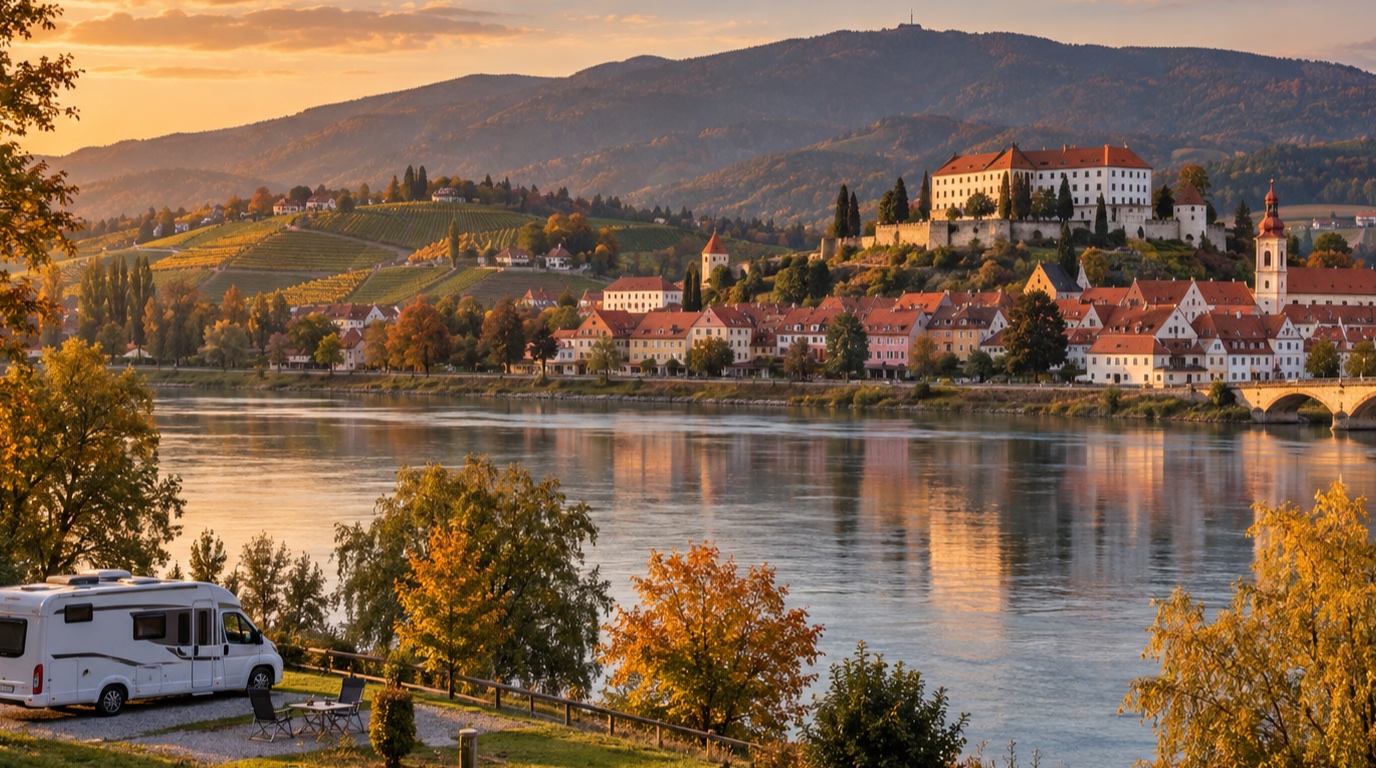
In the morning you drive through the Karawanks Tunnel into Slovenia and follow the motorway past Ljubljana down to Nova Gorica. By the afternoon you find yourself in a completely different landscape: Goriška Brda is a country of terraced hills full of vineyards, orchards and stone villages. Climb up to the walled village of Šmartno with its towers set into the ramparts, and then to the Gonjače lookout tower, where the view runs back across the vines to the Julian Alps. The evening belongs to rebula, aged farmhouse cheese and peace and quiet.
Kanal ob Soči and the Tolmin Gorges
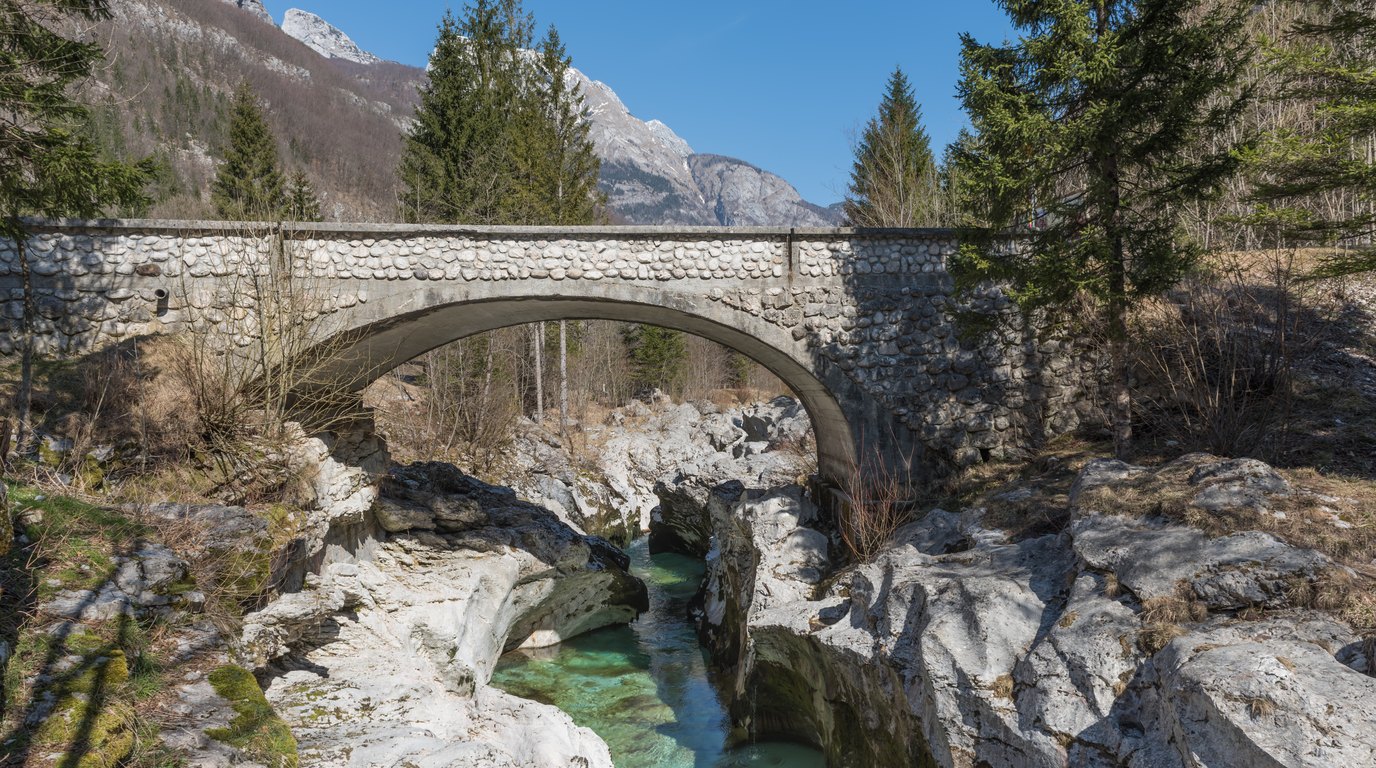
You now head upstream, north along the Soča valley. In Kanal ob Soči the stone bridge above the turquoise water is worth a stop — in mid-August it hosts a traditional diving competition. In the afternoon you reach the Tolmin Gorges, the lowest entrance into Triglav National Park; there is an entrance fee, the circuit has opening hours and it closes after heavy rain, so check the current situation beforehand. Inside the gorge you will find the Devil's Bridge, the Bear's Head boulder wedged between the walls, and a thermal spring.
Kobarid: the Napoleon Bridge and the Kozjak waterfall
Kobarid is the heart of the valley and the best base for a whole day without driving. From the Napoleon Bridge, which arches high above the Soča gorge, an easy trail leads to the Kozjak waterfall hidden in its rock chamber. Save the afternoon for the museum in Kobarid, whose exhibition on the fighting along the Isonzo front received a Council of Europe award in 1993. If you still feel like stretching your legs, follow the Walk of Peace up to the Italian charnel house above the town.
Bovec and the Great Soča Gorge
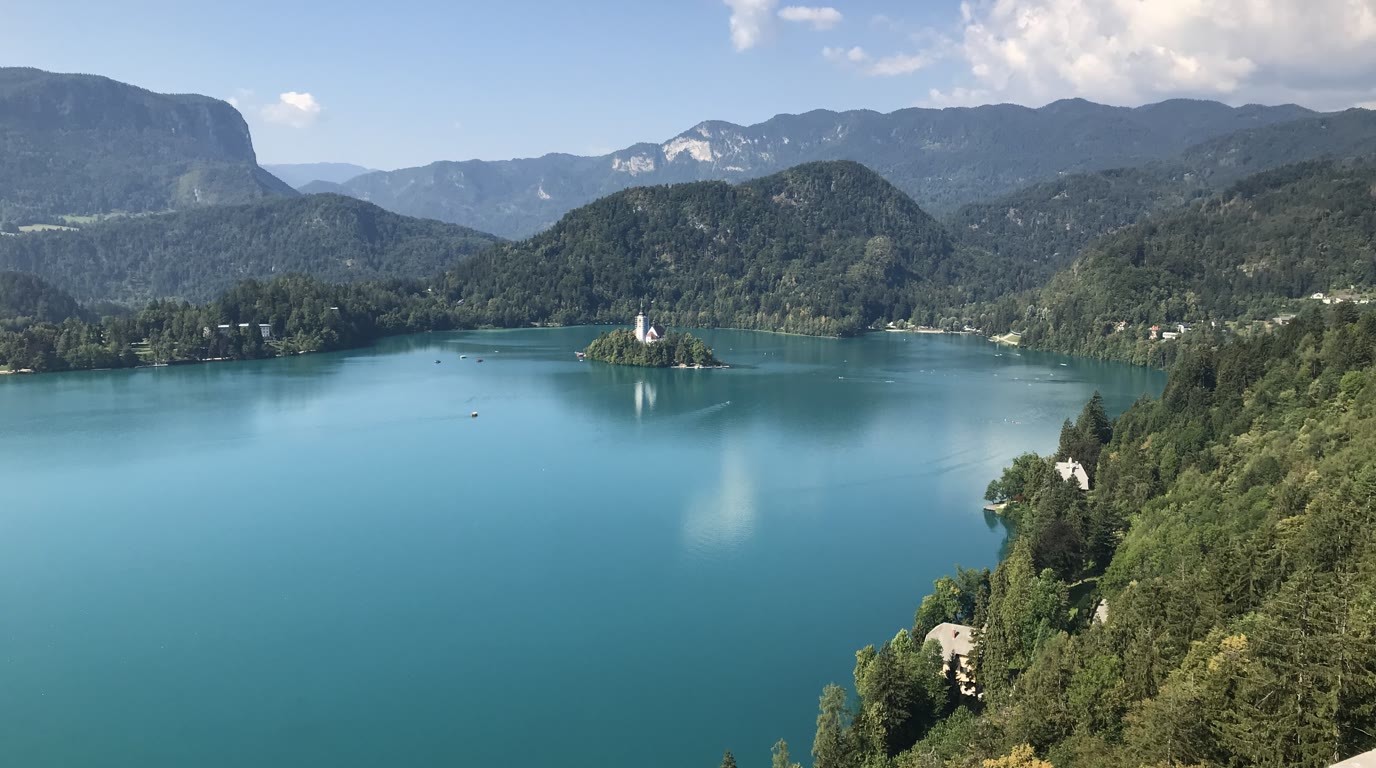
The upper part of the valley is the wildest. Between Bovec and the village of Soča the river cuts into Velika korita, a narrow gorge where the water is so clear that you can see every stone on the bottom. Bovec is also the base for rafting, canyoning and the cable car up to Kanin, so the day fills itself here. If you have time left over, turn off to the Boka waterfall below Bovec or into the side valley of Lepena.
Over Vršič back to Austria
From Trenta the road climbs to Vršič, the highest road pass in Slovenia: fifty hairpins, some of them paved with stone setts, and the Russian Chapel built by the prisoners of war who laid the road during the war. The carriageway is narrow and the climb long — with an A-class or overcab motorhome longer than roughly seven metres, or with a car and caravan, it is wiser to skip Vršič and return from Bovec over the Predel pass into Tarvisio in Italy. Beyond the saddle you drop down to Kranjska Gora and cross into Austria in the afternoon, where you spend the night.
The journey home
The last day is another pure transfer — Villach, Salzburg, Linz and home. Seven days is the bare minimum for this route, so if you want to travel at an unhurried pace, add an eighth day and keep the final night somewhere near Linz. The time you gain can then go to the valley itself, to everything the seven-day version leaves no room for.
Practical motorhome information
Austria: vehicles up to 3.5 t need a vignette (for 2026 the ten-day one costs €12.80, the two-month €32.00 and the annual €106.80), while vehicles over 3.5 t use a GO-Box unit and pay per kilometre instead. On top of the vignette you pay separate section tolls — the Tauern and Katschberg sections of the A10 cost €15.00 per drive-through for a vehicle up to 3.5 t and the Karawanks Tunnel €9.00; heavier vehicles pay more and are handled through the GO-Box. Slovenia: an e-vignette, and DARS puts a motorhome up to 3.5 t into the cheaper 2A class regardless of its height above the front axle — €16.00 for a week, €32.00 for a month. What matters is that the vehicle is registered as a motorhome in its papers; tall vans without that entry fall into the more expensive 2B class (€32.00 for a week, €64.10 for a month). Vehicles over 3.5 t do not use a vignette in Slovenia at all and need a DarsGo unit. Neither Vršič nor Predel is tolled; if you drive to Bovec via Tarvisio in Italy, budget for the toll on the A23 motorway.
Kamp Brda, Podsabotin (Goriška Brda) — open all year, twelve pitches for motorhomes with electricity and water, heated washrooms and a swimming pool · Kamp Gabrje, Gabrje near Tolmin — on the right bank of the Soča, season roughly from mid-April to the beginning of October, pitches with electricity, water and waste disposal · Eko Kamp Koren, Kobarid — above the gorge by the Napoleon Bridge, dedicated areas for motorhomes and caravans, a restaurant and equipment rental · Kamp Polovnik, Bovec — on the edge of town a short walk from the centre, pitches for motorhomes and caravans, restaurant with a terrace · Kamp Liza, Bovec — the second option in Bovec, useful when Polovnik is full
Spending the night outside campsites is not allowed in Slovenia and in Triglav National Park it really is checked, so plan your nights into campsites and book them ahead in July and August. The car parks at Velika korita and at the Tolmin Gorges in Zatolmin are small and charged for, in high season they tend to be full by late morning and a long vehicle manoeuvres badly on them — it pays to arrive early in the morning. On Vršič you can only stop in the lay-bys along the hairpins; there is no large car park up at the top.
You can empty waste water and take on drinking water at Kamp Gabrje below Tolmin, where the pitches have both water and waste connections, and at Kamp Brda in Podsabotin, which has a disposal point and is open all year — one sits at the start of the route and the other at the end, so the two complement each other nicely. In the upper part of the valley, Eko Kamp Koren in Kobarid does the job. Bigger shopping, a pharmacy and a garage can all be dealt with in Tolmin, and in Nova Gorica at the southern end of the route.
Stops along the route
You may also like
The map and GPX contain separate planning waypoints, not a driving route. Follow the itinerary for access to attractions and campsites.
Adria Twin
The Adria Twin is a compact van conversion, and that is exactly what the Soča valley asks for — in both width and height you stay within the dimensions of an ordinary van, so the narrow vineyard lanes of Brda and the tight passages through the villages above the Soča never turn stressful. It parks in a normal parking space, whether you stop for lunch in Kobarid or for the shopping in Tolmin, and on long Alpine climbs it behaves more like a van than like a big motorhome. At the same time it has its own washroom and tanks large enough to last you in the campsites of the Soča valley without topping up every single day.
Get road trip ideas by email
Leave us your email and we will send motorhome inspiration and stock updates.
Adria Karavany · https://www.adriakaravany.cz/en/vylety/udoli-soci-a-goriska-brda/