
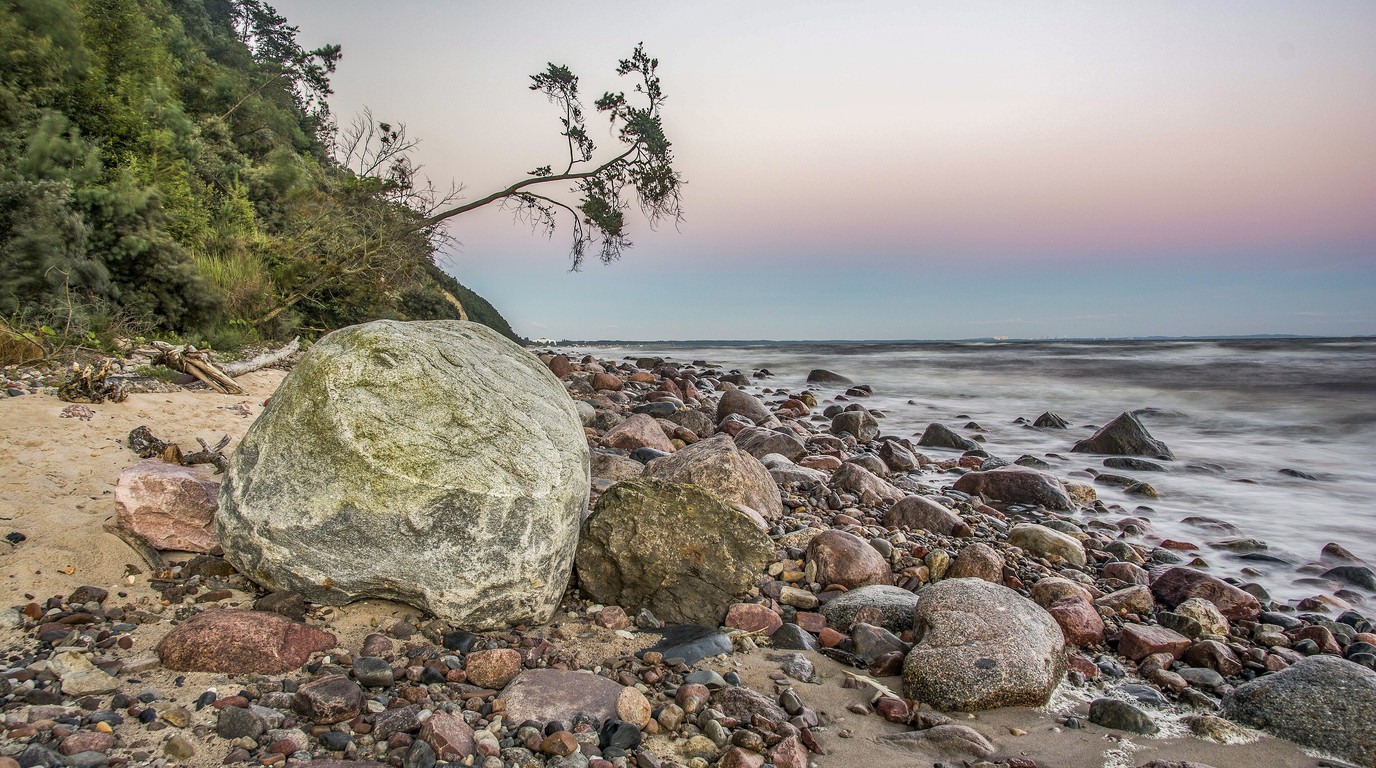
Wolin, Szczecin and Western Pomerania
The closest Polish seaside to Prague: the cliffs of Wolin National Park, the spa town of Międzyzdroje and the pier at Kołobrzeg. Six days in which two motorway legs, out and back, alternate with short hops along the coast — from Szczecin through the tunnel under the Świna to the island of Usedom, then back to Wolin and further east on the coast road. This is family country: wide sandy beaches, a bison enclosure, lighthouses with viewing galleries and a cliff whose edge you can walk along for a whole afternoon. The season here runs from May to September, but July and August are the busiest — in June or September the promenades and viewpoints are noticeably emptier.
Itinerary
Across Germany to the Oder
From Prague the route runs through Ústí nad Labem, Dresden and the Berlin ring road onto the A11 motorway and on to the border crossing at Kołbaskowo. It is a long day, but entirely on motorways, so it can be managed with one proper break. In Szczecin, save the Chrobry Embankment for the evening — a wide terrace above the Oder with staircases, a fountain and a view of the harbour cranes.
Szczecin: the ducal castle and the old town
The Ducal Castle of Pomerania stands on a rise above the river. The Renaissance courtyard is open to walk through, and inside you will find a museum, exhibition halls and a café. From the castle runs the so-called Red Route, marked directly in the pavement, past St James' Cathedral and the city gates. In the afternoon, drive west to Świnoujście: the shortest way crosses the island of Wolin and, since 2023, continues through the new tunnel under the Świna, so there is no waiting for a ferry. Świnoujście already lies on the island of Usedom, right at the German border.
Świnoujście: the lighthouse and a wide beach
The lighthouse in the Warszów district is the tallest on the Polish Baltic coast and more than three hundred steps lead to the top; from the gallery you can see the mouth of the Świna, the port and a stretch of German Usedom. The rest of the day belongs to the beach and the promenade, which runs seamlessly into the neighbouring German resort of Ahlbeck — you will mostly recognise the border by the information board. Anyone keen on military history can head for Fort Gerharda, a 19th-century Prussian coastal fortress.
Through the tunnel under the Świna to Wolin
You take the tunnel under the Świna back to the island of Wolin; pedestrians and cyclists are not allowed inside, so the Bielik ferries still run for them. In Międzyzdroje, leave time for the pier and for the bison enclosure run by Wolin National Park; entry to the park and to the enclosure is charged separately. In the afternoon, walk up Gosań — a hill more than ninety metres high whose viewpoint takes in a long stretch of cliff coast and the open sea.
Ruins on the cliff and the drive to Kołobrzeg
Of St Nicholas' Church in Trzęsacz, a piece of wall right on the edge of the cliff is all that remains. The Gothic church from the turn of the 14th and 15th centuries originally stood further from the water, but the sea took a little of the cliff year after year until the remnant ended up above the beach; a multimedia museum and a viewing platform stand beside the ruins today. Then follow the coast road through Niechorze with its red brick lighthouse to Kołobrzeg, where the afternoon is enough for both the concrete pier and the lighthouse at the mouth of the Parsęta.
The journey home
There are two ways home. Either back through Szczecin, Berlin and Dresden, motorway the whole way, or south on the S3 expressway through Gorzów and Zielona Góra to the border at Lubawka and Královec — that option runs through the Polish interior and tends to be quieter. Whichever you choose, it is the longest drive of the entire trip, so set off early and count on two breaks.
Practical motorhome information
Up to 3.5 t: in the Czech Republic you need a motorway e-vignette (annual, monthly or ten-day; the annual one costs in the low thousands of crowns), Germany charges nothing for motorway use, and in Poland this entire route — the A6 near Szczecin, the S3 and the coastal S6 — is toll-free; Poland's tolled concession sections lie elsewhere on the map. Over 3.5 t: the Czech Republic uses electronic tolling with an on-board unit, Poland requires registration in the e-TOLL system (which applies to vehicles with a gross weight over 3.5 t), and although Germany does have a toll for vehicles over 3.5 t, motorhomes are exempt from it — it is paid by vehicles designed to carry goods. The tunnel under the Świna between Świnoujście and the island of Wolin is free for all categories, so leave it out of your budget.
Camping Marina PTTK, Szczecin-Dąbie (ul. Przestrzenna 23) — by Lake Dąbie on the edge of the city, practical for your first night after arriving · Camping nr 44 Relax, Świnoujście (ul. Słowackiego 1) — in the seaside district a short walk from the promenade · Camping Plaża, Międzyzdroje (ul. Gryfa Pomorskiego 76) — by the beach on the south-western edge of town · CAMP-ANA, Trzęsacz (ul. Łąkowa 30) — right in the village with the church ruins · Camping Klif, Rewal (ul. Kamieńska 26) — a little further along the coast, for when Trzęsacz is full · Camping nr 78 Baltic, Kołobrzeg (ul. 4 Dywizji Wojska Polskiego 1) — east of the centre, within reach of the beach · In July and August, book your pitch in advance — the seaside campsites in Międzyzdroje and Kołobrzeg tend to be full in high season and you cannot count on finding a free place.
Inside Wolin National Park you may spend the night only at designated places, and outside the park Polish rules ban camping away from campsites and official stopovers. Paid car parks in the seaside resorts are meant for day visits and fill up by mid-morning in high season. The alternative to campsites are motorhome stopovers: OAZA in the Podczele district of Kołobrzeg and Summercamp in Grzybowo west of Kołobrzeg, and on the German side of Usedom the Wohnmobilstellplatz Seebad Ahlbeck just across the border from Świnoujście.
The surest option is to take on water and empty your waste at the campsite where you are staying — reception will show you the dump point and the drinking-water tap. Outside campsites, two of the stopovers listed above have a service point, Summercamp and Seebad Ahlbeck; OAZA in Podczele does not. Before the long drive back it is worth topping up the tank in Kołobrzeg so you do not have to deal with it on the way.
Stops along the route
You may also like
The map and GPX contain separate planning waypoints, not a driving route. Follow the itinerary for access to attractions and campsites.
Adria Coral XL
The route rests on two long motorway legs, out and back, with only short coastal hops in between — so it pays to have a vehicle that stays calm on the motorway and still fits comfortably into a seaside campsite. The Adria Coral XL adds a large garage for bikes and beach gear and a layout with fixed beds, so for six days nothing has to be folded out every evening.
Get road trip ideas by email
Leave us your email and we will send motorhome inspiration and stock updates.
Adria Karavany · https://www.adriakaravany.cz/en/vylety/wolin-stetin-zapadni-pomorany/