
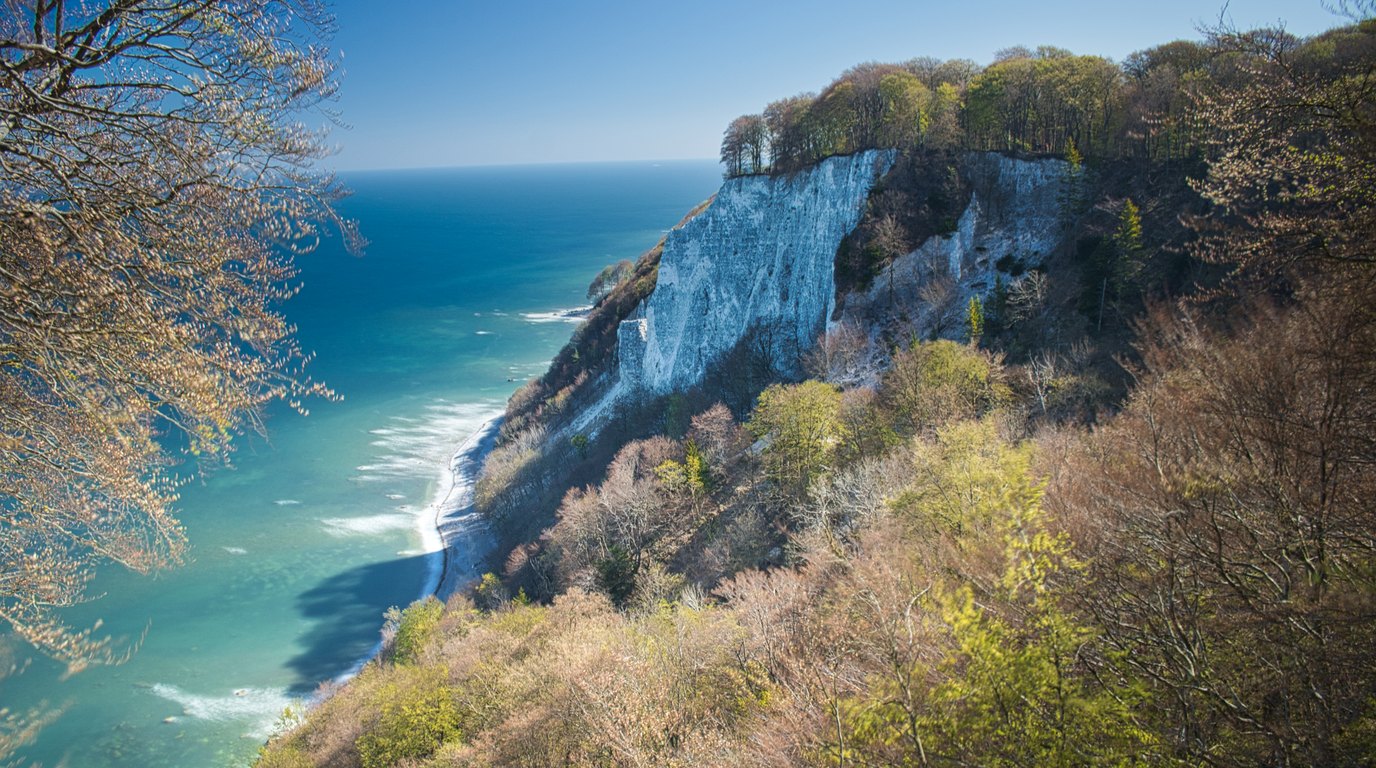
Baltic Coast — Rügen, Usedom and the Chalk Cliffs
Rügen and Usedom are the closest sea to Prague — the chalk cliffs of Jasmund, wooden spa piers, the lighthouses of Cape Arkona and sandy beaches. The eight-day route links the Hanseatic city of Stralsund, a UNESCO World Heritage site, with Jasmund National Park, the northern tip of Rügen and the imperial spa towns in the south of Usedom. The whole coast is flat, laced with cycle paths and dotted with campsites in pine woods a short walk from the beach, so it works well even as a first longer motorhome trip with children. Expect to spend the first and the last day on the motorway — everything in between is the sea.
Itinerary
From Prague to the Baltic
The longest leg of the whole trip runs by motorway through Dresden, the Berlin ring road and Mecklenburg all the way to the Strelasund. Allow seven to eight hours of pure driving, so set off early in the morning and break the day up with several longer stops. If you would rather not do the whole stretch in one go, you can spend the night by the Müritz in Waren — but that costs you one day on the coast. You will reach Stralsund in the early evening, in time for a first walk down to the harbour.
Stralsund and the crossing to Rügen
The historic core of Stralsund has been on the UNESCO World Heritage list since 2002, together with Wismar. The Old Market square is dominated by the brick Gothic town hall with its openwork façade, and right behind it stands St Nicholas' Church; the sailing ship Gorch Fock I is moored in the harbour. If the weather turns, the Ozeaneum with its displays on the Baltic and the northern seas is a safe bet for half a day. In the afternoon you cross the Rügenbrücke onto the island.
Jasmund National Park and the Königsstuhl
Germany's smallest national park protects the beech woods above the chalk cliffs, and part of them is likewise on the UNESCO list. The rock spur of the Königsstuhl itself is closed to visitors because of erosion — the viewpoint has been replaced by the steel Königsweg arch, opened in 2023, which is included in the paid admission to the Nationalpark-Zentrum. You cannot drive to the centre yourself: you park at Hagen and take the shuttle bus up, or walk there through the beech woods. To see the cliffs in peace and without queuing, walk the Hochuferweg coastal path from Sassnitz.
Cape Arkona and the fishing hamlet of Vitt
Three towers close off the northern tip of Rügen: Schinkel's lighthouse from the 1820s, the taller lighthouse from the beginning of the twentieth century and, between them, a former navigation tower of 1927. Cars and motorhomes stay in the large car park in Putgarten; from there you continue on foot, by horse-drawn carriage or aboard the Kap-Arkona-Bahn road train. Parking here is charged and the rate depends on the height of your vehicle. A short way west lies Vitt, a fishing hamlet of thatched roofs tucked into a gully above the sea.
Binz, Prora and the pier at Sellin
Binz is a textbook of seaside spa architecture — white verandas, wooden balconies and a promenade along the beach. North of it stretches Prora, an unfinished holiday complex from the 1930s whose history is explained by the local documentation centre. The afternoon belongs to Sellin: its pier is the longest on Rügen, the present structure dates from 1998, though the first bridge stood here as early as 1906. Between the spa towns you can ride the Rasender Roland narrow-gauge railway, which has run from Putbus via Binz and Sellin to Göhren since the end of the nineteenth century.
Crossing to Usedom and Peenemünde
Getting from Rügen to Usedom means a detour through Stralsund, Greifswald and Wolgast — it is a transfer day in its own right, not an afternoon outing. At Wolgast you cross the Peenestrom on a bridge that opens for shipping several times a day in season and closes the road for up to half an hour; the current times are published by the road authority and by the island's tourist websites. On the northern tip of Usedom stands Peenemünde, with its Historical Technical Museum in a former power station, which covers the history of the wartime weapons research carried out here. In the main season it is open from ten to six.
The imperial spas: Bansin, Heringsdorf and Ahlbeck
The trio of Bansin, Heringsdorf and Ahlbeck still carries the name Kaiserbäder, the imperial spas, and a continuous seafront promenade ties them together. The pier at Ahlbeck, whose oldest part has stood above the beach since 1882, is the oldest surviving pier in Germany, and its wooden pavilion with four turrets counts as the symbol of the whole island. The beach here is wide and shallow, which you will appreciate with smaller children from the very first morning. The coastal cycle path carries on into Świnoujście in Poland, so you can ride over to another country for lunch and come back by bike.
Back to Prague
The last day is given over to the drive home — from Usedom you return via Berlin and Dresden at roughly the same pace as on the way out. It pays to set off early in the morning, before the traffic builds up on the Berlin ring road, and to take a longer lunch break. If you have a day to spare, you can split the drive with a look around Berlin or Dresden.
Practical motorhome information
Up to 3.5 t: Germany has no motorway vignette and no toll for cars or motorhomes up to 3.5 t — motorways and federal roads are free. Over 3.5 t: the extended German toll has applied to vehicles over 3.5 t since July 2024, but only to those intended for the carriage of goods; motorhomes carry people and are therefore exempt. With conversions on a truck chassis that do not look like a motorhome, Toll Collect may ask you to document the character of the vehicle. Both key bridges on the route are free of charge — the Rügenbrücke from Stralsund to Rügen and the bridge over the Peenestrom at Wolgast. You do pay admission to the Nationalpark-Zentrum Königsstuhl (around €12 for an adult, around €6 for a child aged 6 to 14, around €25 for a family ticket, always including the Königsweg viewing arch) and parking at Cape Arkona in Putgarten (roughly €15 per 24 hours for vehicles up to 3.10 m high, around €20 above that). The Kap-Arkona-Bahn road train from Putgarten to the cape costs about €4 per adult per ride.
Caravanstellplatz “An der Rügenbrücke”, Stralsund — 102 pitches on gravel terraces, the old town is within walking distance · Naturcamping Rügen (Krüger Naturcamping), Lohme, Nipmerow district — a family campsite right on the boundary of Jasmund National Park · Wohnmobil-Oase Rügen, Binz, Prora district — 165 pitches, open all year, restaurant and playground on site · Camping Prora, Binz, Prora district — a site for motorhomes, caravans and tents a short walk from the beach · Wohnmobilstellplatz beim Kap Arkona, Putgarten — room for around 30 motorhomes on the edge of the village, from where you carry on to the cape on foot or by road train · Naturcampingplatz “Am Strand”, Ostseebad Ückeritz on Usedom — a large campsite in coastal woodland, open from April to the end of October · Camping- und Wohnmobilpark Kamerun, Waren (Müritz) — a useful stopover if you want to split the drive from Prague
Wild camping outside designated places is banned in Mecklenburg-Western Pomerania, and the spa towns of Binz, Sellin, Heringsdorf and Ahlbeck all enforce it in their car parks. Those car parks are sized for cars anyway, so with a vehicle over six metres you often will not fit at all — leave it at the campsite and go into town by bike or on the narrow-gauge railway. In July and August the whole coast is full: book your pitch well ahead, and expect queues on the Strelasund bridges in the afternoon.
The most reliable service point at both the start and the end of the route is Caravanstellplatz “An der Rügenbrücke” in Stralsund — fresh water and grey-water disposal are charged there by the unit (water per ten litres, electricity per kilowatt-hour, showers by the minute). Full facilities including a chemical toilet disposal point are available at Naturcamping Rügen in Nipmerow on Rügen and at Naturcampingplatz “Am Strand” in Ückeritz on Usedom. The car park at Cape Arkona in Putgarten, by contrast, has neither water nor a disposal point, only waste containers and paid public toilets across the street — arrive there with a full tank and an empty cassette.
Stops along the route
You may also like
The map and GPX contain separate planning waypoints, not a driving route. Follow the itinerary for access to attractions and campsites.
Adria Coral XL
The Coral XL is built for families — five to seven berths and a large garage that swallows the bikes you need for the flat cycle paths of Rügen and Usedom along with a week's worth of beach gear. The double floor keeps luggage and equipment dry, which you will appreciate every single day on a coast of damp wind and sand.
Get road trip ideas by email
Leave us your email and we will send motorhome inspiration and stock updates.
Adria Karavany · https://www.adriakaravany.cz/en/vylety/baltske-pobrezi-rujana-a-usedom/