
Bavarian Forest — primeval woods, glass and three rivers
The Bavarian Forest fits into a long weekend: a treetop walkway, the climb up Lusen, the glassmaking town of Zwiesel and Passau above three rivers. It is one of the few big European destinations where you cross the border before lunch and spend the afternoon standing under ancient spruces. The region is used to motorhomes — the roads are wide, the campsites open, and the signage in the national park assumes you will head into the forest on foot or by bus rather than by car. For families it is a rewarding mix: half a day of nature, half a day in a glassworks workshop or in town.
Itinerary
Across the Strážný border to Passau
You cross at the Strážný–Philippsreut border point, and by the afternoon you can be standing on the Ortspitze, the tip of the Passau peninsula, where the dark Ilz joins the Danube from the left and the green Inn from the right. St Stephen's Cathedral holds the largest cathedral organ in the world and the largest church organ in Europe, with 233 stops and almost eighteen thousand pipes; from May to October there are lunchtime recitals on weekdays. Above the town stands the Veste Oberhaus fortress, with a view over the whole confluence. Do not take a motorhome into the narrow lanes of the old town — park below the centre and walk.
The treetop walkway and the animal enclosures
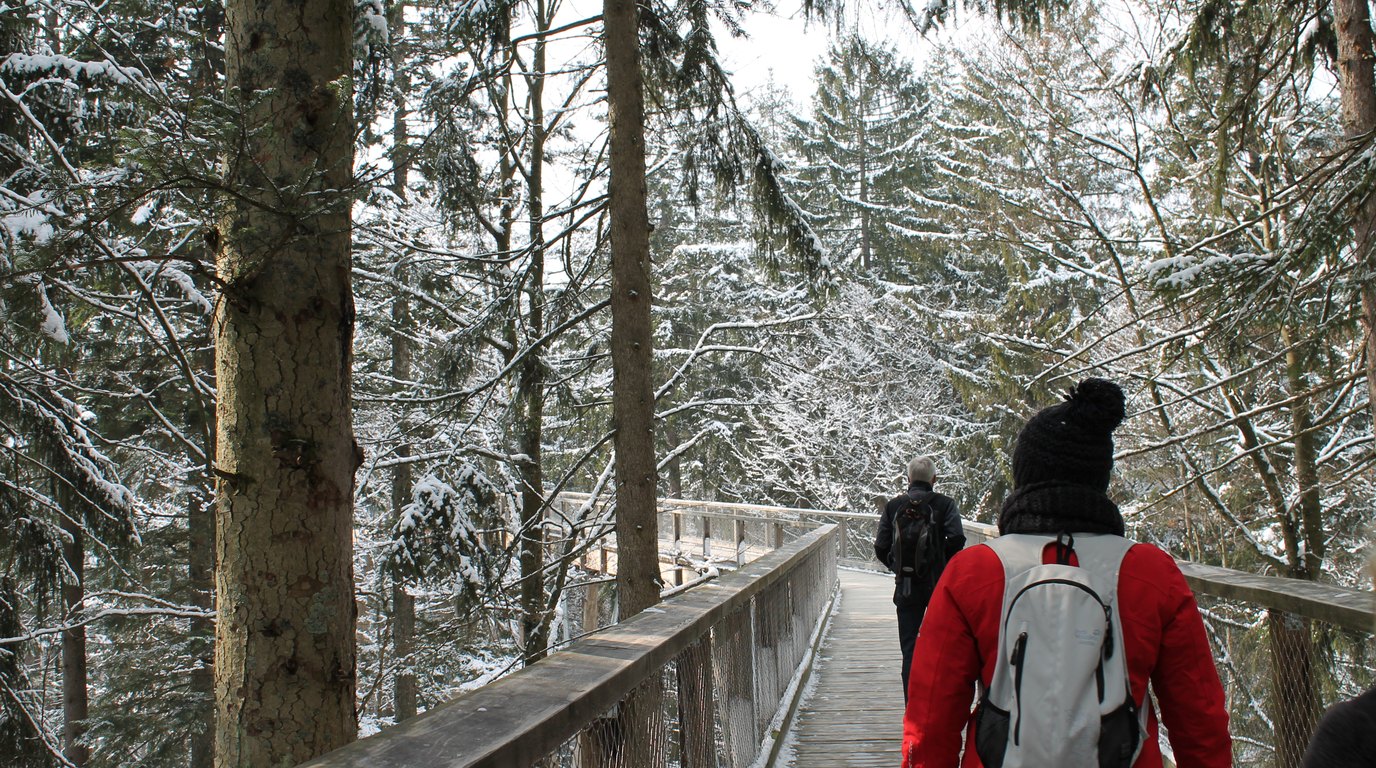
The Nationalparkzentrum Lusen in Neuschönau is the easiest way into the national park. The treetop walkway winds between beeches, firs and spruces roughly eight to twenty-five metres above the ground and ends in an egg-shaped viewing tower, which you climb by a gentle ramp — a pushchair gets up it too. Next to it are the Hans-Eisenmann-Haus visitor centre and large enclosures with wolves, lynx and bears. Allow half a day for the whole site, or a full day if you have children with you.
The climb up Lusen and glass in Frauenau
The summit of Lusen is covered by a sea of boulders, and a staircase known as the Himmelsleiter climbs across it to the summit cross; the view reaches deep into the Czech side of Šumava. In high season the approach to Waldhausreibe is closed to cars during the day and the Igelbus shuttle takes you up — it runs roughly from mid-May to the end of October, so leave the vehicle at the park-and-ride rather than counting on slipping through. In the afternoon drive down to Frauenau, where glass has a museum of its own (closed on Mondays) and the Glass Gardens around it scatter dozens of glass objects through the landscape.
The glass pyramid, Großer Arber and the way home
In Zwiesel, in front of the glassworks' factory shop, stands a pyramid built from almost a hundred thousand glasses without a single drop of glue — the tallest crystal pyramid in the world, protected by a glazed cover of its own. From there it is a short hop to the foot of Großer Arber, the highest mountain of the Bavarian Forest: the cable car runs daily in summer from roughly nine until half past four, and from the top station you can walk to the summit chapel and to the Richard-Wagner-Kopf rock. Head home through Bayerisch Eisenstein and Železná Ruda, the natural way out to the Czech side. In early May there may still be patches of snow up there, so allow for it when planning your hikes.
Practical motorhome information
Germany has no motorway vignettes and vehicles up to 3.5 t pay nothing for the roads. Above 3.5 t, the toll obligation was extended in July 2024 to goods vehicles over 3.5 t, but motorhomes are exempt — the federal BALM authority treats them as vehicles with living accommodation built to carry people; it helps if the registration papers describe the vehicle as a “Wohnmobil”. The Czech leg of the journey is charged: up to 3.5 t an electronic vignette (edalnice.cz), above 3.5 t electronic tolling with an on-board unit (myto.cz) — motorways and selected first-class roads are tolled, so check the individual sections in the toll-section map. Among the paid attractions, budget for parking at the trailheads for Lusen (a few euros a day, more at Waldhausreibe), for parking at the lower cable-car station on Großer Arber at around €4 a day, and for the cable-car ticket; admission is charged separately at the treetop walkway and at the glass museum in Frauenau.
Natur und Camping am Nationalpark, Spiegelau (Bergstraße 44) — open all year, dozens of motorhome pitches, electricity and its own waste-water disposal · Camping Green Village, Frauenau-Zwieselau — season roughly May to October, copes with longer vehicles too, water and electricity on site · Camping Heiner, Regenhütte near Bayerisch Eisenstein — a small family campsite below Großer Arber, only about fifteen motorhome pitches, worth calling ahead in season · Dreiflüsse-Camping, Irring near Passau (Am Sonnenhang 8) — April to October, on a sunny slope above the Danube by the cycle path, refurbished sanitary facilities
Wild camping is not allowed in Bavaria, and inside the national park that goes double — you spend the night at a campsite or at a designated Stellplatz. The most comfortable is the Reisemobilstellplatz Zwiesel run by the municipal utility: twelve pitches, each with its own electrical hook-up, open all year except during the Grenzlandfest, around €11.50 a night plus the local visitor tax. Near Großer Arber and the Großer Arbersee there are three pitches reserved for motorhomes at around €12 a night, bookable online at arber.de. In Passau the Winterhafen Racklau site is free, but only for 24 hours and it lies in the flood zone; the paid alternative is the Stellplatz on Bahnhofstraße, a short walk from the station.
The surest place to fill up is the Reisemobilstellplatz Zwiesel — it has a central drinking-water tap (around €1 for 80 litres) as well as a drain for grey water and the cassette (around €3 per use), and because it is open all year it serves outside the main season too. At the southern end of the route the service point is Dreiflüsse-Camping in Irring near Passau, at the northern end the campsite in Spiegelau. There is no filling or emptying station inside the national park, so top up the tank down in the village before your day at Lusen.
Stops along the route
You may also like
The map and GPX contain separate planning waypoints, not a driving route. Follow the itinerary for access to attractions and campsites.
Adria Compact
The Adria Compact is one of the shortest low-profile motorhomes in the range, and at 2.12 m wide it fits comfortably into the small paid car parks around the national park and onto the narrow roads between Neuschönau, Frauenau and Bayerisch Eisenstein. Organised storage throughout the vehicle takes your boots and poles for Lusen, and a weight under 3.5 t means you deal with no heavy-category tolls either in Germany or back home.
Get road trip ideas by email
Leave us your email and we will send motorhome inspiration and stock updates.
Adria Karavany · https://www.adriakaravany.cz/en/vylety/bavorsky-les-pralesy-a-sklo/