
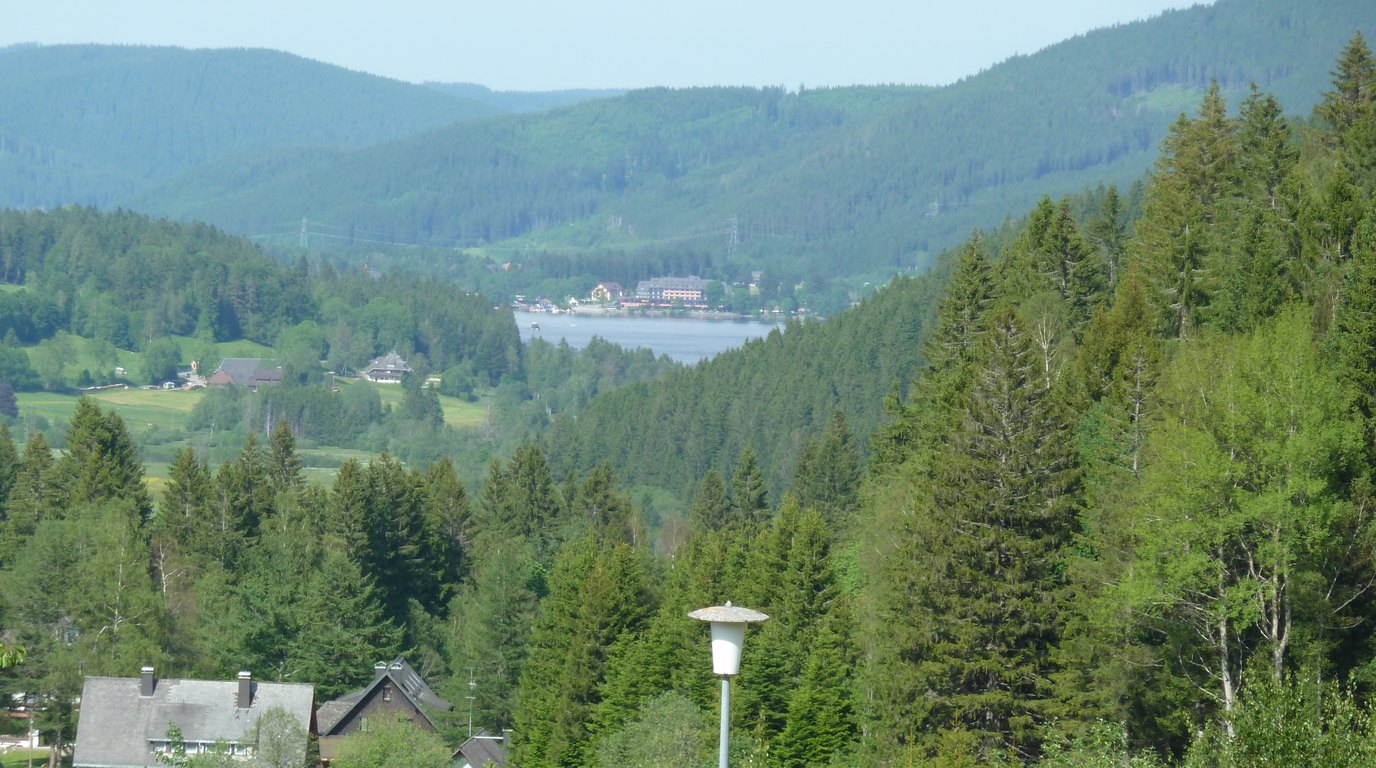
The Black Forest and Baden — clocks, lakes and thermal baths
Eight days among the clock workshops of the Black Forest, the lakes of Titisee and Schluchsee and the spa promenade of Baden-Baden. The route starts at the castle above the Neckar in Heidelberg, climbs the panoramic Schwarzwaldhochstraße onto ridges above eight hundred metres and ends in Freiburg beneath the tower of the minster. Along the way are the Triberg waterfalls, the cable car up to the Feldberg and the Höllental valley, where the road and a mountain railway squeeze through a rocky gorge side by side. The roads here are wide and easy to read, the network of campsites is dense, and dinner is part of the programme too — Baden cooking is one of the reasons people come.
Itinerary
West across Bavaria
From Prague the route runs along the D5 to Rozvadov and then the Bavarian A6 past Nuremberg. The whole transfer to Baden will not comfortably fit into a single day, so plan the first night somewhere between Nuremberg and Heilbronn. That leaves only a short stage in the morning and you reach Heidelberg with the entire day still ahead of you.
Heidelberg and the castle above the Neckar
The ruined red sandstone castle hangs over the old town and is visible from practically everywhere. Inside, the Great Vat and the pharmacy museum are worth a look, and the funicular from Kornmarkt takes you up. The afternoon belongs to the pedestrianised Hauptstraße and to a walk along the Philosophenweg on the opposite bank, from where you have the castle and the Old Bridge laid out in front of you.
Baden-Baden: Friedrichsbad and Caracalla
The spa town below the northern edge of the Black Forest offers two completely different bathing experiences. The Friedrichsbad is a Roman-Irish bath more than a hundred and forty years old, where you move through a set sequence of steam rooms and pools; the Caracalla Therme next door is a modern thermal spa open daily from eight in the morning until ten at night. Between the baths and the Trinkhalle you can stroll along the Lichtentaler Allee beside the little river Oos.
Schwarzwaldhochstraße and Mummelsee
The B 500 lifts out of Baden-Baden onto the ridges and stays between eight hundred and a thousand metres all the way to Freudenstadt. Stop at the Mummelsee, a glacial tarn below the Hornisgrinde, the highest mountain of the northern Black Forest, and at Ruhestein, where the national park visitor centre stands. The carriageway is wide and easy to read, so a longer vehicle can take it without any nerves.
Triberg: waterfalls and clocks
At Triberg the Gutach river drops in seven stages and falls a total of one hundred and sixty-three metres; around half a million people come every year, so you certainly will not have it to yourself. In town you will find the Schwarzwaldmuseum with its collection of clocks and shops full of cuckoos. The clock museum proper, however, is over in Furtwangen — and before you set off, check whether it is open: it was closed for building work in 2026.
Titisee, Schluchsee and Feldberg
Titisee really is overcrowded in July and August, so head there first thing in the morning — motorhome parking is paid for and limited in capacity. A little further south lies the Schluchsee, the largest reservoir in the Black Forest, quiet even in season, with a cycle route running right around the shore. The afternoon belongs to the Feldberg: a gondola lift carries you up to the Seebuck, and in good visibility the Feldbergturm gives views as far as the Alps.
Through the Höllental to Freiburg and the start of the way home
From Hinterzarten the road drops through the Höllental, where the B 31 squeezes through the narrowest point at Hirschsprung together with the mountain railway. In Freiburg everything points to Münsterplatz beneath the cathedral tower, where a market is held, and to the lanes with the Bächle — the little water channels running through the paving. In the afternoon it pays to head east and split the journey home into two stages.
The journey home
The last day is a straight run back through Bavaria. If you got as far as Nuremberg the previous evening, only an easy stage is left for today and you will be home in the afternoon.
Practical motorhome information
Up to 3.5 t: Germany charges nothing at all for motorways or federal roads — no vignette, no toll. For the Czech part of the route from Prague to Rozvadov you need an electronic motorway vignette. Over 3.5 t: under § 1 of the German act on tolls for federal trunk roads (BFStrMG), the toll applies only to vehicles intended or used for the carriage of goods — a motorhome does not fall into that category, so even a heavier vehicle crosses Germany free of charge; do make sure, though, that your registration documents state the motorhome category. In the Czech Republic, by contrast, a vehicle over 3.5 t pays a toll through an on-board unit instead of buying a vignette. The Schwarzwaldhochstraße (B 500) itself is free; you pay for individual attractions: admission to the Triberg waterfalls cost 9 € in summer and 7 € in winter in 2026, and the Feldbergbahn cable car up to the Seebuck is charged separately.
Camping Heidelberg, Heidelberg-Schlierbach (Schlierbacher Landstraße 151) — motorhomes up to 8 m, season roughly from mid-April to the beginning of October, a bus or a cycle path takes you into the old town. · Freizeitcenter Oberrhein, Rheinmünster near Baden-Baden — a large lakeside campsite with its own area for motorhomes, reception open daily. · Naturcamping Herrenwies, Forbach — a small site right up in the ridges by the Schwarzwaldhochstraße at 780 m; closed from October to April. · Naturcamping Weiherhof, Hinterzarten (Bruderhalde 25) — an unparcelled meadow right on the south-western shore of the Titisee, takes motorhomes, season roughly from spring to mid-October. · Camping-Schluchsee, Schluchsee — more than two hundred pitches right by the reservoir, open all year round. · Camping Hirzberg, Freiburg im Breisgau (Kartäuserstraße 99) — the cycle path along the Dreisam takes you into the centre from here. · A warning about Camping Bankenhof in Hinterzarten: it has been closed since a fire on 23 May 2026, so check its website before you travel to see whether it is running again.
Wild camping outside campsites and designated parking areas is prohibited in Baden-Württemberg, but the network of municipal Wohnmobilstellplätze is dense and a single night on one is usually cheap. Driving a motorhome into the historic centres of Freiburg or Heidelberg is practically impossible, let alone parking there — leave the vehicle at a campsite or a Stellplatz on the edge of town and come in by public transport or by bike. Both cities also have a low-emission zone (Umweltzone), which you may only enter with a green sticker on the windscreen; without one you risk a fine.
The easiest servicing is at municipal Stellplätze: on the eastern edge of Titisee, between the station and the Badeparadies, there is a paid parking area with drinking water and disposal points for grey water and the cassette toilet, and it works independently of the campsite season. That matters most outside summer, when the campsites higher up in the Black Forest are closed. Do not count on topping up in the cities: the Freiburg Bächle, the little channels running through the paving of the old town, are not drinking water, and service points are found only at campsites and Stellplätze.
Stops along the route
You may also like
The map and GPX contain separate planning waypoints, not a driving route. Follow the itinerary for access to attractions and campsites.
Adria Matrix
The Adria Matrix suits this route thanks to its large garage — the bikes do most of the work here: from Camping Hirzberg you ride into Freiburg along the cycle path beside the Dreisam, from the campsite in Schlierbach into Heidelberg in the same way, and the loop around the Schluchsee is more of a bike ride than a drive. At the same time, the semi-integrated build handles the motorway transfer from Prague and the climb up the Schwarzwaldhochstraße without any trouble.
Get road trip ideas by email
Leave us your email and we will send motorhome inspiration and stock updates.
Adria Karavany · https://www.adriakaravany.cz/en/vylety/cerny-les-a-badensko/