
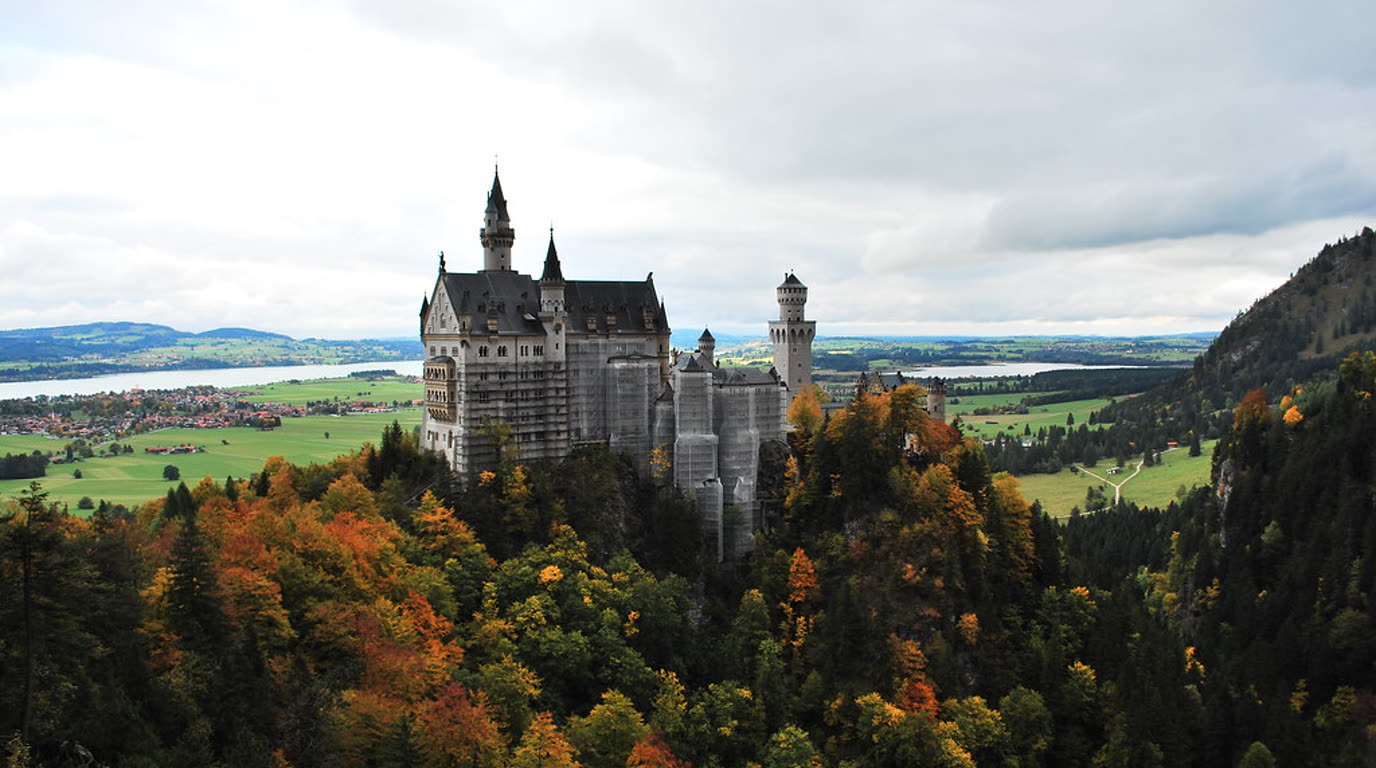
The Bavarian Alps and the Alpine foothills — from Neuschwanstein to the Königssee
The Bavarian Alps offer fairytale Neuschwanstein, the Partnachklamm gorge and emerald Königssee, all of it without demanding mountain drives. The route runs along the German-Austrian border on wide valley roads: the motorhome stays down in the valley and a cog railway, a cable car or an electric boat carries you up. Eight days is a pace that lets you spend a whole day at the Königssee and still ride up the Zugspitze without a rushed morning — and it leaves room for what Bavaria does best, slow evenings by the water. Bear in mind that Neuschwanstein and the Eagle's Nest are booked ahead and that motorhome parking is regulated everywhere here, so it pays to know in advance where you are allowed to drive.
Itinerary
From Prague to the Alpine foothills
The whole day belongs to the drive via Rozvadov, Regensburg and Munich. Beyond Landsberg am Lech the countryside starts to roll and just before Füssen the wall of the Ammergau Alps opens up. Make your base around Schwangau or by Hopfen am See and walk down to the water in the evening — from the shore of the Forggensee you can see the whole of Neuschwanstein on its rocky spur, which never works directly below the castle.
Neuschwanstein and Hohenschwangau
Book your Neuschwanstein ticket online for a specific tour time; in high season it sells out days in advance. The castle can only be seen on a guided tour or with an audio guide at a fixed admission time — there is no walking through on your own. You can walk up the hill on foot, but a shuttle bus and a horse-drawn carriage run there as well. In the afternoon add the yellow Hohenschwangau, where Ludwig II grew up, and a walk around the Alpsee; whether the Marienbrücke viewing bridge is open is best checked on the spot, as its accessibility keeps changing.
Wieskirche and Oberammergau
The Wieskirche pilgrimage church near Steingaden is on the UNESCO list and admission is free; from April to October it usually opens from eight in the morning until seven in the evening, in the winter months until five, though it cannot be viewed during services. The rococo decoration inside is the exact opposite of the sober exterior, and that contrast is the whole magic of the place. In the afternoon carry on to Oberammergau for painted facades, woodcarving workshops and the Passion Play theatre. If you still have the energy, add the baroque Ettal monastery just outside the village.
The Partnachklamm gorge
From Oberammergau it is only a hop to Garmisch-Partenkirchen via Ettal and Oberau, so the morning leaves room for an unhurried breakfast. The Partnachklamm gorge is open from June to September from eight in the morning until eight in the evening, and the last visitors are let in half an hour before closing time. The gorge is carved into the rock and the water races a few metres below your feet — a waterproof jacket makes sense even on a sunny day. You can stretch the way back into a loop via Graseck and come down to the Olympic stadium from above.
The Zugspitze and Lake Eibsee
The cog railway sets off straight from Garmisch, stops at the Eibsee on the way and from there a cable car continues to the summit. At the top you stand on the highest point in Germany and in clear weather you can see into Austria, Switzerland and Italy, so it pays to watch the forecast and go on a day with good visibility. On the way back take the cable car down to the Eibsee and walk the loop around the lake — the colour of the water and the reflection of the Wetterstein massif are why people come here even without going up. Allow around two hours for the loop and wear proper shoes, as the path runs over roots and stones in places.
Over to Berchtesgaden and the Eagle's Nest
Set off east in the morning. The shortest way stays entirely on German soil via Bad Tölz, Rosenheim and Bad Reichenhall; navigation will sometimes offer a detour through Tyrol and the Salzburg region, which is longer and calls for an Austrian motorway charge on top. You cannot drive up the Kehlstein in your own vehicle — the road is closed to public traffic and the ascent is by compulsory shuttle bus from the Obersalzberg Documentation Centre. As you board you are given a fixed time for the return trip, so keep an eye on the clock up there. The last stretch to the Kehlsteinhaus runs through a tunnel in the rock and a historic brass lift, and the view from the top reaches over the Königssee and out towards Salzburg.
A whole day at the Königssee
You cannot reach the lake by car; the last stretch is on foot from Schönau am Königssee. Boat trips run exclusively on electric boats: the shorter run ends at the pilgrimage church of St. Bartholomä, the longer one carries on to Salet at the southern end of the lake and includes the St. Bartholomä stop as well. From Salet it takes less than half an hour to walk to the Obersee, the quietest part of the whole lake. In season there are queues at the landing stage, so take one of the first boats and count on the lake swallowing your entire day.
Back to Prague
The last day belongs to the journey home and there are two options. Either via Salzburg and Linz to the Dolní Dvořiště border crossing, or the more northerly run via Bad Reichenhall, Passau and Strážný. Whichever you choose, there is still time in the morning for one final stop — the salt mine in Berchtesgaden, for instance, if you did not get to it during your stay.
Practical motorhome information
Up to 3.5 t: motorhomes pay no motorway charge in Germany and there is no vignette to buy, so the entire Bavarian part of the route is free. Watch out for the transfer from Garmisch-Partenkirchen to Berchtesgaden, though — navigation will sometimes offer a variant cutting through Tyrol and the Salzburg region, and there you need an Austrian motorway vignette; in 2026 the ten-day one costs 12.80 € and the one-day 9.60 €. The purely German road described on day six is in fact the shorter one and needs no vignette at all. Over 3.5 t: German tolls are aimed at freight transport, and motorhomes stay outside them even above 3.5 tonnes as long as they are clearly recognisable as living vehicles from the outside — with a conversion it is safer to check the entry in the registration document. In Austria, however, a vehicle over 3.5 tonnes drops out of the vignette system and runs on a GO-Box with tolls charged by the kilometre, which makes the German variant doubly worthwhile. The paid attractions the trip is built around carry charges of their own: the shuttle bus to the Kehlstein roughly 34.70 € return for an adult (admission to the Obersalzberg Documentation Centre included, the lift is not paid for separately), a return boat trip on the Königssee 23.40 € to St. Bartholomä and 29.80 € to Salet, entry to the Partnachklamm 10 € for an adult and 5 € for children from six to seventeen, a Neuschwanstein tour 21 € for an adult plus the booking fee, free for under-eighteens. Check the Zugspitze fare against the current price list — it is the single most expensive item of the trip.
Camping Brunnen am Forggensee, Schwangau-Brunnen · Camping Hopfensee, Hopfen am See near Füssen · Campingpark Oberammergau, Oberammergau · Camping Resort Zugspitze, Grainau · Camping Erlebnis Zugspitze with its Wohnmobilhafen, Grainau · Alpen-Caravanpark Tennsee, Krün · Camping Grafenlehen, Schönau am Königssee · Camping Allweglehen, Berchtesgaden-Unterau
In Hohenschwangau motorhomes are allowed only on car park P2 — 16 € for six hours, every further hour 2 €; they have no access to P1, P3 or P4. At the Königssee there is a reserved motorhome area on car park P2 in Schönau am Königssee for 25 € per twenty-four hours. You cannot get to the Eibsee in a motorhome: the car park there has a 2.10 metre height barrier and camping vehicles are excluded from it, so leave the vehicle in Grainau or in Garmisch-Partenkirchen and take the cog railway up. For the Partnachklamm you park at the Olympic stadium in Garmisch-Partenkirchen, for the Kehlstein at the documentation centre on the Obersalzberg. Overnighting outside campsites and designated parking areas is prohibited in Bavaria, and within the Berchtesgaden National Park that applies without any exception whatsoever.
The Reisemobilhafen at Campingpark Oberammergau sells water at 1 € per 100 litres and electricity by consumption, so you can top up even on a short stop. In Grainau, the Wohnmobilhafen Zugspitze has a fresh-water connection as well as a waste-water drain and is open all year round, which helps if you linger longer around the Zugspitze. In the eastern part of the route, Camping Grafenlehen in Schönau am Königssee has water and drainage right at the comfort pitches, plus four central water points and its own disposal point for chemical toilets. There is a supply and disposal station on the reserved P2 car park by the Königssee as well, though it takes bank and credit cards only; on the Obersalzberg and at the Eibsee you will find none.
Stops along the route
You may also like
The map and GPX contain separate planning waypoints, not a driving route. Follow the itinerary for access to attractions and campsites.
Adria Matrix
The Matrix is a low-profile motorhome under 3.5 tonnes with a garage, and on this route both matter — the garage takes poles and boots for the Partnachklamm as well as bikes for the loop around the Forggensee, and the lower weight keeps you on an Austrian motorway vignette instead of a pricier GO-Box if you do end up crossing Tyrol. At the same time its dimensions fit the reserved P2 in Hohenschwangau as well as the motorhome parking in Schönau am Königssee.
Get road trip ideas by email
Leave us your email and we will send motorhome inspiration and stock updates.
Adria Karavany · https://www.adriakaravany.cz/en/vylety/bavorske-alpy-a-alpske-predhori/