
Krka, Šibenik and Central Dalmatia
Krka National Park, Šibenik's cathedral and Diocletian's Palace in Split sit so close together that you barely drive between them. Two days go to reaching the sea and two to the way home; the rest belongs to Krka's cascades, stone towns under Venetian walls and evenings on the riva. It is a trip for anyone who would rather not pack up every morning — you change base only twice and otherwise set out light.
Itinerary
Through Austria to the Slovenian thermal spas
From Prague the route runs via Linz and Styria towards Maribor, so it makes sense to spend the first night in Ptuj in Slovenia, where the campsite lies right beside the thermal baths. Sort out the Austrian and Slovenian vignettes before you leave home — with the Austrian digital vignette the ten-day one is valid immediately, while the two-month version only starts on the eighteenth day after purchase. After a full day of driving, the pool is a better choice than trying to push on a little further.
Down to the sea and an evening in Skradin
In the morning you skirt Zagreb and join the A1 motorway, which runs beneath the Velebit range all the way to the Dalmatian coast. Stay in Lozovac or in Skradin; both lie by entrances to the national park, so the next morning you do not have to move anywhere. The evening belongs to Skradin's waterfront and to the local risotto, which is simmered here for hours.
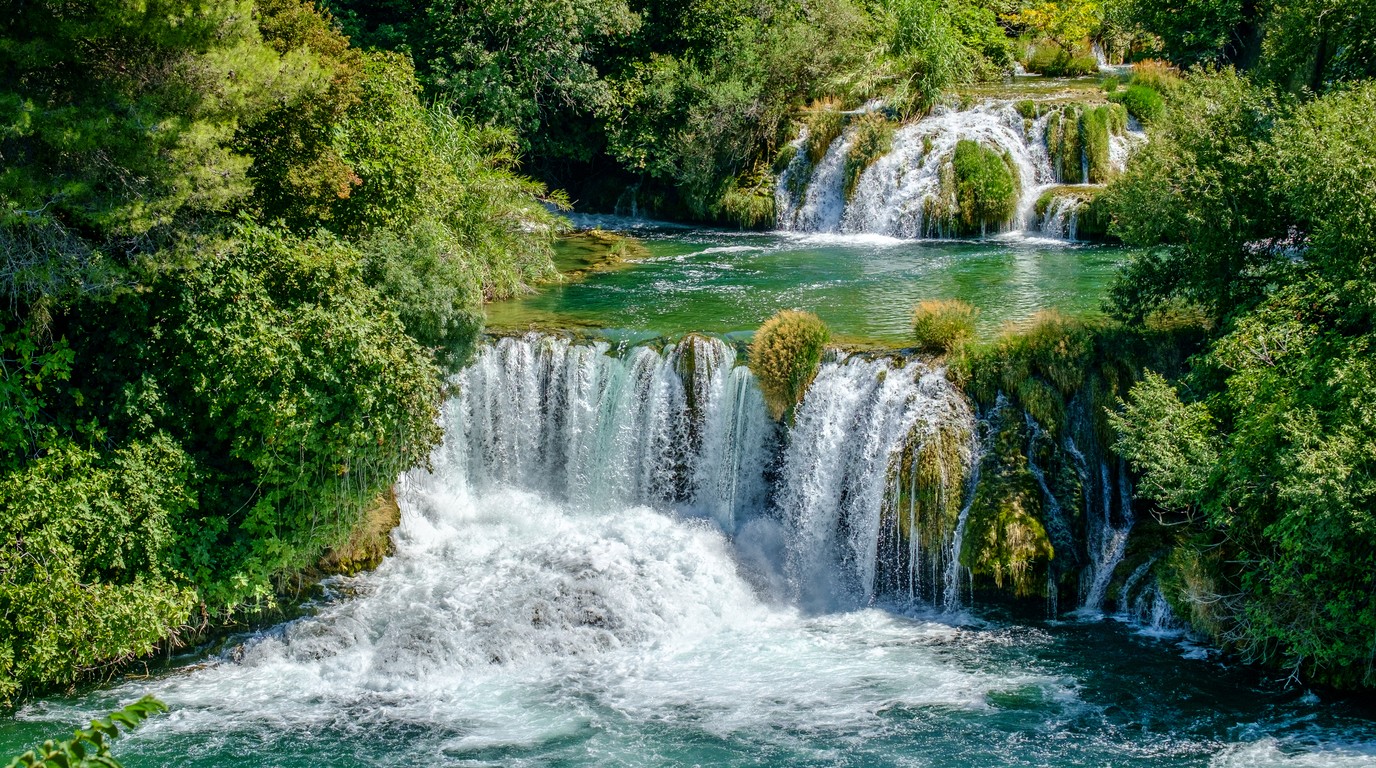
Skradinski buk
Buy your park ticket online — with it there is no queuing at the reception and you head straight for the boat or the bus. From Skradin visitors are carried into the park by small boats and from April to the end of October that ride is included in the ticket; from Lozovac the park bus runs instead. Wooden walkways take you around the whole system of cascades, the mills and the ethno village. Swimming below Skradinski buk is not allowed, so leave your swimsuit at the campsite.
Roški slap and the island of Visovac
The second day in the park belongs to its quieter, upper section. Excursion boats leave Skradinski buk for the island of Visovac with its Franciscan monastery and further on to Roški slap — these cruises are paid separately and tickets are sold only on site, never online. From June to the end of September you may swim at marked spots by Roški slap, nowhere else in the park.
Šibenik beneath its fortresses
The Cathedral of St James is built entirely of stone, without mortar or timber, and around the outside of the apses runs a frieze with portraits of the townspeople of the day. Above the town stand St Michael's Fortress, which today hosts open-air performances, and Barone Fortress with its view over the St Anthony Channel. You enter the old town on foot and most of the lanes are really staircases, so bring proper shoes.
Primošten and the move to Trogir
Heading south you stop in Primošten — the old town sits on a small peninsula and above it rise the Bucavac slopes, vineyards divided by dry stone walls, home of the red babić. In the afternoon you move on to Seget Vranjica near Trogir, where the campsites lie directly on the pebble beach. The rest of the day is for swimming and for settling in for several nights.
Trogir
Trogir's old town stands on its own islet between the mainland and Čiovo and is on the UNESCO list. Do not miss the Cathedral of St Lawrence with Radovan's portal and the Kamerlengo fortress on the western tip of the island. A taxi boat runs into town from the campsites in Vranjica, which is the most pleasant way to reach Trogir. The early evening on the waterfront, with a view of Šolta and Drvenik, is worth waiting for.
Split and Diocletian's Palace
You move your base to Stobreč on the edge of Split. Diocletian's Palace is not a museum but a living quarter — there are stalls in the underground halls, cafés on the Peristyle, and the Cathedral of St Domnius now stands in the emperor's former mausoleum. In the afternoon choose between Marjan hill with its views over the city and ancient Salona, which lies close to the campsite. Anyone fond of boats can travel from Split to Šolta as a foot passenger.
Omiš and the Cetina canyon
At Omiš the Cetina forces its way through a rock gate straight into the sea, and the small Mirabela fortress presides over the town. This is a day for activities rather than sightseeing: rafting on the calmer stretch of the river, a zipline across the canyon or the climb up to Fortica. Leave the vehicle in one of the paid municipal car parks on the edge of Omiš; from there it is a few minutes along the Cetina into the centre. For lunch try soparnik, a flat spinach pie from nearby Poljica.
Back north
In the morning you set off along the A1 towards Zagreb and on through Slovenia to the north; Ptuj is again an obvious place for the night. Empty your tanks and take on water while you are still at the Croatian campsite — there will be nowhere to do it on the way. In high season expect delays at the toll gates before Zagreb, especially on Saturday mornings.
Return to Prague
The last stretch runs through Styria and Linz and is the calmest day of the whole trip. Before you leave the Austrian motorway, check that your vignette is still valid — checks in southern Austria are frequent. At home you then only need to dry the vehicle out and clean it, as the tanks are already empty.
Practical motorhome information
Austria: up to 3.5 t a vignette is enough, with 2026 rates of €12.80 for ten days, €32 for two months and €106.80 for a year; above 3.5 t you pay through the GO-Box on-board unit according to the kilometres driven. Slovenia: up to 3.5 t an e-vignette is compulsory — class 2A costs €16 for a week and €32 for a month, class 2B for vehicles higher than 1.3 m above the front axle €32 and €64.10 respectively; you can check which class your vehicle belongs to in the DARS list of measured vehicles. Above 3.5 t Slovenia uses DarsGo. Croatia collects toll at the gates or through ENC: a motorhome up to 3.5 t and higher than 1.90 m falls into group II and pays roughly €35 from Zagreb to Šibenik and roughly €41 to Split; above 3.5 t it is group III, so about €46.50 and €55 respectively. If you travel via Villach, the Karavanke tunnel costs €9 up to 3.5 t. Entry to Krka National Park is a chapter of its own: from June to September €40 per adult (€30 after three in the afternoon), €20 in April, May and October, children under seven free.
Camping Marina, Lozovac by the entrance to Krka National Park — open all year, camper service · Camp Krka, Lozovac between Lozovac and Skradin — family campsite, season roughly March to October · Amadria Park Camping Šibenik (Solaris), Šibenik — large resort campsite by the sea · Amadria Park Camping Trogir, Seget Vranjica near Trogir — taxi boat to Trogir · Camping Stobreč Split, Stobreč on the edge of Split — open all year · Camping Almissa, Omiš at the mouth of the Cetina — open roughly from June to November · Camping Ptuj, Ptuj in Slovenia — stopover night on the way out and back
Wild camping outside campsites is banned in Croatia and in Dalmatia it is enforced, so count on campsites; in July and August book them in advance, as the places near Trogir and Split fill up first. At the Lozovac entrance to Krka National Park the park car park is free, whereas the car parks in Skradin are in private hands and charge a fee. You will not get into the old towns with a motorhome and it is not worth trying — Šibenik, Trogir and Omiš are all explored on foot.
The most reliable service is right by Krka: the Marina and Krka campsites in Lozovac both have camper service and a chemical toilet disposal point, and Marina is open all year, so it serves you outside the main season too. Further south, Camping Stobreč Split has a dedicated point for emptying portable toilets and is likewise open year round — handy in May or October, when some of the coastal campsites are not open yet or no longer. Mains water is drinkable in Croatia; only in August does it tend to be lukewarm in the hose after a day in the sun, so fill the tank in the morning rather than later.
Stops along the route
You may also like
The map and GPX contain separate planning waypoints, not a driving route. Follow the itinerary for access to attractions and campsites.
Adria Compact
This route is not about kilometres but about parking — you keep stopping in seaside towns, at park entrances and on narrow roads above the Cetina canyon, and among low-profile motorhomes the Compact is one of the more compact ones, so it slots into a parking space more easily. Even so it has a full bathroom and a large fridge, which over eleven days of a Dalmatian summer you appreciate every single day.
Get road trip ideas by email
Leave us your email and we will send motorhome inspiration and stock updates.
Adria Karavany · https://www.adriakaravany.cz/en/vylety/krka-sibenik-a-stredni-dalmacie/