
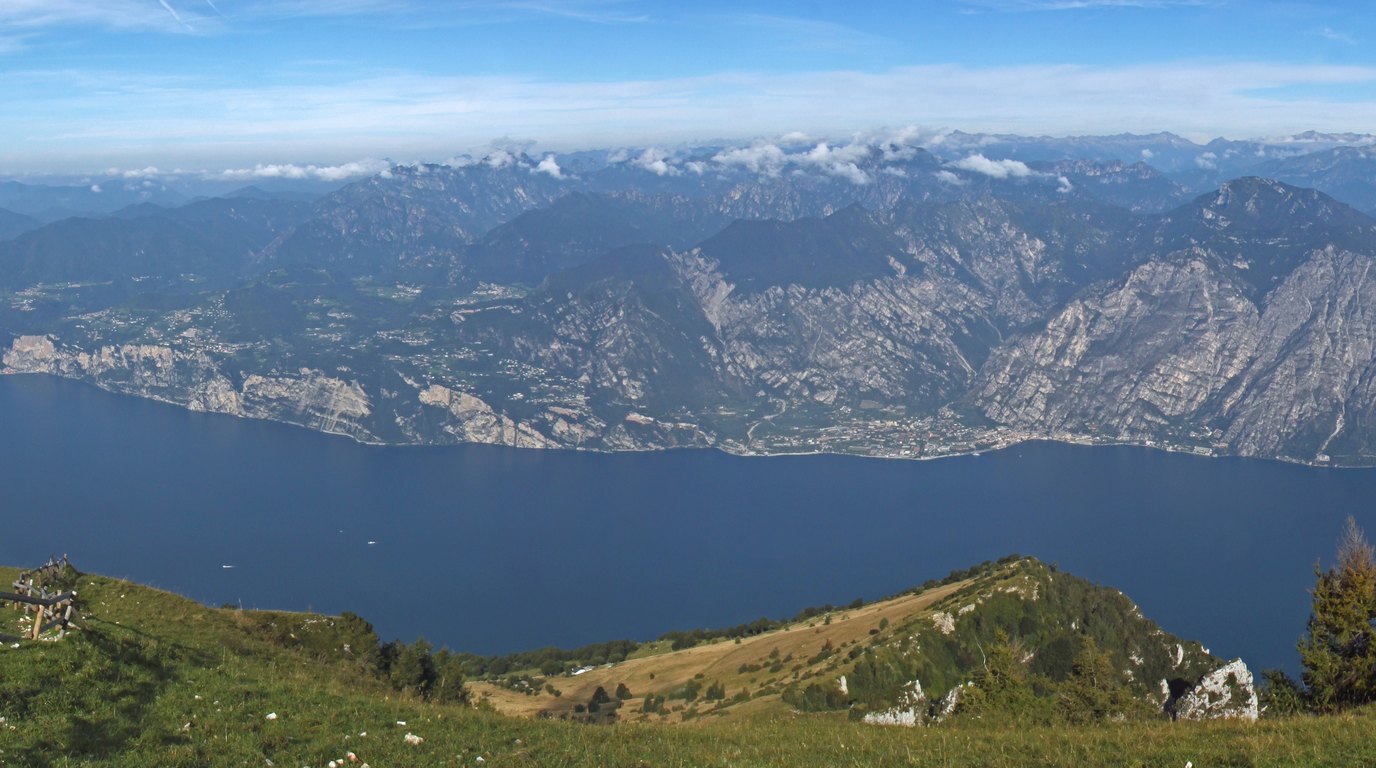
Lake Garda and Verona — the lake beneath the Alps
Lake Garda is often the first Italian trip by motorhome — swimming below Alpine cliffs, the Monte Baldo cable car and an evening in Verona. The northern tip of the lake at Riva del Garda looks more like a fjord than an Italian resort: a surface squeezed between rock walls, a reliable afternoon wind that windsurfers here plan their whole day around, and just outside town the Varone waterfall dropping into a narrow gorge. The southern shore is a different country altogether — shallow warm water, olive trees, a Roman villa on the tip of the Sirmione peninsula and Verona within easy reach. You set up base in one place and make only short hops, which is exactly the style people buy a motorhome for.
Itinerary
From Prague to the Alps
The first day is a pure transfer via Rozvadov, Nuremberg and Munich into the Inn valley. An overnight stop near Innsbruck splits the drive into two sensible stages and leaves the Brenner right above you the next morning. Austrian campsites in this area stay open for most of the year, but outside the main season it pays to call ahead.
Over the Brenner to Garda's northern shore
The Brenner Pass is one of the lowest Alpine crossings and a motorhome handles it without any stress — the A22 motorway then drops down the Adige valley all the way to Rovereto. From the Rovereto Sud exit the fast SS240 road runs through Mori and past Loppio to Torbole and Riva del Garda, and at one point the lake opens up between the rock walls. The afternoon is enough for the promenade, the Porto San Nicolò harbour and a first swim.
Riva del Garda and the Varone waterfall
The morning belongs to Riva: Piazza III Novembre with the Torre Apponale, the water-ringed Rocca fortress and the Sabbioni beach on the north-eastern edge of town. In the afternoon head to Tenno and the Cascata del Varone, which falls into a gorge and can be watched from two viewing platforms set one above the other; entry costs around €7 and the park is open all year. If you are travelling between 10 July and the end of August, the operator itself advises against a visit in that period because of the queues — go right after opening, or save the waterfall for another day.
Limone sul Garda and the western shore
The Gardesana Occidentale road runs along a rock ledge through a series of narrow tunnels with size limits — with a taller or wider vehicle, check the permitted height and width in advance and allow for a detour. In Limone, walk through the Limonaia del Castèl lemon house, a reminder of what the town lived on for centuries. A cantilevered cycle path runs above the water here, and the lake looks completely different from it than it does from the shore.
Malcesine and Monte Baldo
You reach the eastern shore from Riva via Torbole and Navene, beneath the walls of Monte Baldo. The cable car from Malcesine carries you up to the Tratto Spino station, the second section runs in rotating cabins and the whole lake opens up at the top. For 2026 the operator has the summer service listed from 4 April to 1 November, with the last ride up usually at 16:45 — and the ridge is noticeably colder than the shore even in summer, so take an extra layer. Back down in Malcesine there is still time for the Castello Scaligero standing right above the water.
Moving to the southern shore and Sirmione
The southern shore is a different world in both climate and landscape — shallow water, olive groves and vineyards instead of cliffs. Sirmione sits on a long narrow peninsula whose historic core you cannot reach by motorhome; the vehicle stays in Colombare and you continue on foot. At the tip of the peninsula stand the Grotte di Catullo, the extensive remains of a Roman villa above an olive grove, and at the entrance to the old town the water-surrounded Rocca Scaligera.
Verona and the Arena, evening start for home
Verona's historic centre is a camera-monitored ZTL zone, so leave the vehicle at the campsite or a park-and-ride and take public transport into town. The Arena di Verona is a Roman amphitheatre from the 1st century that hosts an opera festival through the summer; tickets for the stone steps tend to be the cheapest, but a seat cushion comes in handy. The rest of the day belongs to Piazza delle Erbe and the Adige embankment, and towards evening you head back north and spend the night in Austria again.
Back to Prague
The return leg follows the same route over the Brenner and through Munich. Set off early in the morning — on summer weekends the Brenner route backs up regularly and an afternoon delay can add hours to the day. You will reach Prague in the evening with a full tank of photos and an empty waste tank, assuming you emptied it back at the campsite.
Practical motorhome information
Italy: motorways are charged by the distance travelled — you take a ticket at the entry and pay at the exit. The rate does not follow weight but the number of axles and the height above the front axle — a two-axle motorhome taller than 1.30 m falls into class B, both under and over 3.5 t; only a third axle means the more expensive class 3. Austria: up to 3.5 t a digital motorway vignette is enough (2026 prices: ten-day €12.80, two-month €32.00), above 3.5 t you drive on a GO-Box and the toll is calculated per kilometre. The A13 Brenner motorway is charged separately as a section toll — €12.50 for a single trip for vehicles up to 3.5 t (2026); you do not need a vignette on the A13 itself, but you do on the connecting A12 from Innsbruck, and above 3.5 t the section is billed through the GO-Box. The return journey is paid again. Germany: a motorhome pays no toll here regardless of weight — since 1 July 2024 the toll applies to vehicles over 3.5 t intended for the carriage of goods, and motorhomes are exempt even when they weigh more.
Camping Brione, Riva del Garda (Via Brione) — a four-star site in an old olive grove above the town, 2026 season from 26 March to 2 November · Camping al Porto, Torbole sul Garda (Via al Cor) — large pitches for motorhomes at the northern tip of the lake, a short walk from the Torbole promenade · Camping Nanzel, Limone sul Garda (Via IV Novembre) — a small terraced site above the lake; the operator itself states that it is not suitable for large vehicles, so it only works for a compact van conversion such as the Adria Twin, not for a low-profile motorhome · Camping Sirmione, Sirmione — Colombare (Via Sirmioncino) — right by the water a short way from the peninsula, properly equipped for motorhomes · Camping Bella Italia, Peschiera del Garda (Via Bella Italia) — a large family resort with a water park, a practical base for a trip into Verona · Camping Castel San Pietro, Verona — the only campsite in Verona itself, on the hill above the centre; the motorhome pitches are small, so check the dimensions when booking
Free camping — steps folded out, awning open and chairs beside the vehicle outside a campsite — is banned in the municipalities around Garda and it is checked. You may park the vehicle in an ordinary car park, but you may not spend the night with your outdoor set-up extended: around the lake the system is built on campsites and paid aree di sosta. Car parks by the shore are also often fitted with height barriers, so with a motorhome you frequently cannot even get in. In July and August book a campsite in advance, on the southern shore comfortably several weeks ahead.
A service point for emptying and refilling (scarico/carico) is available in the north at Camping al Porto in Torbole sul Garda, which also runs a stop for motorhomes passing through, and in the south at Camping Bella Italia in Peschiera del Garda. When you are staying at a campsite, the service is usually included in the price of the pitch; passing through, you pay a one-off fee. The public fountains in Riva and Torbole can be used to top up drinking water, as long as there is no “acqua non potabile” sign beside them.
Stops along the route
You may also like
The map and GPX contain separate planning waypoints, not a driving route. Follow the itinerary for access to attractions and campsites.
Adria Compact
The Adria Compact is well judged for this route: with its dimensions you get through the tunnels of the Gardesana Occidentale and the hairpins above Limone, where a longer vehicle starts to be a problem, and you also fit onto the smaller pitches at the lakeside campsites and onto the park-and-ride sites outside Verona. The garage takes bikes for the cycle path along the lake and 3+1 berths are enough for an eight-day family loop.
Get road trip ideas by email
Leave us your email and we will send motorhome inspiration and stock updates.
Adria Karavany · https://www.adriakaravany.cz/en/vylety/lago-di-garda-a-verona/