
Dolomites: Val Gardena, Cortina and Tre Cime
Nine days in the Dolomites: the turquoise Lago di Braies, the three rock towers of Tre Cime and the hairpin bends of the Sella Ronda. You set up a base below the Sciliar massif and then simply move between the valleys — a different pass, a different cable car and a different lake every day. The main season runs from June to September, and the biggest obstacle is not the climbing but the organisation: the finest places now let vehicles in only with a slot booked in advance for a given time. Know that beforehand and you will drive the region calmly and without queues. Do not, and you will spend half your holiday turning around on full car parks.
Itinerary
Crossing Austria
The first day is a pure transfer, so count on a full day behind the wheel and allow yourself a buffer for the tailbacks before Linz and Salzburg. For the night head into the Inn valley around Innsbruck — the Brenner is then within reach in the morning and you will arrive in the mountains rested rather than wrung out. The last stretch already climbs, so do not be surprised by higher fuel consumption.
Over the Brenner to Lago di Carezza
Beyond the Brenner everything changes within a single hour — the language on the signs, the shape of the roofs and the colour of the rock. Above Bolzano turn off into the Val d'Ega valley to Lago di Carezza, a small lake beneath the jagged wall of the Latemar; a marked footpath leads to the shore from the roadside car park. In the evening drop down below the Sciliar massif, where you will have your base for the next three nights.
Alpe di Siusi
You will not reach the broad upland pasture of the Alpe di Siusi by car during the day — the road up is closed to private traffic between nine in the morning and five in the afternoon. With a motorhome it is simpler anyway to leave it free of charge at the lower cable car station in Siusi and ride up in the cabin; that spares you both the narrow mountain road and the hunt for a space on the plateau. The plateau is almost level, so even with smaller children you can walk for hours there without a single steep climb.
Val Gardena: Ortisei, Selva and Vallunga
Give the whole day to the valley itself. In Ortisei the woodcarving workshops and shops are worth a stop — carving is an old craft here, not a souvenir backdrop. From Selva you can walk up the Vallunga valley, which is flat, wide and lined with limestone walls on both sides. If you want the view without the effort, the cable car from Ortisei will carry you up to Seceda.
Sella Ronda and Passo Pordoi
The loop around the Sella massif links four passes — Gardena, Campolongo, Pordoi and Sella — and it is the most demanding day of the trip behind the wheel. The hairpins are narrow, the climbs and descents steep and the places to turn around few, so set aside a whole day for the loop and certainly do not leave it for the afternoon, when the passes carry the most motorbikes and coaches. At Passo Pordoi a cable car carries you up to Sass Pordoi, a stone plateau with a view of the Marmolada. Check the date of the Sella Ronda Bike Day in advance — on that day the passes are closed to motor vehicles from morning until evening.
On to Cortina d'Ampezzo
Two roads lead to Cortina: the high one over Passo Falzarego past the Cinque Torri rock towers, or the low one through the Val Pusteria. The upper option is more spectacular, the lower one considerably calmer for a longer vehicle — decide according to how the previous day suited you. Cortina is an elegant little town with a promenade rather than a mountain village; it hosted the Winter Olympics in 1956 and again in 2026, so part of the infrastructure is new.
Tre Cime di Lavaredo
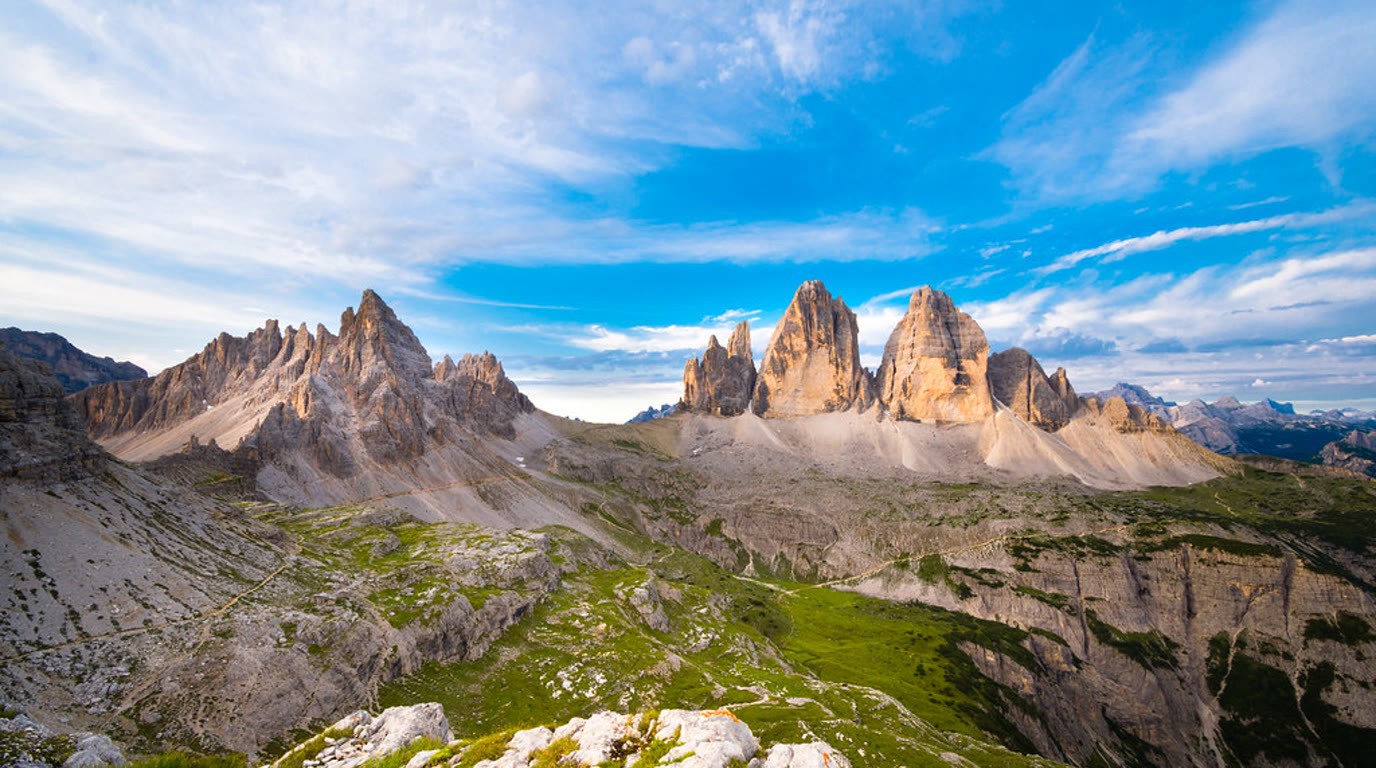
The three rock towers above the Rifugio Auronzo are the icon of the whole Dolomites and also the most closely controlled place on the trip. The capacity of the upper car park is usually taken by late morning in the main season, so either set off at daybreak or leave the vehicle down at Misurina and ride up by bus. A comfortable loop on a surfaced track runs around the massif — children manage it too, and the reward is the towers seen gradually from every side.
Lago di Braies and back over the Brenner
The last mountain morning belongs to Lago di Braies, a turquoise basin below the wall of the Croda del Becco. In the main season, from the beginning of July to the middle of September, the access road into the valley is closed to private traffic roughly from half past nine until four in the afternoon — you get in only with a reserved parking space, an arrival before the closure or by bus. After lunch head down the Val Pusteria and back over the Brenner into Austria; you will spend the night across the border so that the last day is not endless.
The journey home
All that remains is the run home through Austria. Plan two longer breaks and allow yourself a time buffer — the return tends to be slower than people expect, especially at the weekend. Before you park the vehicle up, it pays to fill the tank while still in Austria.
Practical motorhome information
Austria, up to 3.5 t: a motorway vignette is compulsory — ten-day €12.80, two-month €32.00, annual €106.80 (ASFINAG rates valid from 1 December 2025). Above 3.5 t the vignette does not apply and you pay a per-kilometre toll through a GO-Box on-board unit. The A13 Brenner motorway has its own section toll on top of that, paid separately at the toll gate, for both categories. Italy has no vignette; toll is collected at the gates according to vehicle class: a motorhome up to 3.5 t with two axles and a body higher than 1.30 m above the front axle falls into class B, one step dearer than a car, while above 3.5 t the number of axles decides and a three-axle vehicle already belongs to class 3. The main attraction is charged as well: the mountain road from Misurina to the Rifugio Auronzo below Tre Cime costs in the order of tens of euros and is noticeably dearer for a motorhome than for a car — and since the summer of 2025 entry also has to be booked in advance online at auronzo.info. The car park at Lago di Braies is charged, but the online booking covers cars and motorcycles only — a motorhome over two metres tall is let onto the lakeside car park only during the hours when the attendants are there, so plan on arriving outside the closure or taking the bus. Car parks on the Alpe di Siusi are booked online from 29 June 2026, with a daily rate for a car of €15 (Spitzbühl) and €30 (Compatsch). The Dolomite passes Pordoi, Sella, Gardena and Campolongo are all toll-free.
Camping Seiser Alm, Völs am Schlern (Fiè allo Sciliar) — a base for Val Gardena and the Alpe di Siusi, with its own motorhome pitches · Camping Colfosco, Colfosco near Corvara (Alta Badia) — directly on the Sella Ronda loop, below the walls of the Sella massif · Camping Marmolada, Canazei (Val di Fassa) — below Passo Pordoi, open in the 2026 season from the end of May to the end of September · International Camping Olympia, Cortina d'Ampezzo (Fiames) — a family campsite on the northern edge of Cortina · Camping Rocchetta, Cortina d'Ampezzo — a smaller campsite that takes no reservations, first come first served · Camping Olympia, Dobbiaco (Toblach) — open all year, a good starting point for both Braies and Tre Cime · Caravan Park Sexten, Sesto/Sexten (Alta Pusteria) — a year-round campsite with extensive facilities at the eastern end of the Val Pusteria
Camping outside a campsite is prohibited and fined in South Tyrol as well as in Veneto, including a night on a car park at a pass or by a cable car. Overnight stays are not allowed on the car park at Lago di Braies either, nor up at the Rifugio Auronzo below Tre Cime — both are strictly for daytime use. On the Alpe di Siusi parking is prohibited between 11 pm and 5 am. Campsites in the region fill up a long way ahead in July and August, so book early, ideally as far back as the spring.
Camping Seiser Alm in Völs am Schlern (Fiè allo Sciliar) has a separate motorhome area with a point for taking on fresh water and emptying waste tanks — it is the most practical service point on the western half of the route. At the eastern end of the same loop, the year-round Camping Olympia in Dobbiaco does the job. There are no service points on the passes or on the upper car parks by the cable cars, so always fill up with water at the campsite before driving up.
Stops along the route
You may also like
The map and GPX contain separate planning waypoints, not a driving route. Follow the itinerary for access to attractions and campsites.
Adria Twin Supreme
The hairpins of the Sella Ronda loop, the climb to Passo Pordoi and the narrow toll road to Tre Cime all reward a short vehicle — the Adria Twin Supreme measures just under 6 to 6.4 metres and, with the dimensions of a van, it gets through and parks where a longer integrated motorhome is already only manoeuvring. At the same time it sleeps up to four people inside, which is quite enough for a family version of this route.
Get road trip ideas by email
Leave us your email and we will send motorhome inspiration and stock updates.
Adria Karavany · https://www.adriakaravany.cz/en/vylety/dolomity-val-gardena-cortina-tre-cime/