
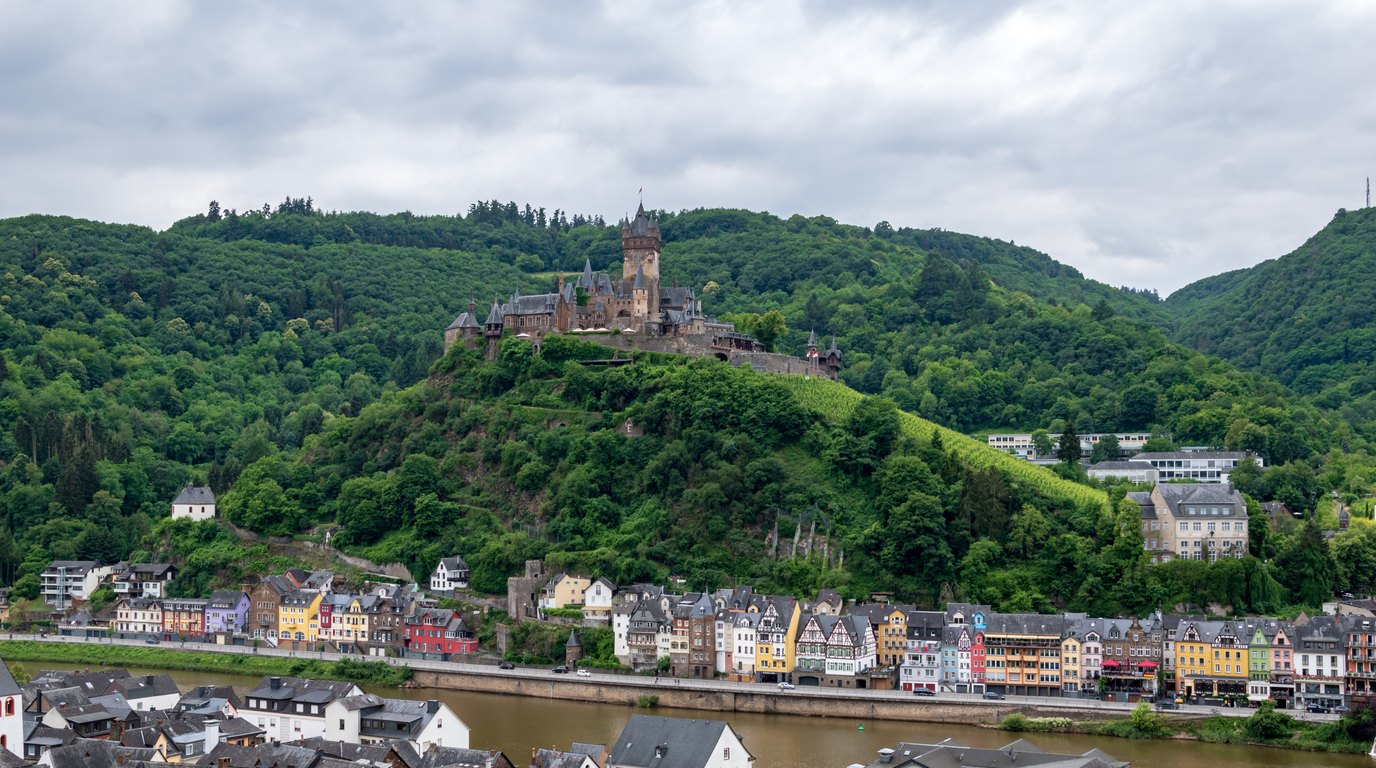
The Moselle and the Romantic Rhine — vineyards, castles and a cathedral
Eight days along two rivers: Roman Trier, riesling in Bernkastel-Kues, the castle above Cochem, the Loreley rock and Cologne Cathedral. The whole route runs flat along the water, the towns follow one after another, and between stops you can take the bikes out onto the cycle path by the river. It is at its best in September and October, when the harvest is on, the vineyards turn yellow and the wine estates pour young Federweißer. If you are travelling with children, the route offers a cable car, ferries and enough castles to keep the trip from turning into a tasting marathon.
Itinerary
West through Franconia
You set off through the Rozvadov crossing and then along the motorway past Nuremberg towards Würzburg. Trier sits on the Luxembourg border, in the opposite corner of Germany from the one you enter it by — doing it in one go is simply not sensible. You spend the night roughly halfway, in Franconia, and the next day leaves you an unhurried morning to finish the drive.
Trier: Porta Nigra and the cathedral
The Romans founded Trier as Augusta Treverorum before the Common Era, and you can tell on every other corner. The main draw is the Porta Nigra, the blackened sandstone gate on the northern edge of the old town. The cathedral of Dom St. Peter and the Church of Our Lady stand a short walk away — the Roman monuments and both churches have been on the UNESCO list since 1986. An afternoon is enough for all of it, plus a coffee on the market square.
Imperial baths and an afternoon on the Moselle
In the morning you walk through the Kaiserthermen, the amphitheatre with its accessible cellars under the arena, and the Constantine Basilica with its vast throne hall. After lunch you head upstream along the Moselle to Bernkastel-Kues. The road follows the river and the vineyards drop to the water so steeply that the grapes have to be picked by hand — the drive itself is half the experience.
Bernkastel-Kues and the castle above Cochem
The market square in Bernkastel is lined with half-timbered houses from the 15th to the 17th century and the Renaissance town hall of 1608, with the parish church of St Michael a few steps away, its bell tower originally built as a defensive tower. The ruins of Burg Landshut stand above the town — the summer seat of the archbishops of Trier, which burned down at the end of the 17th century. On the Kues bank you will find the Cusanusstift, the hospice of Nicholas of Cusa with its preserved library, and in the cellars of the surrounding wineries riesling from sites that include the famous Bernkasteler Doctor. In the afternoon you carry on through the loops of the river to Cochem. The Reichsburg above the town can only be seen on a guided tour, the courtyard included; tours run daily from 9:30 to 17:00 and there is no parking at the castle itself — the vehicle stays down in town and a footpath or a shuttle bus takes you up.
The Loreley rock and the Upper Middle Rhine Valley
From Cochem you follow the Moselle down to the confluence at Koblenz and then turn upstream along the Rhine. Above Sankt Goarshausen the slate rock of the Loreley rises from the water at a point where the channel is narrow and the current treacherous — hence the legend of the maiden whose singing sent boats to the bottom. On the opposite bank in St. Goar stand the ruins of Rheinfels Castle, shelled by French revolutionary troops in the 1790s; today you can walk the inner and outer circuits, climb the clock tower and go through the castle museum. A ferry carries you between the two banks.
Koblenz: Deutsches Eck and Ehrenbreitstein Fortress
At Koblenz the Moselle flows into the Rhine, and on the spit between the two stands the Deutsches Eck with its equestrian statue of Emperor Wilhelm I. A cable car crosses to the far bank and up to Ehrenbreitstein Fortress; it runs daily from ten in the morning and you can buy a combined ticket that includes the fortress. From up there you see both rivers at once, and it becomes obvious why the fortress was built exactly here.
Cologne and the start of the journey home
In the morning you drive on to Cologne, where the cathedral stands right next to the main railway station and is visible from practically anywhere in the centre. If you have the legs for it, more than five hundred steps take you up to the gallery of the south tower. In the afternoon you turn for home and spend the night somewhere halfway, so that the last day is not spent entirely behind the wheel.
Back to the Czech Republic
The last day is pure driving. Depending on where you slept, you return either via Erfurt and Dresden to the Cínovec crossing, or via Nuremberg to Rozvadov. Set off early in the morning if you can — German motorways tend to jam up in the afternoon.
Practical motorhome information
Up to 3.5 t: in the Czech Republic you need an electronic motorway vignette (edalnice.gov.cz), while in Germany you pay nothing for motorways — the toll for passenger vehicles never actually came into force there. Over 3.5 t: in the Czech Republic you pay electronic toll through an on-board unit, while the German toll under § 1 of the Federal Trunk Road Toll Act (BFStrMG) applies to vehicles designed or used for carrying goods, and a motorhome does not fall into that category — so you pay nothing on German motorways even over 3.5 t. What you do pay for are the attractions themselves: the tour of the Reichsburg above Cochem, the cable car to Ehrenbreitstein Fortress and the Rhine ferries. There is no bridge across the Rhine between Koblenz and Rüdesheim; the St. Goar – Sankt Goarshausen ferry runs every 20 to 25 minutes, from 5:30 on weekdays, from 6:20 on Saturdays and from 7:20 on Sundays and public holidays, always until 21:00, and when the water level is low it takes vehicles only up to 7.5 t. On top of that, the centre of Cologne may only be entered with a green emissions sticker, and the rule applies to foreign vehicles in exactly the same way.
Campingpark Treviris and Reisemobilpark Trier, Trier · KNAUS Campingpark Bernkastel-Kues, Am Hafen 2, Bernkastel-Kues — on a green peninsula in a bend of the Moselle · Mosel Camping Bernkastel, Bernkastel-Kues — note that the site is adults only · Mosel Camping Cochem, Moritzburger Straße 1, Cochem · Campingplatz Loreleystadt, Sankt Goarshausen — right on the bank of the Rhine below the Loreley rock · Campingplatz Sonneneck, Boppard · KNAUS Campingpark Koblenz/Rhein-Mosel, Schartwiesenweg 6, Koblenz — open all year, across the water from the Deutsches Eck and the old town · Camping Berger, Cologne – Rodenkirchen, by the Rhine, with a train or bus into the centre
Germany does not allow wild camping. A single overnight stop is tolerated wherever parking is permitted, and only so that the driver can recover fitness to drive — which means no awning rolled out, no chairs and table outside. The wine towns on the Moselle have paid motorhome pitches (Stellplätze) by the river, for example Wohnmobilstellplatz Studert-Prüm – Maximinhof in Bernkastel-Kues; in Koblenz there is the year-round Reisemobil-Stellplatz Koblenz with thirty-eight pitches. In September and October, when the harvest is on and the villages celebrate the vintage, places fill up — book ahead.
KNAUS Campingpark Koblenz/Rhein-Mosel (Schartwiesenweg 6) has a disposal point for grey water and for the chemical toilet as well as a drinking water supply, and it is open all year, so it works as a dependable service stop outside the main season too. KNAUS Campingpark Bernkastel-Kues (Am Hafen 2) offers the same facilities from roughly the beginning of March to the beginning of November, which covers the entire period when this trip makes sense.
Stops along the route
You may also like
The map and GPX contain separate planning waypoints, not a driving route. Follow the itinerary for access to attractions and campsites.
Adria Compact
On the Moselle you park in narrow wine towns, and you walk up to the Reichsburg anyway, so the compact low-profile Compact gets through where a longer vehicle would have to reverse back out. Its garage takes the bikes for the cycle path along the river, which is a far more comfortable way to move between the vineyards than driving.
Get road trip ideas by email
Leave us your email and we will send motorhome inspiration and stock updates.
Adria Karavany · https://www.adriakaravany.cz/en/vylety/mosela-a-romanticky-ryn/