
Poland's Baltic Coast: Gdańsk, Hel and the Shifting Dunes
Ten days on Poland's Baltic coast: Hanseatic Gdańsk, the pier at Sopot, the lighthouse at Hel and the shifting dunes of Słowiński National Park. The drive north splits comfortably with a night in Toruń, and on the coast you alternate between brick Gothic, fishing harbours and endless sandy beaches. Most of the highlights you can reach without the vehicle — by suburban train, by boat or by bicycle, which on the Hel Peninsula is the only sensible way to get around in high season.
Itinerary
Through Kłodzko and Wrocław to Toruń
Set off early in the morning; you cross the border at Náchod and continue north via Wrocław and Łódź. It is the longest transfer of the whole trip, so keep the evening free and plan nothing for it. You reach Toruń in the afternoon, just in time for a first walk along the Vistula embankment, from where you can see the entire Gothic skyline of the city.
Toruń and the A1 motorway north
Toruń already lies in the Kuyavian-Pomeranian Voivodeship and its Old Town is a UNESCO World Heritage Site. Spend the morning on the Rynek Staromiejski with the town hall, around the house where Nicolaus Copernicus was born and in one of the gingerbread museums; gingerbread has been baked here since the Middle Ages and a tasting is part of the programme. In the afternoon you join the A1 motorway and move on towards Gdańsk.
Malbork Castle
Malbork is the largest brick castle in the world and a UNESCO site since 1997 — the seat of the Grand Masters of the Teutonic Order covers more than twenty hectares. The audio-guided tour can easily take half a day, so allow for that when you plan. The finest view of the whole complex is from the opposite bank of the Nogat, reached by the footbridge from the car park.
Gdańsk: Długi Targ and the Motława waterfront
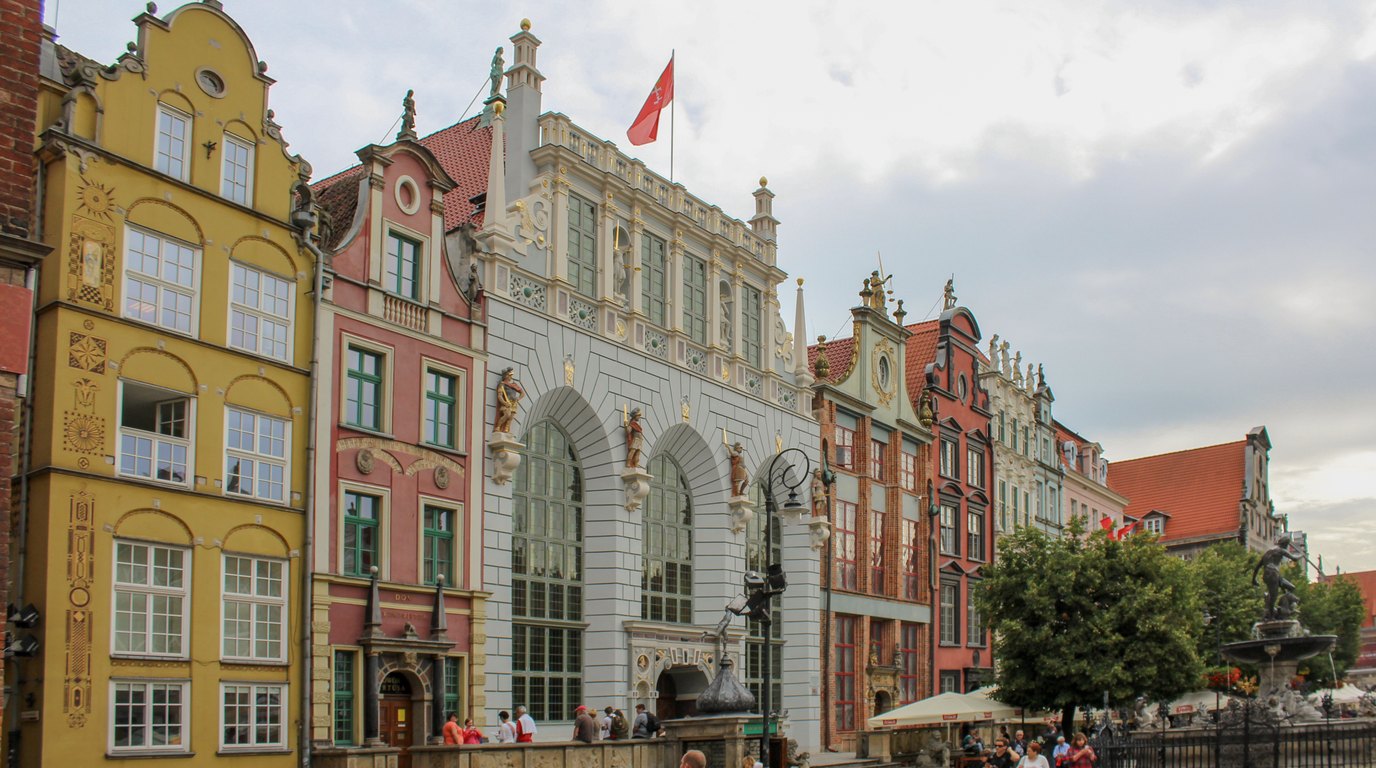
You can walk the Main Town comfortably: Długa street and Długi Targ with Neptune's Fountain, the Green Gate and the Motława waterfront with the wooden Żuraw crane. For amber people head to Mariacka street, for the view up the tower of St Mary's Basilica. Leave the afternoon for the Museum of the Second World War or the European Solidarity Centre — both in one go is too much.
Sopot and the spa promenade
The SKM suburban train runs to Sopot and back to Gdańsk every few minutes, and Sopot station sits right at the top of the busy Bohaterów Monte Cassino street. The wooden pier in Sopot is one of the longest in Europe and leads into the promenade towards the spa house. If you prefer quiet, climb through the pine woods above the town to the viewpoint.
Onto the Hel Peninsula
The drive runs along the Bay of Puck to the root of the Hel Peninsula. Set up base in Chłapowo near Władysławowo, from where a scenic path along the edge of the cliff leads to the Rozewie lighthouse. The afternoon belongs to the beach and to getting the bikes ready for the next day.
Hel without the vehicle
A single road leads to the tip of the peninsula and in July and August it regularly comes to a standstill; parking for long vehicles is limited as well — leave the vehicle at the campsite and go by train, by boat or by bike along the cycle path that runs the length of the spit. In Hel you will find the lighthouse with its viewing platform, the seal sanctuary of the Marine Station of the University of Gdańsk and the Coastal Defence Museum in a former artillery battery. You can take a boat back across the Bay of Puck and end the day on deck.
On to Łeba
The route west runs via Puck and Lębork to Łeba, a classic Baltic resort with a fishing harbour, fried fish and a wide beach. The afternoon is enough for the harbour and the little lighthouse on the pier. Stay in the Rąbka district right by the entrance to Słowiński National Park, so that the next day you do not have to move at all.
Shifting dunes and the start south
You cannot reach the Łącka Góra dune by car: from the car park in Rąbka it is roughly an hour on foot, with a bicycle or the electric train as the alternatives, and the park charges admission. The sand moves several metres a year and in 2016 a forest buried thousands of years ago emerged from under it — but you will find no shade out there, so take water and a hat. In the afternoon pack up the campsite and head south towards Poznań, so that the last day is not a marathon.
The journey home
The rest of the way follows the motorway via Wrocław and Kłodzko back to Bohemia. If you leave after breakfast, you are home in the afternoon. Take care of the last refuelling and the water fill-up while still in Poland, it tends to be cheaper there.
Practical motorhome information
Up to 3.5 t: Poland has no motorway vignettes and the state-run sections of motorways and expressways are free for vehicles up to 3.5 t. You do pay on concession sections, though, and this route uses one of them — the A1 "AmberOne" between Toruń (Nowa Wieś) and Gdańsk (Rusocin). The rate is not based on weight but on the number of axles and on twin wheels: a two-axle vehicle without twin wheels and without a trailer falls into category 1 and pays just under 30 zł for the whole section one way; a vehicle with twin wheels falls into category 2, while a rig towing a trailer counts as having more than two axles and falls into category 2a — in both cases the rate is the same, 71 zł. You take a ticket on entry and pay on exit. Over 3.5 t: on top of that comes compulsory registration in the e-TOLL system and payment by the kilometres driven on the network of state motorways, expressways and selected class I roads; on the A1 concession section you still pay at the toll gate according to categories 2 to 5. The main natural attraction of the route charges its own admission as well — Słowiński National Park collects 10 zł full and 5 zł reduced admission on selected trails from 1 May to 30 September.
Camping "Stogi" nr 218, Gdańsk-Stogi — dedicated pitches for motorhomes, hot water in the sanitary blocks around the clock, electric hook-ups, tram to the centre · Sopot 34, Sopot (ul. Bitwy pod Płowcami) — pitches for motorhomes and caravans with electricity, a short walk from the Sopot beach · Camping Alexa, Chłapowo near Władysławowo — a campsite on the cliff above the sea, a good base for the trip to Hel without the vehicle · Camping Morski nr 21, Łeba-Rąbka (ul. Turystyczna) — open roughly from mid-April to the end of October, right on the tourist trail to the shifting dunes · Camping Tramp, Toruń (ul. Kujawska 14) — the caravanning section by the Vistula, across the bridge and on foot to the Old Town · Camping Malta, Poznań (ul. Krańcowa) — a practical stop on the way back
In Poland you do not camp outside designated places. In Słowiński National Park staying overnight outside campsites is prohibited, and the same applies to the beaches, dunes and cliffs, where overnight stays are banned by the maritime authority's rules. Coastal car parks are usually paid in season and many of them have a height barrier that a motorhome will not fit under — on the Hel Peninsula doubly so. Book your pitch in Gdańsk, Sopot and Łeba in advance; in July and August the capacity is not something you find at short notice.
Rely on campsites, not on lay-bys. Empty the cassette and top up the water wherever you sleep — but check the opening dates of the coastal campsites in advance, as a number of them close outside the main season and the site in Rąbka is the last sure thing before the dunes. Do not expect a motorhome service point at Polish motorway rest areas, so always fill the tanks when you leave a campsite. Swapping propane-butane cylinders in Poland is possible, but do not count on Czech cylinders — set out for the ten days with a full supply from home.
Stops along the route
You may also like
The map and GPX contain separate planning waypoints, not a driving route. Follow the itinerary for access to attractions and campsites.
Adria Matrix
The Adria Matrix has a spacious rear garage that takes bicycles — and the bicycle is the key item on this route: the Hel Peninsula and the shifting dunes are only sensibly reachable by bike, by train or by boat, because the vehicle stays at the campsite. At the same time the Matrix is compact enough for the narrow approaches to the coastal campsites and comfortable enough for the long motorway runs on the A1.
Get road trip ideas by email
Leave us your email and we will send motorhome inspiration and stock updates.
Adria Karavany · https://www.adriakaravany.cz/en/vylety/polske-baltske-pobrezi/