
Bernese Oberland and Lucerne
One valley route from Lucerne through Interlaken and Lauterbrunnen to Bern, where the Swiss Alps unfold without a single demanding climb. The hops between stops fit into roughly an hour, so the days belong to the places rather than to the steering wheel: a covered wooden bridge over the Reuss, the turquoise Lake Brienz, an open-air museum holding a hundred relocated buildings, the rock wall with the Staubbach falls and the arcades of Bern's old town. A rack railway carries you up to Jungfraujoch, the highest railway station in Europe — the vehicle stays down in the valley. It is a trip you can take with small children, but prepare a higher budget for it than for the rest of the Alps.
Itinerary
South through Bavaria and Swabia
From Prague you set off via Pilsen and Nuremberg towards Stuttgart. German motorways are free for motorhomes up to 3.5 t, so the first day is mainly about a calm pace and about not taking on more driving than you can comfortably manage. Pick a Stellplatz in Swabia or by Lake Constance for the night and leave the rest for the morning.
Arriving at Lake Lucerne
You cross into Switzerland in the morning and drop down to Lucerne past Zurich. The afternoon is free: the campsite lies right on the lakeshore, you can swim, and in the evening you can walk the Reuss embankment once the coach crowds have gone. That is plenty for a first acquaintance with the city; there is time for the sights tomorrow.
Lucerne
The 14th-century Kapellbrücke is the oldest covered wooden bridge in Europe; after the fire of 1993 much of it had to be rebuilt, but some of the painted panels in the gables remain the original ones. From the bridge it is a short walk to the octagonal water tower and to the dying lion carved into the rock face above a small pond. Save the afternoon for the Museggmauer wall — from its walkway you can see the whole old town and the lake with the ridges of Pilatus and Rigi.
Over the Brünig to Lake Brienz and Ballenberg
The road over the Brünig Pass is wide and easy to drive even in a motorhome, and it ends at the turquoise water of Lake Brienz, which takes its colour from the glacial silt in the inflowing streams. Above Brienz lies the Ballenberg open-air museum: more than a hundred historic buildings from every corner of Switzerland scattered across sixty-six hectares of meadow and woodland, plus workshops and farm animals. The grounds are open roughly from mid-April to the end of October and walking them at an unhurried pace takes half a day. The evening belongs to the lakeshore.
The Lauterbrunnen valley
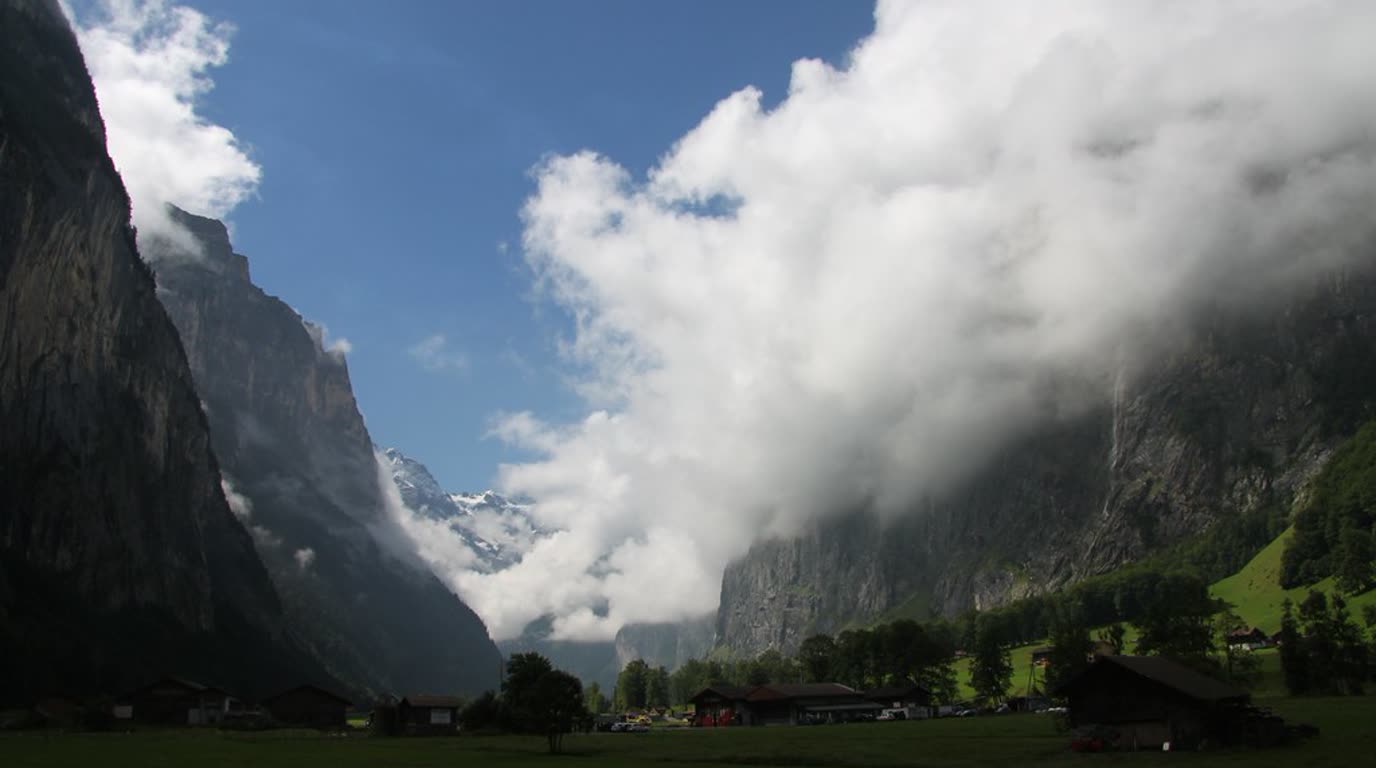
From Brienz you move through Interlaken to Lauterbrunnen, a valley squeezed between two vertical walls. The road through it is narrow and in season it carries scheduled buses, so it pays to drive slowly and leave overtaking for the wider stretches. The Staubbach falls almost three hundred metres in free fall directly above the village, and a path leads all the way beneath its overhang, where you step into the spray. A little further up the valley are the Trümmelbach falls — ten glacial cascades inside the rock, reached by a tunnel lift.
Jungfraujoch
You cannot get up there by car: the vehicle stays parked in Lauterbrunnen and you ride the rack railway to the saddle via Wengen and Kleine Scheidegg. The terminus at 3,454 metres is the highest railway station in Europe, and at the top there is the Sphinx observation deck, corridors cut into the glacier and a view of the Aletsch Glacier. The ticket is among the most expensive in the Alps, so choose your day by the forecast — in fog it is money thrown away. The journey up and back with a break at the top fills a whole day.
Car-free villages and the move to Lake Thun
Save the morning for Wengen or Mürren. Both are reached only by railway and cable car, no cars run in them, and that is exactly why you hear cowbells instead of engines in the early hours. In the afternoon you drop back down to the valley, pass through Interlaken and move on to Lake Thun.
Thun and Lake Thun
Above the town stands a castle from the end of the 12th century with four corner towers; the knights' hall now houses a museum and from the walkway you can see the lake and the Stockhorn ridge. In the Obere Hauptgasse the shops sit on two levels above one another and the pedestrian walkway runs across the roofs of the lower row of stores — the so-called Hochtrottoirs, which you will not find anywhere else in Europe. In the afternoon you can take a boat trip on the lake and leave the vehicle where it stands.
Bern and the road north
In the morning you set off for Bern, whose old town in a bend of the Aare has been on the UNESCO list since 1983. The arcades beneath the houses rank among the longest continuous covered shopping streets in Europe and take you through much of the centre in the dry; add to that the Zytglogge with its astronomical clock, the bear park below the Nydegg Bridge and the rose garden looking out over the rooftops. After lunch you turn north and cross back into Germany.
The journey home
The last day is a straight transfer via Stuttgart and Nuremberg back to Bohemia. If you have time and appetite left, you can stop on the way in the Swabian Jura or in Nuremberg for lunch. You will arrive home in the afternoon or early evening.
Practical motorhome information
Up to 3.5 t: Switzerland has a single nationwide motorway vignette costing CHF 40. You buy it either as a sticker for the windscreen or as an electronic e-vignette tied to the registration plate (via.admin.ch); it is valid for roughly fourteen months, from the beginning of December to the end of January of the following year. A towed caravan or cargo trailer needs its own separate vignette. Over 3.5 t: you do not buy a vignette at all — instead you pay the flat-rate heavy vehicle charge (PSVA): CHF 3.25 per day, at least CHF 25 and at most CHF 58.50 for a continuous period of up to thirty days, CHF 58.50 per month, CHF 650 per year. It is paid in advance through the Via portal and applies on the entire road network, not just on motorways; the charge also runs on days when the vehicle merely stands at a campsite. Paid attraction on the route: the rack railway to Jungfraujoch. A return ticket from Wengen or Grindelwald comes to roughly CHF 240 in the main season (May to October) and around CHF 200 outside it; from Lauterbrunnen, where your vehicle stays parked, the leg up to Wengen is added on top, so it works out a little dearer. In season a seat reservation fee is charged as well. Holders of a Half Fare card or a Swiss Travel Pass pay considerably less. The outbound journey runs through Germany, where motorhomes up to 3.5 t pay no toll at all.
Camping International Lido Luzern, Lucerne — right on the shore of Lake Lucerne, into the old town on foot along the water or by public transport · Camping Aaregg, Brienz — on a peninsula in Lake Brienz below Ballenberg, seasonal operation roughly from April to October · Camping Jungfrau, Lauterbrunnen — in the valley itself below the Staubbach, open all year round; for July and August reserve a pitch well in advance, the valley is overloaded in season · Camping Lazy Rancho, Unterseen near Interlaken — a family campsite with a view of the Eiger, Mönch and Jungfrau · TCS Camping Gwatt Thunersee, Gwatt near Thun — on the shore of Lake Thun a short way from the centre, with separate pitches for longer and heavier vehicles · TCS Camping Bern Eymatt, Hinterkappelen near Bern — between the Bremgarten forest and Lake Wohlen, under half an hour into the centre of Bern by public transport
Switzerland has no blanket right to free overnighting — the rules are set by the cantons and by individual municipalities, and in the tourist centres of the Bernese Oberland staying overnight outside a campsite tends to be prohibited and policed. Count on a campsite for every night; in the main season a pitch here commonly comes to CHF 50 to 70 a night, which is among the highest prices in Europe, so it is worth working the budget out in advance. In all three towns on the route (Lucerne, Thun, Bern) the campsite lies so that you can reach the centre by public transport, by boat or on foot — cheaper and calmer than hunting for a parking space for a large vehicle.
A drinking water point and a waste water disposal are available at all the recommended campsites. At TCS Camping Gwatt Thunersee the service station is a few steps from the pitches for longer vehicles, so there is no need to move the vehicle anywhere before departure. In Swiss towns you can also refill a canister from the public fountains — the old town of Bern has a whole string of them and the water in them is drinkable everywhere there is no 'Kein Trinkwasser' sign. Propane-butane cylinders with a Czech valve cannot be exchanged in Switzerland, so take a full spare cylinder from home.
Stops along the route
You may also like
The map and GPX contain separate planning waypoints, not a driving route. Follow the itinerary for access to attractions and campsites.
Adria Compact
The Adria Compact is a semi-integrated motorhome that stays under seven metres long and only a little over two metres wide — exactly what you need in the narrow Lauterbrunnen valley, where you pass scheduled buses, and on the small pitches of Swiss campsites. At the same time it stays in the up-to-3.5-t category, so the CHF 40 motorway vignette is all you need and the flat-rate heavy vehicle charge does not concern you.
Get road trip ideas by email
Leave us your email and we will send motorhome inspiration and stock updates.
Adria Karavany · https://www.adriakaravany.cz/en/vylety/berner-oberland-a-lucern/