
Normandy and Brittany — cliffs, tides and megaliths
Two weeks along the coast of Normandy and Brittany — the chalk cliffs of Étretat, the D-Day beaches, Mont-Saint-Michel and the Carnac menhirs. The route keeps the sea on your right and changes with the tide: the bay below Mont-Saint-Michel looks like two entirely different places at low water and at spring tide, so you will want the tide tables in hand before the itinerary. The further west you go, the narrower the roads — in Finistère you drive between stone walls and hedgerows, so a wide motorhome means passing places and a slower pace. Late spring and early autumn are the most pleasant, when the coast and the campsites are far quieter than in August.
Itinerary
Crossing to Normandy
From Prague you head west through Germany and Lorraine, with one overnight roughly halfway. The second day continues via Reims and Rouen — the northern route lets you avoid Paris — and you reach the sea in the early evening, so the first cliffs can wait until morning. Allow for two solid days behind the wheel; that is the price of the westernmost destination in our selection.
Étretat and the Alabaster Coast
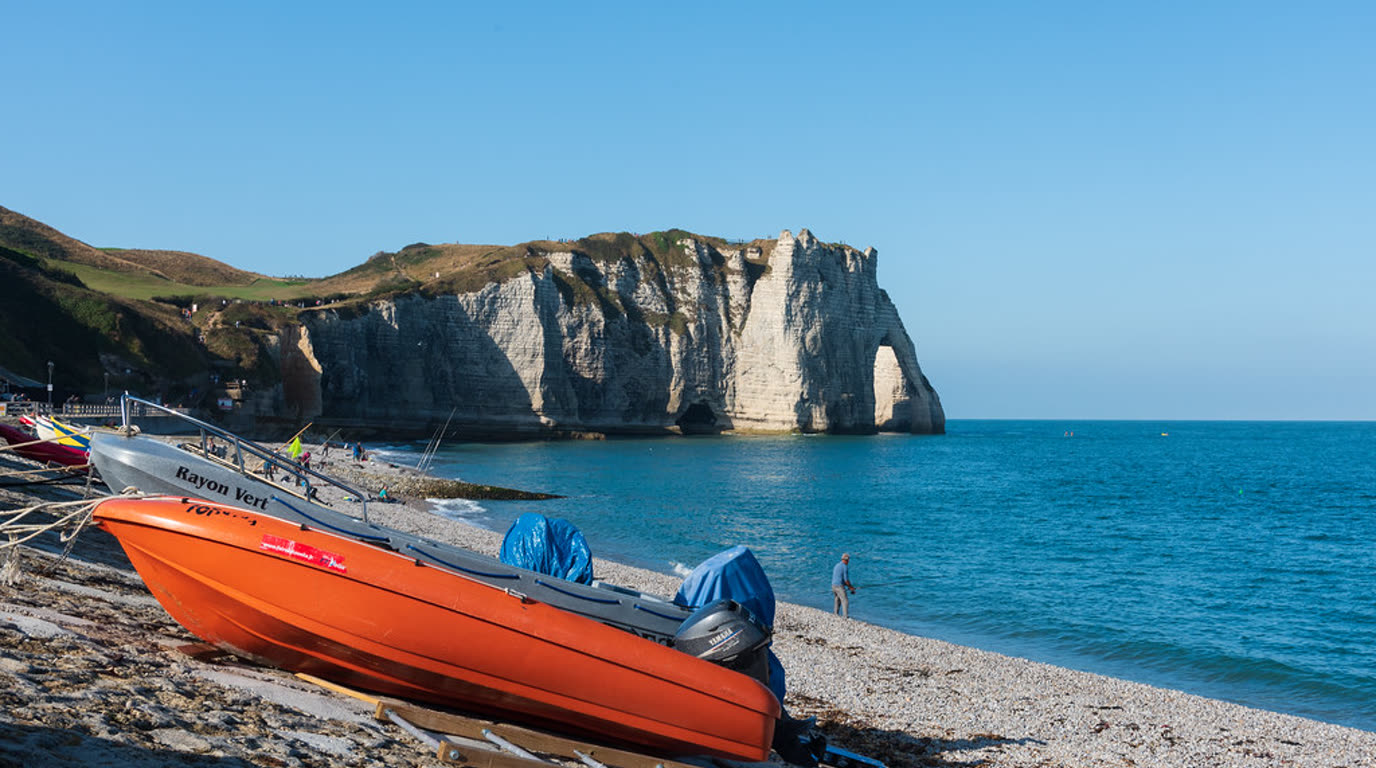
The morning belongs to the Falaise d'Aval with its famous stone arch and lone needle of rock; in the afternoon you cross to the Falaise d'Amont opposite and the chapel of Notre-Dame de la Garde. Along the Côte d'Albâtre it is worth stopping in the fishing village of Yport and in Fécamp with its Benedictine palace. The best light on the cliffs comes late in the afternoon, once the coach parties have moved on.
Honfleur and the Côte de Nacre
The Pont de Normandie, a cable-stayed bridge over the mouth of the Seine, takes you across to Honfleur, whose Vieux Bassin with its tall slate-fronted houses was painted by both Boudin and Monet. In the afternoon you follow the Côte de Nacre past Ouistreham to Arromanches, where the concrete caissons of the Mulberry harbour still stand out in the water. Spend the night in Bayeux, or carry straight on to the landing beaches.
Omaha Beach and the Pointe du Hoc
The day belongs to the landings: the Pointe du Hoc with its bomb craters and shattered bunkers, Omaha Beach, and above it the American cemetery at Colleville-sur-Mer with just under ten thousand graves. Walk out onto the beach itself at low tide, when it uncovers the broad band of wet sand the soldiers had to cross in 1944 — at high water it shrinks to a narrow strip and the whole story loses its scale. The Overlord Museum right beside the cemetery fills in the context.
Bayeux and the move to the bay
The famous Bayeux Tapestry cannot be seen — the museum is closed for renovation and is due to reopen in the autumn of 2027. What remains is the Musée Mémorial de la Bataille de Normandie, the Baron Gérard museum of art and history, and the Gothic cathedral for which the tapestry was originally embroidered. In the afternoon you move on to the bay of Mont-Saint-Michel, so that the abbey is close by the next morning.
Mont-Saint-Michel
A shuttle runs to the rocky island from the car parks, or you can walk across the causeway; entry to the abbey costs around sixteen euros and is free for visitors under twenty-six from the European Union. The tide changes the experience completely — at spring tides the sea returns around the mount and floods even the causeway, so compare your plan with the SHOM tables a day ahead. The mount is at its finest at dusk, once the day trippers have left and the lit abbey is reflected in the wet sand.
Saint-Malo and the Emerald Coast
The walled corsair town is best circled along the rampart walk, looking out over the rocky forts that low tide links to the shore with a band of sand. In the afternoon you cross the mouth of the Rance to the resort of Dinard with its belle époque villas, and come back through Cancale, where oysters are sold right beside the beds. The day ends at the Pointe du Grouin, with its view of the Île des Landes.
The Pink Granite Coast and the road west
This transfer day runs along the Côte de Granit Rose: around the lighthouse at Ploumanac'h lie giant granite boulders that surf and wind have worn into rounded shapes. In the afternoon you carry on west into Finistère, where the coastline breaks and the real end of Europe begins. It is the longest drive within the trip, so plan it for the morning.
The Crozon peninsula
Crozon is a cross-shaped peninsula whose arms end in heathland dropping away into the Atlantic. The finest of them are the Pointe de Pen-Hir with the Tas de Pois rocks pushed out into the sea, and the Cap de la Chèvre above the bay of Douarnenez. In Camaret-sur-Mer a Vauban tower stands on the jetty and the hulls of wooden boats are still rotting away in the harbour — photogenic even in poor weather.
The Pointe du Raz and Cap Sizun
The westernmost headland of mainland Brittany is protected as a Grand Site de France: the vehicle stays in the paid car park and you walk across the heath to the statue of Notre-Dame des Naufragés. Below the cliffs the sea churns in the Raz de Sein current even on a calm day, and the La Vieille and Tévennec lighthouses are visible from the shore. Save the Baie des Trépassés and the Pointe du Van for the way back, where it tends to stay quiet even in August.
The Carnac menhirs and the start of the return
Cap Sizun ends at the Pointe du Raz, one of the best-known headlands in Brittany, protected as a Grand Site de France — the true westernmost point of mainland France lies further north at the Pointe de Corsen near Plouarzel. The statue of Notre-Dame des Naufragés stands on the heath above the cliffs; below them the sea churns in the Raz de Sein current even on a calm day, and the La Vieille and Tévennec lighthouses are visible from the shore. Save the Baie des Trépassés and the Pointe du Van for the way back, where it tends to stay quiet even in August.
Back to Prague
The return follows the same corridor through northern France and Germany, again with one overnight on the way. Two days for the journey back may look generous, but after a fortnight by the sea you will appreciate not having to rush. Book the halfway stop in advance — in high season the sites along the motorway routes fill up early in the evening.
Practical motorhome information
France has no motorway vignette; tolls are paid at the barriers according to the vehicle class, which is determined by height and weight. Because it stands over two metres tall, a motorhome under 3.5 t falls into a more expensive class than a car, while vehicles over 3.5 t count as heavy goods and pay more still — for taller vehicles the rate steps up at around three metres of overall height, so it pays to know the figure from your registration document. Budget roughly €120–180 in tolls for the round trip; the calculator at autoroutes.fr will work out the exact amount for a specific route. The Pont de Normandie near Honfleur charges its own separate toll on top of that. The approach route passes through Rouen, which operates a low-emission zone (ZFE-m), so you will need a Crit'Air sticker — without one the zone is closed to you, and the restrictions currently target the oldest categories. Check the current rules at certificat-air.gouv.fr before you leave; the sticker is ordered online and sent by post, so it cannot be arranged at the last minute.
Camping L'Aiguille Creuse, Les Loges — four-star site near Étretat with pitches equipped for motorhomes · Aire de camping-cars d'Étretat, Rue Guy de Maupassant — 35 places with a service point, right next to the municipal campsite · Camping municipal des Bords de l'Aure, Bayeux — 140 pitches, 61 of them reserved for motorhomes, walking distance from the centre · Camping Le Robinson, Colleville-sur-Mer — quiet family campsite directly above Omaha Beach · Camping Les Portes du Mont Saint-Michel, Le Mont-Saint-Michel — motorhome pitches by the causeway, where the shuttle departs · Camping de la Cité d'Aleth, Saint-Malo — above the mouth of the Rance, a short walk from the intra-muros ramparts · À la ferme du Bout du Monde, Plogoff — an overnight stop for motorhomes and vans only, a base for the Pointe du Raz · Camping Kerabus, Carnac — three-star site a short way from the stone alignments
The loi littoral applies along the coasts of both Normandy and Brittany: overnighting outside campsites and designated areas is broadly prohibited, including most of the coastal car parks with a view where it would otherwise be tempting. The backbone of your nights is therefore the dense network of municipal aires de camping-car, which you can supplement with the France Passion membership scheme at winegrowers, farmers and cider producers. At Mont-Saint-Michel motorhomes have their own daytime sector in the car parks by the causeway, but staying the night there is not allowed — you return to a campsite nearby. The Pointe du Raz has a paid car park with no overnight option, and the headland is reached on foot across the heath from there. In Étretat, access and parking for large vehicles in the centre are restricted in high season, so a motorhome belongs on the dedicated aire listed above; in Carnac there is a round-the-clock motorhome zone in the Kérabus car park by the Ménec alignments.
At the start of the route the aire in Étretat listed above is all you need, with the service point and drinking water available around the clock. At the far end of the loop the municipal aire de services in Cléden-Cap-Sizun is the last sensible place to top up with water before the final stretch to the Pointe du Raz. French service points are found on almost every municipal aire; some of them charge, using a token or a card from the town hall or the local newsagent, so it is worth carrying both change and a contactless card. Gas bottles in France use their own fittings — for a fortnight, take a supply from home or count on an adapter.
Stops along the route
You may also like
The map and GPX contain separate planning waypoints, not a driving route. Follow the itinerary for access to attractions and campsites.
Adria Compact
The Adria Compact is a compact low-profile motorhome — shorter and noticeably narrower than the larger Matrix or Coral models, so it takes you along the narrow roads of Cap Sizun and into the villages of the Crozon peninsula, and it parks where a longer vehicle would be turned away: in Étretat, Saint-Malo or at the Carnac alignments. The rear garage swallows bikes for the coastal paths, and an overall height under three metres keeps you out of the most expensive band at French toll barriers.
Get road trip ideas by email
Leave us your email and we will send motorhome inspiration and stock updates.
Adria Karavany · https://www.adriakaravany.cz/en/vylety/normandie-a-bretan-utesy-a-more/