
Norwegian Fjords – Preikestolen, Bergen and Geiranger
Norway's fjords by motorhome: the Preikestolen clifftop above Lysefjord, Hanseatic Bergen and the hairpins above Geirangerfjord. The route starts with the ferry from Danish Hirtshals to Kristiansand, continues through Ryfylke and Hardanger to Sognefjord, and its northernmost point is the Trollstigen and Romsdalen area. You sail back on the overnight ship from Bergen to Denmark, which saves roughly a day and a half compared with driving home overland. Allow sixteen days: the transfers between fjords are slow, because you are forever waiting for a ferry or climbing to a mountain pass.
Itinerary
Through Germany and Jutland to Hirtshals
Two days of pure motorway driving: north through Germany and then across Danish Jutland to the fishing port of Hirtshals at the very tip of the peninsula. Book both international crossings, out and back, well in advance — in high season the slots for longer vehicles are the first to go. Arrive at the terminal with time to spare; Color Line wants passengers checked in no later than an hour before departure.
Ferry to Kristiansand and the first fjord
The crossing of the Skagerrak takes roughly two and a half to four hours depending on the ship and ends in Kristiansand on Norway's southern tip. From there the road runs along the coast to the north-west into Ryfylke, to the foot of Preikestolen. The last stretch passes through the undersea Ryfylketunnel with gradients of up to seven per cent — drop into a lower gear and let the brakes breathe.
The hike up to Preikestolen
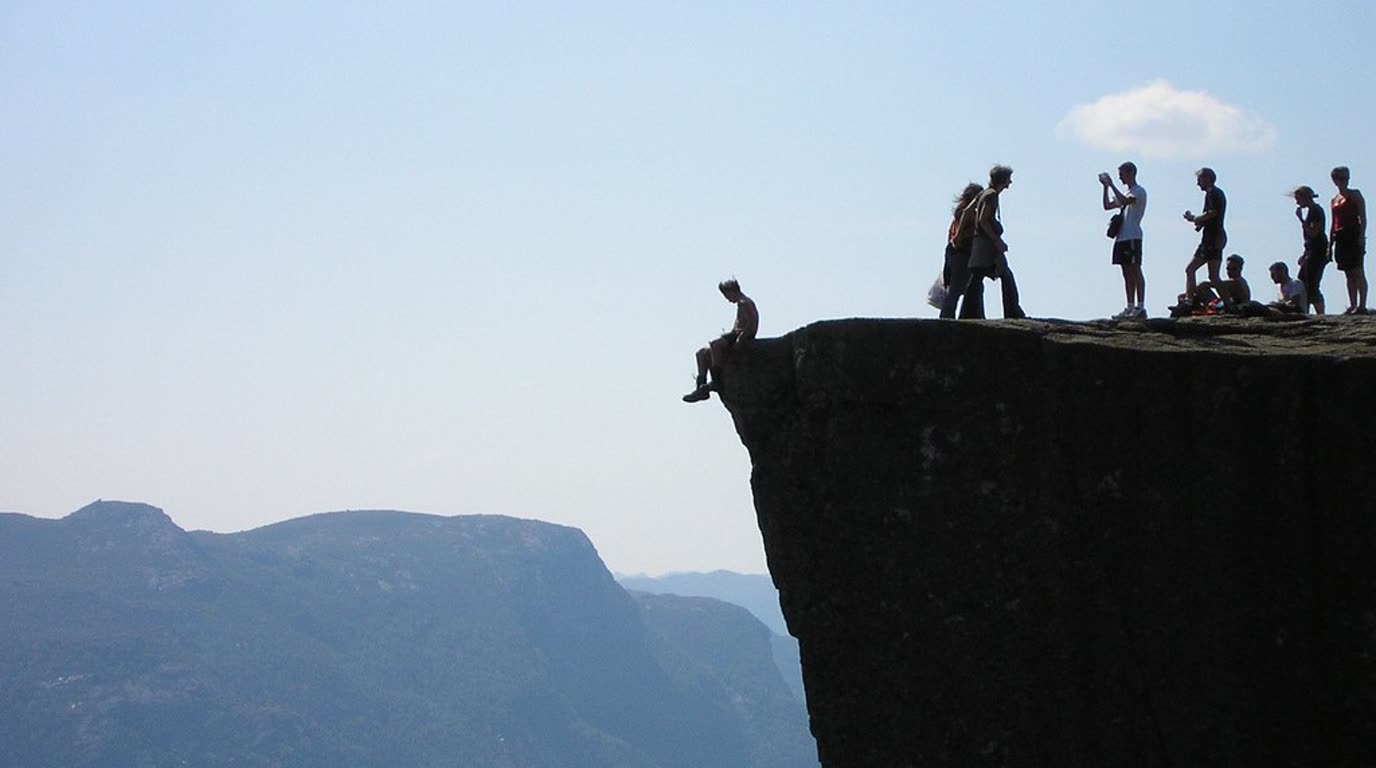
The Preikestolen rock plateau breaks off vertically above the water of Lysefjord and the view from it is among the most powerful that western Norway has to offer. Allow four to five hours for the walk there and back; the trail is waymarked and maintained, but stony and steep in places. Take sturdy boots, layers of clothing and plenty of water — the weather above the fjord changes within minutes. The edge of the plateau has no railing of any kind.
The Ryfylke National Tourist Route
The Rv13 road runs as the Nasjonal turistveg Ryfylke along fjords and waterfalls, and the short Hjelmeland–Nesvik ferry crossing is part of it. The day ends in Odda at the head of Sørfjord, the starting point for the demanding all-day hike to Trolltunga. You drive slowly and stop often; average speeds in Norway are markedly lower than the map suggests.
Sørfjorden and the Vøringsfossen waterfall
The road north runs through the orchard belt along Sørfjord, where fruit and cider are sold at the roadside in late summer. At Eidfjord you turn off into the Måbødalen gorge to the Vøringsfossen waterfall, which Statens vegvesen describes as Norway's best-known waterfall. The waterfall drops a total of 182 metres, and a system of viewing platforms and walkways has been built above the gorge.
Hardangerbrua, Aurlandsfjellet and Flåm
The Hardangerbrua bridge and Voss bring you to Aurland, from where the road climbs onto Aurlandsfjellet. The Stegastein viewpoint hangs on a wooden bracket above Aurlandsfjord and is one of the architectural stops on the national tourist route. The stretch from Aurlandsvangen up to Stegastein is open all year round, while the rest of the mountain road over Aurlandsfjellet closes for the winter. The night is spent down in Flåm.
Nærøyfjord and the Flåm Railway
Nærøyfjord, one of the narrowest arms of Sognefjord, is on the UNESCO World Heritage list and is best seen from the deck of a boat between Flåm and Gudvangen. The other local classic is the Flåm Railway, which climbs from the head of the fjord into the mountains past the Kjosfossen waterfall. You can reach both on foot from the campsite, so the vehicle can stay parked all day.
Over Sognefjellet and Strynefjellet to Geiranger
The Lærdal tunnel and the mountain road over Sognefjellet take you among glacial lakes and snowfields that lie here even in midsummer. From Lom the route follows the Rv15 through Ottadalen past Grotli to Langvatnet, where the Rv63 mountain road branches off past Djupvatnet and drops in hairpins down to Geiranger. This mountain section is closed in winter and opens according to the snow, so check its status the day before.
A day on Geirangerfjord
Geirangerfjord is on the UNESCO list along with Nærøyfjord, and you will see most of it from the deck. The excursion boats pass the Seven Sisters waterfall and abandoned mountain farms clinging high on the walls of the fjord. Anyone who stays ashore gets the whole fjord and its harbour laid out below them from the Flydalsjuvet viewpoint.
Ørnevegen, Trollstigen and Åndalsnes
From Geiranger the Ørnevegen climbs in hairpins to the Ørnesvingen viewpoint, then comes the short Eidsdal–Linge ferry and the Gudbrandsjuvet gorge. The high point of the day is Trollstigen with its eleven bends cut into the wall of Isterdalen. The road is under a multi-year programme of rockfall protection, the season shifts from year to year and tends to be shorter than the plan promises — check the current status on vegvesen.no before you set off. If it is closed, you can still drive up to Gudbrandsjuvet and then turn back to Linge, from where the Fv650 runs along Storfjord to Sjøholt and on along the E136 to Åndalsnes.
Art nouveau Ålesund and Nordfjord
In the morning you set off from Romsdalen to the coast and Ålesund, which burned down in 1904 and was rebuilt entirely in art nouveau — which is why its centre holds a unity of style that few Norwegian towns can match. In the afternoon you head south along the coastal E39 into Nordfjord; ferry crossings shorten the journey and run frequently without a reservation.
Across Sognefjord to Bergen
The E39 continues south and crosses Sognefjord on the Lavik–Oppedal ferry. You reach Bergen in the afternoon, which is the better half of the day for a walk along the Bryggen waterfront — the cruise ships have sailed by then. The wooden Hanseatic houses are on the UNESCO list and the lanes behind them are worth getting lost in.
Bergen and the overnight crossing to Denmark
In the morning take the Fløibanen funicular up Mount Fløyen, from where you can see the city and the fjords around it, and walk through the Fisketorget fish market. After midday you board the Fjord Line ferry, which leaves Bergen in the afternoon and arrives in Hirtshals the following morning. The crossing is overnight and calls at Stavanger, so you get one more look at the Norwegian coast on the way.
Back through Denmark and Germany
From Hirtshals you head straight south in the morning, and for two days it is nothing but a motorway run through Jutland and Germany. Split it so that the second day leaves you a margin for the queues around Hamburg and Dresden. You will spend the last night somewhere in Germany and arrive home in the afternoon.
Practical motorhome information
Norway has no motorway vignettes. Tolls are paid automatically through the AutoPASS system: the gantries read your number plate and without a tag (brikke in Norwegian) an invoice arrives in the post. Vehicles up to 3.5 t fall into takstgruppe 1, that is the lower rate, and with a valid contract and a tag they get a further twenty per cent discount on top of it. Vehicles over 3.5 t belong in takstgruppe 2 — with one crucial exception: motorhomes are usually registered in category M1, and those fit into group 1 even above 3.5 t, but only if they have a valid contract and a tag in the vehicle. With a vehicle registered outside Norway you also need to notify the tag issuer, so that the classification into group 1 actually happens. The difference is not cosmetic: one passage through the Ryfylketunnel on the way to Preikestolen costs roughly 95 NOK in group 1 with a tag and 119 NOK without one, but 357 NOK in group 2 — and it is charged in both directions. The Hardangerbrua bridge comes to roughly 114 NOK in group 1 with a tag and 143 NOK without, and to 428 NOK in group 2. Fjord ferries are paid for separately and charged by vehicle length, so above six metres the price jumps sharply; with an AutoPASS ferje tag you save ten per cent, with a prepaid contract for private individuals fifty, and otherwise an invoice arrives with a 35 NOK fee. The international Hirtshals–Kristiansand and Bergen–Hirtshals ferries are booked separately and are not part of AutoPASS. On the way out you have no tolls to deal with: Germany does not charge vehicles up to 7.5 t and the route through Jutland avoids the Danish bridges.
Preikestolen Camping, Jørpeland — in the area below Preikestolen, with pitches for motorhomes and caravans · Trolltunga Camping, Jordalsveien, Odda — its own motorhome section at the head of Sørfjord · Flåm Camping & Hostel, Flåm — terraced pitches with electricity, a drinking water tap and grey water disposal by the service building · Vinje Camping, Geiranger — hard-standing motorhome pitches with electricity and a shared water tap · Trollveggen Camping, Romsdalen south of Åndalsnes — below the Trollveggen wall, close to the foot of Trollstigen · Lone Camping, Haukeland near Bergen — by Lake Haukeland, with a large motorhome area and a connection into the centre
The Norwegian allemannsretten, the right to roam the countryside, covers moving on foot and camping in a tent in open country — it does not extend to sleeping in a motorhome at the roadside. A motorhome therefore belongs on a campsite or on a designated paid pitch. The car park below Preikestolen is paid and its capacity for large vehicles is limited, so in July and August it pays to set off early in the morning. And keep the length of your vehicle in mind: the roads over Aurlandsfjellet and over Trollstigen both have length restrictions for buses, and on the hairpins a longer vehicle has to reverse into passing places.
Do not empty the cassette in the toilets at the rest areas on the national tourist routes — Statens vegvesen explicitly forbids it there and the tanks are not built for it. On this route the nearest disposal points (tømmeplass in Norwegian) are at Øvre Eidfjord below Hardangervidda, at Gudvangen below Aurlandsfjellet, and then in Isterdalen, Valldal and Geiranger on the Geiranger–Trollstigen stretch. You can top up drinking water at the campsites: Flåm Camping & Hostel has a drinking water tap and grey water disposal by the service building, and Vinje Camping in Geiranger has a shared water tap right by the motorhome pitches.
Stops along the route
You may also like
The map and GPX contain separate planning waypoints, not a driving route. Follow the itinerary for access to attractions and campsites.
Adria Twin
The Twin is a van conversion and in its shorter versions it stays under six metres — exactly the length class that makes the biggest difference in price on the fjord ferries. It parks even in a full car park below Preikestolen, it takes the narrow road up to Stegastein and the bends of Trollstigen far more calmly than a low-profile motorhome, and as a vehicle up to 3.5 tonnes it falls into the lower toll rate.
Get road trip ideas by email
Leave us your email and we will send motorhome inspiration and stock updates.
Adria Karavany · https://www.adriakaravany.cz/en/vylety/norske-fjordy-preikestolen-bergen-geiranger/