
The Baltics and the Gulf of Finland – Curonian Spit, Riga and Tallinn
Curonian Spit dunes, Riga's old town, medieval Tallinn and a ferry across the Gulf of Finland, linked into a single route along the Baltic. Vilnius, Riga and Tallinn can all be covered on foot, and between them lie the baroque palace at Rundāle, the pine forests of the spit and the white beaches of Jūrmala. The Via Baltica is now largely expressway, so the long legs pass faster than you would expect, and in June it barely gets dark in Tallinn and Helsinki. Count on two long driving days on the way out and three on the way back — the rest is easy going across flat country.
Itinerary
Across Poland to Warsaw
The first day is pure driving, so set off early in the morning. The motorway takes you past Wrocław and Łódź towards Warsaw, where you stop for the night. It is one of the longest legs of the whole trip, but it runs on motorway and the second day will be considerably shorter.
Via Baltica to Vilnius
In the morning you continue along the Via Baltica through Suwałki and Kaunas to the Lithuanian capital. Leave the navigation on the main route: the Kaliningrad region has to be bypassed and the borders with Russia and Belarus are closed, so no shortcut to the east exists. You reach Vilnius in the afternoon, leaving time for a first walk along the Neris embankment.
Vilnius
The historic core of Vilnius is one of the largest surviving old towns in Eastern Europe and is inscribed on the UNESCO list. Climb Gediminas Hill for the view over the red roofs and walk around the baroque churches near the university. In the afternoon, wander into Užupis, the artists' district across the little river Vilnia, which declared its own constitution and posted it on a wall in twenty-three languages.
Trakai Castle and on to the Baltic
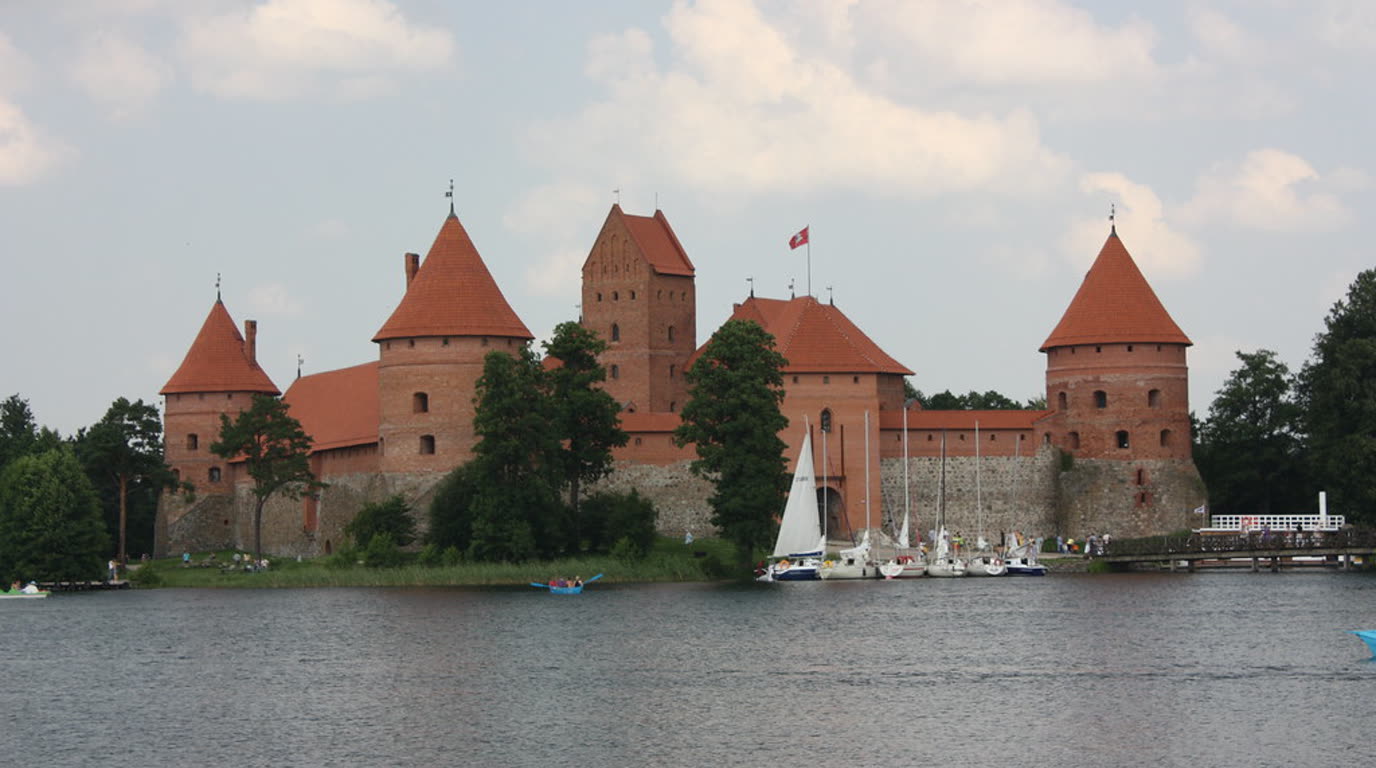
The island castle in Trakai stands in the middle of Lake Galvė and you reach it over wooden footbridges; the brick Gothic complex, completed under Vytautas the Great, now houses a history museum. After the visit you cross Lithuania to the coast at Klaipėda. In the evening it is worth walking through the old town with its half-timbered houses, left behind by German Memel.
The Curonian Spit and Nida
The only way onto the Curonian Spit with a vehicle is the ferry from Smiltynė; there is no other route from the Lithuanian side. At the southern end of the spit lies Nida, with wooden fishermen's cottages, colourful Curonian weathervanes and the summer house of Thomas Mann. Above the town rises the Parnidis Dune with its stone sundial and views of both the sea and the lagoon — the sand is on the move, so you walk strictly on the marked steps and boardwalks.
Juodkrantė and the Grey Dunes
The northern part of the spit is forested and far quieter than the area around Nida. In Juodkrantė, climb the Hill of Witches, a forest path lined with dozens of wooden sculptures drawn from Lithuanian legends. In the afternoon stop at the Grey Dunes in the Nagliai nature reserve, reached by a wooden boardwalk; it is the best idea you will get of how the spit looked before it was planted with forest.
Rundāle Palace and arrival in Riga
In the morning you take the ferry back to the mainland and head across the Latvian border to Rundāle, west of Bauska. The baroque palace was designed by Bartolomeo Rastrelli, the architect of the Winter Palace in St Petersburg, and built for the Duke of Courland Ernst Johann Biron; the tour of the interiors also includes the French garden. In the afternoon you drive on to Riga.
Riga
You can walk around Riga's old town in half a day: the Cathedral, the House of the Blackheads and the lanes around the Swedish Gate. Save the afternoon for the Art Nouveau district on Alberta and Elizabetes streets, home to one of the most complete collections of Art Nouveau facades in Europe. You can stock up in the halls of the Central Market, built from former airship hangars.
Jūrmala and the drive to Tallinn
In the morning make a stop in Jūrmala, a strip of white beaches and wooden villas just outside Riga. Then you head north through Pärnu, the Estonian resort with a shallow sandy beach and a good place to break for lunch. You arrive in Tallinn in the early evening.
Tallinn
Tallinn's old town is one of the best preserved medieval centres in Europe and falls into two parts: upper Toompea with the castle and the Kohtuotsa and Patkuli viewpoints, and the lower town around the Town Hall Square. In the afternoon walk out to Kadriorg, the baroque palace and park built for Peter the Great. The same park also holds the modern building of the KUMU art museum.
Ferry to Helsinki and Suomenlinna
The morning ferry takes you across the Gulf of Finland in roughly two hours, and the terminals in both cities lie close to the centre. From Helsinki you then take the public ferry out to Suomenlinna, a vast sea fortress spread over several islands and inscribed on the UNESCO list. For the night you drive to the campsite in Rastila, which the metro reaches directly from the centre.
Helsinki and the start of the way home
In the morning you can fit in the Temppeliaukio rock church hewn into the granite, the Esplanade and the market hall by the harbour. Then you board the midday ferry back to Tallinn and the return begins: the first leg runs through Pärnu to Riga. You arrive in the early evening, so there is still time for an evening walk along the Daugava on Ķīpsala.
Via Baltica back to Warsaw
A long driving day along the Via Baltica: Riga, Panevėžys, Kaunas and across the Lithuanian-Polish border at Suwałki to Warsaw. The road is largely dual carriageway and drives well, but you will spend most of the day behind the wheel. Set off right after breakfast and save the longer break for Kaunas.
Back to Prague
The last leg runs from Warsaw through Łódź and Wrocław back home. If you are not in a hurry, break the day with a stop in Wrocław — the old town with its town hall and bronze dwarfs is a short hop from the motorway and a pleasant full stop to two weeks in the north.
Practical motorhome information
Up to 3.5 t: Lithuania, Latvia and Estonia charge no toll on cars and motorhomes up to 3.5 t, and Finland has neither tolls nor vignettes. In Poland the state motorways are free for vehicles up to 3.5 t; three concession sections remain paid — A1 Gdańsk–Toruń, A2 Konin–Świecko and A4 Katowice–Kraków (roughly 30–130 zł for a car, depending on the section) — and the route via Warsaw and the Via Baltica avoids them. Over 3.5 t: the Lithuanian e-vignette applies to categories N1–N3, M2 and M3, the Latvian one to goods vehicles from 3,001 kg and the Estonian one to trucks over 3.5 t, so a motorhome registered in category M1 buys no vignette even at a higher weight — but check the category in your registration document. Above 3.5 t Poland also charges electronically through the e-TOLL system. Charges specific to this route: the Klaipėda–Smiltynė ferry costs 46.40 € for a motorhome (one ticket covers the trip there and back), and entering Neringa carries a local fee — 50 € for a motorhome in the main season from 20 June to 20 August and 20 € outside it, payable by card or in cash at the Alksnynė checkpoint or in advance through the UNIPARK system. The Tallinn–Helsinki ferry (Tallink, Eckerö Line, Viking Line) charges for a vehicle by its length and tends to sell out in July and August, so book it ahead.
Camping WOK, ul. Odrębna, Warsaw — open all year, takes vehicles up to 8 m long (the overnight stop both out and back) · Vilnius City Camping, Vilnius · Slėnis Trakuose, Trakai · Nidos kempingas, Nida (Neringa) — book ahead in the main season, capacity on the spit is limited · Pajūrio kempingas, Klaipėda · Riga City Camping, Ķīpsalas iela, Riga · Pirita Harbour Camping, Tallinn · Vanamõisa Caravan Park, Vanamõisa near Tallinn · Rastila Camping, Helsinki — 165 caravan pitches, open all year round, Rastila metro station right by the campsite
Camping outside official sites is banned in the Baltic national parks and protected areas, and on the Curonian Spit you may stay overnight only at a campsite. In Finland the right of public access does not cover sleeping in a motor vehicle, so head for a campsite there as well. The historic centres of Vilnius, Riga and Tallinn are awkward for a large vehicle — leave it on the edge of the city and go in by tram or trolleybus; all three have dense networks and cheap fares.
Fill and empty your tanks at campsites: service points elsewhere are not a given in the Baltics, so it pays to leave every time with full water and an empty waste tank, rather than waiting until it is full. On this route you can rely on Nidos kempingas in Nida before the drive onto the spit, on Riga City Camping on Ķīpsala halfway along, and on the year-round Rastila Camping in Helsinki, the last dependable service before the crossing back. Before the long driving days 13 and 14, top up the water in Riga — stopping gets harder on the Polish stretch of the Via Baltica.
Stops along the route
You may also like
The map and GPX contain separate planning waypoints, not a driving route. Follow the itinerary for access to attractions and campsites.
Adria Compact
The price of the ferry across the Gulf of Finland depends on the length of the vehicle, so a compact low-profile (semi-integrated) motorhome pays off twice on this route — at the ticket desk and when parking in Nida and on the edge of Vilnius, Riga and Tallinn. At the same time it is a fully equipped motorhome with proper insulation and heating, which you will appreciate on cool Baltic evenings even in summer.
Get road trip ideas by email
Leave us your email and we will send motorhome inspiration and stock updates.
Adria Karavany · https://www.adriakaravany.cz/en/vylety/pobalti-kurska-kosa-riga-tallinn/