
Greece: Meteora, Delphi and Athens
The monasteries of Meteora perched on rock pinnacles, the oracle at Delphi and the Acropolis above Athens sit on one axis you can drive in a motorhome. Along the way you can stop below Mount Olympus at Litochoro, at the Leonidas monument at Thermopylae and, on the loop back, at Nafplio and Mycenae. The transit through Hungary, Serbia and North Macedonia passes on the motorways faster than you would expect; just allow for queues at the non-Schengen borders. April, May and October are the most pleasant, and June and September work as well — just plan your Athens sightseeing for the morning, before the city heats up towards thirty-five degrees.
Itinerary
Across the Balkans to Greece
Prague, Bratislava, Budapest, then through Horgoš into Serbia and on past Belgrade and Niš to the Macedonian border. On the third day you drop down the Vardar valley into Greece and finish on the coast below Mount Olympus. Split it into three balanced stages and leave yourself a reserve for the Serbian and North Macedonian borders — in season there are queues. Keep your green card and vehicle documents to hand, they are checked at both crossings.
Mount Olympus from Litochoro
Litochoro is the classic base below the highest mountain in Greece and the Enipeas gorge starts here — a shady route along the stream to the Old Monastery of St Dionysius. Prionia, the starting point for the climbs to the summits, is reached from Litochoro by a narrow mountain road full of hairpins; with a motorhome it is more comfortable to leave the vehicle down in the village and set off through the gorge on foot. The summit area around Mytikas tends to stay under snow until roughly the end of May, so in April and May count on the lower circuits instead.
Transfer to Meteora
From the coast you turn inland into Thessaly and finish in Kastraki, a village pressed right up against the rock towers. An afternoon is enough for the loop along the scenic road between the rocks and for sunset from the viewpoint above the village. Leave the monastery visits for the next day, when you will have a whole morning for them.
The monasteries of Meteora
Six monasteries are open to the public — Great Meteoron, Varlaam, Roussanou, Holy Trinity, St Stephen and St Nicholas Anapafsas. Each has a different closing day of the week and charges its own admission in cash, so check the opening hours a day ahead. A strict dress code applies: women a skirt below the knee, men long trousers, shoulders covered in both cases; some monasteries lend a wrap at the entrance. It makes sense to manage two or three monasteries rather than all of them.
Thermopylae and the climb to Delphi
From Thessaly you head south towards the sea and pass Thermopylae — the Leonidas monument stands beside the main road and opposite it is the Kolonos hill with the epigram of Simonides. The stop takes half an hour and it is a place of remembrance rather than an excavation; the original battlefield now lies deep under the silt of the Sperchios river. In the afternoon you climb into the Parnassus massif and the day ends in Delphi.
Delphi
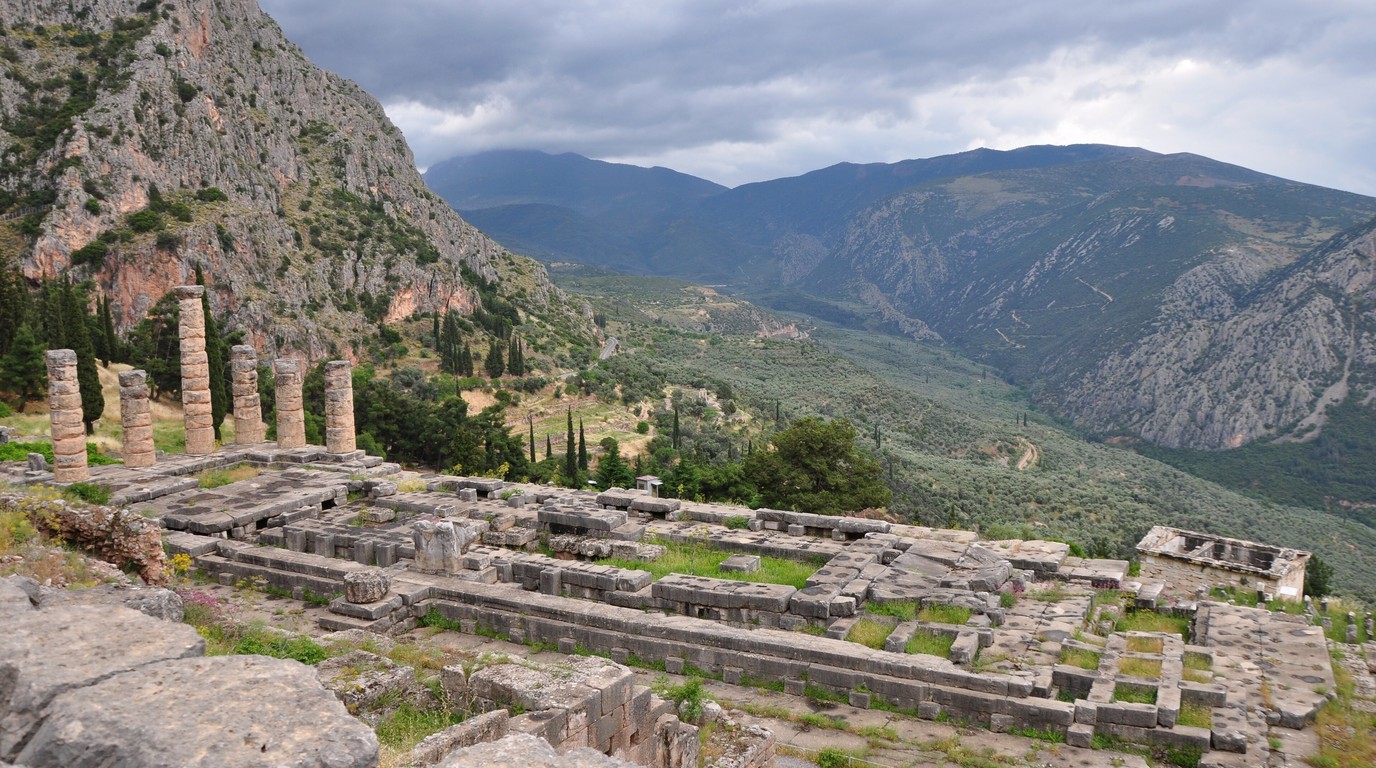
The sacred precinct climbs the slope of Parnassus: the Temple of Apollo, the theatre above it and, right at the top, the stadium. A little way apart stands Athena Pronaia with its circular tholos, whose three standing columns are the most photographed spot in the whole site. Leave the archaeological museum on site for last — the bronze Charioteer gives the entire visit its meaning. Allow a good half day for the circuit and take water with you, as there is practically no shade here.
Down to Athens
The road from Delphi drops to the Boeotian plain and joins the motorway to Athens. Stay at a campsite on the western edge of the city and do not move the vehicle again — a city bus runs from the campsite towards the centre and you carry on by metro. The rest of the day goes on getting your bearings and a first walk through Plaka.
The Acropolis and the Acropolis Museum
Take the Acropolis first thing in the morning, as it opens — during the day the rock is hot and the queues are long. You can walk round the Propylaea, the Temple of Athena Nike, the Parthenon and the Erechtheion in two hours, then go down to the Acropolis Museum below the rock. The afternoon leaves time for the ancient Agora or for the National Archaeological Museum.
Mycenae and arrival in Nafplio
Across the Isthmus of Corinth you continue into the Peloponnese to Mycenae, the centre of Mycenaean civilisation with its Lion Gate and the domed Treasury of Atreus. The site is inscribed on the UNESCO list together with Tiryns and the visit fits comfortably into a morning. In the afternoon you reach Nafplio and stay by the beach below the town.
Nafplio and Palamidi
Nafplio was the first capital of modern Greece and you can see it — Venetian houses, the islet of Bourtzi in the harbour and the Palamidi fortress above it all. You can walk up to Palamidi by the steps from the old town or drive up the road from the back. If you fancy one more ancient site, Epidaurus with its theatre famous for its acoustics is a short hop from here.
The journey home
The way back follows the same axis: from the Peloponnese north to Olympus, through North Macedonia and Serbia into Hungary and from there home. Four days for the return is not a luxury — they take in the borders, the toll gates and the fact that after two weeks nobody wants to drive twelve hours at a stretch. Plan the last night before Prague in Hungary or in southern Slovakia, so that the final stage is not only about driving.
Practical motorhome information
Up to 3.5 t: in the Czech Republic, Slovakia and Hungary you travel on electronic motorway vignettes tied to the number plate — buy them online before you set off. Serbia, North Macedonia and Greece have no vignettes at all; you pay at toll gates, by card or in cash. Over 3.5 t: the vignette does not apply in the Czech Republic, Slovakia or Hungary and distance-based tolling takes over (in Hungary the HU-GO system, either an on-board unit or a one-off route ticket bought in advance). In the Balkans the deciding factor is the height above the front axle: in Serbia a motorhome higher than 1.3 m and up to 3.5 t falls into category II, over 3.5 t into category III; in North Macedonia a vehicle with a front axle height between 1.3 and 1.8 m is in category II (around three euros at the Gevgelija gate). In Greece the weight does not matter at all — the category is set by the height of the vehicle: up to 2.20 m category 2, over 2.20 m category 3, which covers practically every motorhome. The difference is noticeable: at the Leptokarya gate on the motorway from Thessaloniki towards Olympus, for example, category 2 pays roughly €3.80 and category 3 roughly €9.40, and there is a whole series of gates on the Thessaloniki–Athens axis, so budget several tens of euros in tolls in each direction.
Camping Vrachos – Kastraki near Kalambaka, right below the rocks of Meteora, open all year, swimming pool, waste water point and chemical toilet disposal · Camping Olympos Beach – Plaka Litochoro, by the sea below Mount Olympus, open roughly from the second half of April to the beginning of October · Delphi Camping – Delphi, on the road from Delphi to Chrisso, swimming pool and a taverna looking out over the Delphi valley · Camping Athens – Peristeri, Leoforos Athinon, western edge of Athens, open all year, service point for motorhomes and a bus into the centre · Camping Argolic Strand – Plaka Drepanou near Nafplio, open all year, marked pitches with electricity and water and good access even for longer vehicles
Overnight stays outside official campsites are prohibited in Greece and it is enforced in the coastal villages and below Meteora, so plan every night at a campsite — booking pays off above all in Kastraki and in Athens, where campsites are few. There are only small designated car parks at the Meteora monasteries and in season the coaches fill them by mid-morning; set out early in the morning, or leave the loop among the rocks for the early evening. On the Serbian and Macedonian sections of the route you can spend a night at the large guarded motorway service areas, but that is an emergency solution, not a plan.
In practice you can only refill at campsites — Greece has few public service points for motorhomes and signposted ones are the exception. On this route both Camping Vrachos in Kastraki and Camping Athens in Peristeri have a waste water point and chemical toilet disposal, so plan your tanks around them and around the campsite below Olympus. Tap water in Athens is normally drinkable; in smaller places ask at the campsite reception — otherwise bottled water is available without any trouble along the whole route.
Stops along the route
You may also like
The map and GPX contain separate planning waypoints, not a driving route. Follow the itinerary for access to attractions and campsites.
Adria Matrix
The Matrix semi-integrated is a good match for this route: it is still narrow enough for the hairpins above Kastraki and for the mountain road from Delphi, yet inside it carries sixteen days without compromise — a large fridge, decent tanks and a garage for two weeks' worth of gear. Have air conditioning for the living area added to it; on an Athens afternoon that is the item that decides how well you will sleep.
Get road trip ideas by email
Leave us your email and we will send motorhome inspiration and stock updates.
Adria Karavany · https://www.adriakaravany.cz/en/vylety/recko-meteora-delfy-atheny/