
Tuscany — Florence, Siena and Val d'Orcia
Twelve days in Tuscany: Renaissance Florence, Siena with its Piazza del Campo, and the cypress-lined hills and vineyards of Val d'Orcia. It is a classic that works surprisingly well in a motorhome — two days out, two days back, and a full week in between for the towns, the wineries and the hill country. The campsites around Florence, Pisa, Siena and San Gimignano are used to motorhomes, and most of them sit close enough that you can walk into town or catch a local bus. Spring and early autumn are the best times to come, when the hills are pleasant and the towns are not yet packed.
Itinerary
From Prague through Austria to Tyrol
The first day is the longest of the whole trip, so break it up with stops and do not rush anywhere. The route runs through Austria to Salzburg and then up the Inn valley to Innsbruck. Spending the night in Tyrol has one big advantage: the Brenner crossing comes first thing in the morning, in daylight and without fatigue.
Over the Brenner and the Apennines into Tuscany
You will clear the Brenner Pass in the morning, then comes the descent into the Po plain and finally the Apennine crossing above Bologna. The climb into the Apennines is long, full of tunnels and slow behind queues of trucks — bear that in mind when you plan your arrival time. By evening you can already park at a campsite near Florence and leave your first Tuscan day for the morning.
Florence: the Duomo, the Uffizi and Ponte Vecchio
You will not get into the historic centre of Florence in a motorhome — it is a restricted traffic zone monitored by cameras, so leave the vehicle at the campsite or at a park-and-ride (the P+R Villa Costanza, for instance) and take the tram or a bus into town. Santa Maria del Fiore with Brunelleschi's dome, Giotto's bell tower and the baptistery all stand on one square, from which you can walk on to Piazza della Signoria and across Ponte Vecchio. Book tickets for the Uffizi and for the climb up the dome in advance; they routinely sell out on the day.
The Oltrarno and the view from Piazzale Michelangelo
The second day in Florence belongs to the left bank of the Arno. Palazzo Pitti and the Boboli Gardens will take up the morning, and the afternoon is for wandering the lanes of the Oltrarno among the workshops of restorers, bookbinders and goldsmiths, where the city still goes about its own business. Towards evening, climb up to Piazzale Michelangelo — the whole of Florence lies below you, with the hills of Fiesole above it.
Pisa and the Piazza dei Miracoli
The drive west to Pisa is short, so you will have the whole afternoon for the Piazza dei Miracoli. The Leaning Tower is only one part of the ensemble — the cathedral, the round baptistery with its famous acoustics and the Camposanto cemetery deserve just as much attention. Entry to the tower goes in timed waves with a limited number of people, so every ticket is for a specific slot.
Volterra: an Etruscan town above the valley
Volterra is the least touristy stop on the route and at the same time the oldest — the Etruscans were here long before the Romans, and their Porta all'Arco gate is still standing. The collection of funerary urns in the Museo Etrusco Guarnacci is among the finest in Italy, and from the walls you can see far inland. The town still works with alabaster, so in the workshops you can watch the carvers at work.
San Gimignano and its towers
The skyline of towers above the vineyards is one of the most photographed in Tuscany, and it works even better up close than from a distance. Of the dozens of family towers that once stood here, fourteen remain, and you can climb the Torre Grossa. The local white Vernaccia was the first Italian wine to be awarded DOC status — you can taste it right on Piazza della Cisterna. Early morning and late afternoon are the best times; during the day the coach tours pour in.
Siena and the Piazza del Campo
The shell-shaped Piazza del Campo slopes down towards the Palazzo Pubblico and is one of the few squares in Europe where you can simply sit on the paving. From the Torre del Mangia you will see the whole city and the hills around it, but the staircase is narrow and there is no lift. Siena's cathedral has striped marble inside and out, and a mosaic floor that is uncovered only for part of the year. Anyone with an eye for detail should leave time for the Libreria Piccolomini with its frescoes by Pinturicchio.
Montalcino and the Brunello valley
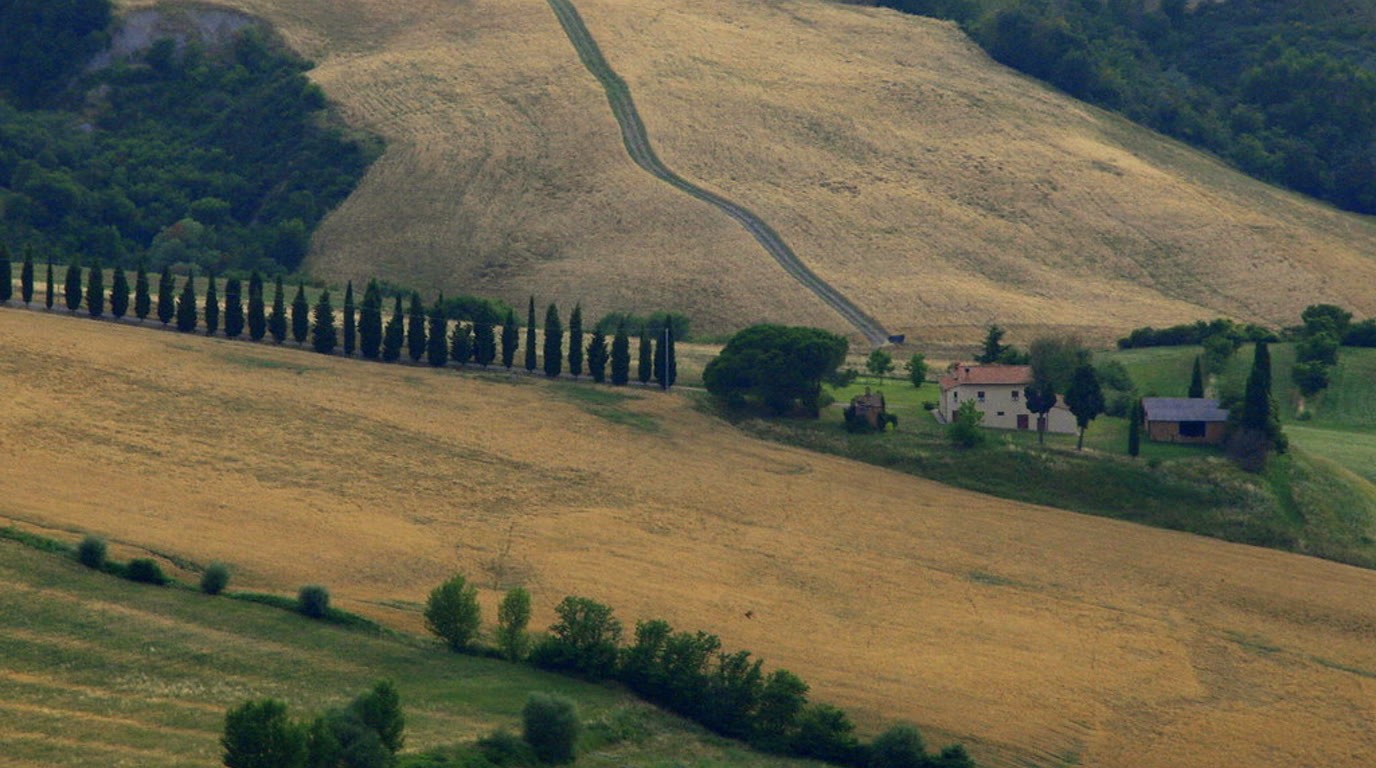
The road south already runs through the landscape people come to Tuscany for — rolling hills, lone farmhouses with cypresses and vineyards all the way to the horizon. Montalcino sits on a hill above them; the fourteenth-century fortress survives intact and houses an enoteca. Brunello di Montalcino spends long years ageing in barrel, so tastings here are not a cheap affair — on the other hand, many wineries welcome visitors by arrangement. Just outside the town stands the Romanesque abbey of Sant'Antimo, which is worth seeing.
Pienza, Val d'Orcia and the thermal pool at Bagno Vignoni
Pienza is a Renaissance ideal city that Pope Pius II had built on the site of his native village — the entire centre is the work of a single architect, and it shows. This is where you buy pecorino sheep's cheese, and the promenade along the walls looks out over the whole of Val d'Orcia, a UNESCO site. In the afternoon stop at Bagno Vignoni, where instead of a square there is a large pool of thermal water in the middle of the village. It is your last day in the region, so leave room for an ordinary stop at the roadside by an avenue of cypresses.
Back over the Apennines into the Alps
The return begins with the Apennine crossing, and after that it is flat driving north across the Po plain. Set off early — the afternoon queues around Bologna and Verona can take more time than you expect. Spend the night in Tyrol or by Lake Garda, so that the final day is nothing but motorway.
The Brenner and the last leg home
The morning brings the climb up to the Brenner and then a long but undemanding run across Austria. Fill up with diesel before the border — it tends to be cheaper in Austria than in Italy. You will reach Prague in the afternoon or towards evening, depending on how long your breaks are.
Practical motorhome information
Up to 3.5 t: in Austria a motorway vignette is enough, and it covers motorhomes up to 3.5 t — the 2026 rates are €12.80 for ten days, €32 for two months and €106.80 for a year. On top of that, the Brenner motorway A13 carries its own section toll; a one-way ticket for the whole stretch costs €12.50. In Italy you pay at the toll gates according to vehicle class: a two-axle vehicle lower than 1.30 m above the front axle is class A, a higher one (which in practice means every motorhome) falls into the more expensive class B. Over 3.5 t: the Austrian vignette does not apply, you need a GO-Box on-board unit and the toll is calculated from the kilometres driven, the number of axles and the emission class — the Brenner included. In Italy, three-axle and heavier vehicles fall into classes 3 to 5. Check the current rates at asfinag.at and autostrade.it, they change every year.
Camping Village il Poggetto, Troghi (Rignano sull'Arno) — a base for Florence · Camping Village Torre Pendente, Pisa — within sight of the Piazza dei Miracoli, open roughly from April to the beginning of November · Camping Boschetto di Piemma, Località Santa Lucia, San Gimignano — a public city bus into town runs past it · Camping Siena Colleverde, Strada di Scacciapensieri, Siena — they also sell bus tickets into the centre · Parco delle Piscine, Sarteano — pools fed with thermal mineral water from the Santa Lucia spring, a good base for Val d'Orcia
Wild camping — an awning rolled out with a table and chairs outside a campsite — is prohibited in Italy, and a number of Tuscan municipalities also restrict simply parking a motorhome overnight. You therefore spend the night at campsites or on municipal areas marked as area di sosta camper, which almost every larger town has. The historic hill towns — San Gimignano, Volterra, Pienza and Montalcino — have dedicated car parks below the walls; do not attempt to drive a motorhome into the lanes of the centre, they are narrow, often one-way and there is no room to turn around. At weekends the areas below the walls fill up by mid-morning, so it pays to arrive early.
Camping Siena Colleverde has a camper service point on site with both a waste dump and a drinking water intake. At Camping Boschetto di Piemma below San Gimignano the service point stands just outside the campsite and water can be taken without staying the night, which is handy when passing through. Tuscan towns also tend to have public drinking fountains (fontanelli, or case dell'acqua) where you can top up a canister — the water is drinkable and locals come for it too.
Stops along the route
You may also like
The map and GPX contain separate planning waypoints, not a driving route. Follow the itinerary for access to attractions and campsites.
Adria Compact
The Adria Compact is a nimble low-profile motorhome with a slim body — at 2,120 mm wide it is noticeably narrower than a typical low-profile, which is exactly what you need on the narrow approach roads to San Gimignano, Volterra or Pienza and in the car parks below the town walls, where a wider vehicle is hard to manoeuvre. For twelve days with two long runs over the Brenner you will also appreciate the 3+1 sleeping berths, the compact kitchen and the organised storage throughout the vehicle.
Get road trip ideas by email
Leave us your email and we will send motorhome inspiration and stock updates.
Adria Karavany · https://www.adriakaravany.cz/en/vylety/toskansko-florencie-siena-val-d-orcia/