
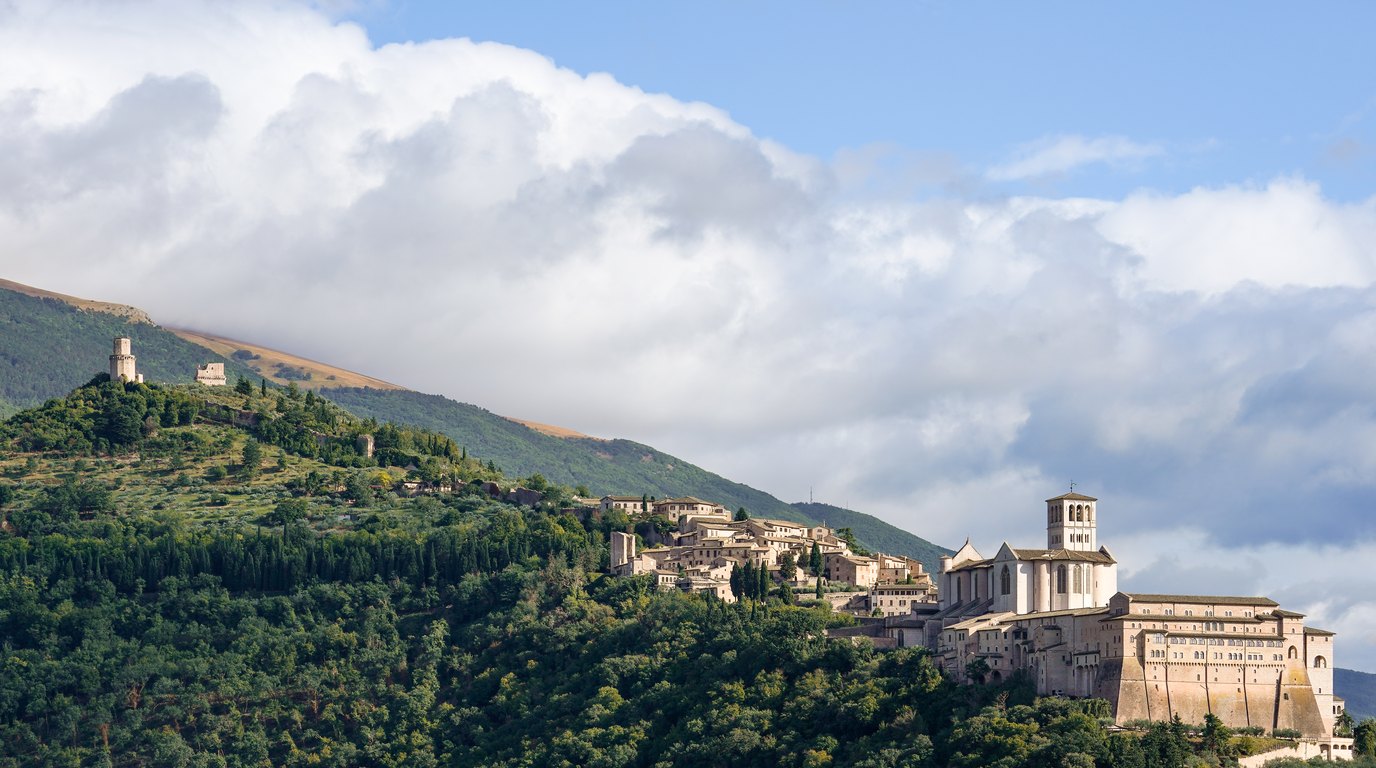
Umbria — the green heart of Italy
Umbria pairs stone hilltop towns, the pilgrim city of Assisi and Lake Trasimeno, and it is calmer, cheaper and easier in the heat than Tuscany. The towns lie close together, so you spend most of the day in one place rather than behind the wheel. The route leads through Assisi with the Basilica of St Francis, Perugia, Orvieto on its tufa rock and the Roman-built waterfall Cascata delle Marmore; in the south-west you cross the regional border into Civita di Bagnoregio in Lazio. Spring and early autumn are the most pleasant seasons here, and Lake Trasimeno keeps the programme going on days when the stone paving turns hot.
Itinerary
From Prague to the foot of the Alps
Set off early in the morning so that the longest transfer is behind you in one go — this is a full day behind the wheel, not a half-day hop. The route runs through Germany and Austria towards Innsbruck; the motorways are good and the only regular hold-up is the traffic around Munich. Spend the night in Tyrol so that you start the second day rested and take the climb to the Brenner first thing.
Over the Brenner into Umbria
The Brenner Pass is the fastest way south from Tyrol, and the landscape breaks into vineyards immediately behind it. Past Verona you join the A1, bypass Bologna and Florence, and at Valdichiana you turn off down into Umbria. This second day is long as well, so take a break roughly every two hours and share the driving where you can. End the day at Lake Trasimeno — after two days in the seat, the water beyond the campsite embankment is the best welcome there is.
Lago Trasimeno and Castiglione del Lago
Trasimeno is Italy's fourth largest lake, shallow and pleasantly mild through the warm half of the year. Castiglione del Lago sits on a promontory above the surface, with the Rocca del Leone fortress and a promenade below the walls looking out over the lake's islands. The afternoon belongs to the beach and the evening to freshwater cooking — locals eat the fish stew tegamaccio or carp stuffed the way porchetta is.
Isola Maggiore and the northern shore
Boats to Isola Maggiore, the only permanently inhabited island on the lake, run from Tuoro sul Trasimeno and from Passignano; you can walk around it in a morning, and the lacemaking tradition is still alive there today. In the hills above Tuoro, the Battle of Lake Trasimene took place in 217 BC, when Hannibal crushed the Roman army, and a waymarked circuit with interpretive stops now crosses the battlefield. Passignano has its walls right above the water and the harbour is a good place to sit in the evening.
Perugia
The capital of Umbria stands on a hill, and from the car parks below, escalators carry you up through the innards of the Rocca Paolina — the papal fortress built in the sixteenth century on a demolished quarter of the Baglioni family. At the top, the Corso Vannucci promenade opens onto Piazza IV Novembre with the Fontana Maggiore and the Gothic cathedral. Perugia is also a chocolate town; you will recognise the name Perugina and the Baci pralines without any sign.
Assisi
The Basilica of St Francis is in fact two churches stacked one above the other: the upper one holds the Legend of St Francis frescoes attributed to Giotto, the lower one paintings by Cimabue and Lorenzetti, and beneath them lies the crypt with the saint's tomb. The whole town is built from the pinkish limestone of Monte Subasio, which gives it a uniform shade you will not see anywhere else. Save the afternoon for the Basilica of St Clare and for the walk through the woods to the Eremo delle Carceri hermitage in the rocky gorge above town.
Spello, Bevagna and Montefalco
The three small towns south of Assisi show Umbria without the crowds. Spello keeps its Roman gates and has flowers in every niche of its narrow lanes, Bevagna a quiet square with two Romanesque churches, and Montefalco a viewpoint known as the balcony of Umbria. This is where Sagrantino di Montefalco is made, a dense red wine with its own DOCG designation — the wineries around town keep their tasting rooms open.
Cascata delle Marmore waterfall
The waterfall above Terni is not natural: the channel was cut in 271 BC on the orders of the Roman consul Manius Curius Dentatus, to lead the water of the river Velino down into the Nera. It drops in three tiers and measures 165 metres, but today the water mostly drives a power station and is released into the channel only at controlled times, typically around midday and in the early evening — outside those windows the rock face is almost dry, so check the schedule in advance with the park management. Several waymarked paths and tunnels lead up the slope to viewpoints right in the spray; count on getting wet.
Orvieto
Orvieto stands on a slab of volcanic tufa rising out of the plain, and its cathedral has a façade studded with mosaics and marble reliefs that can be seen from far away. Inside is the San Brizio chapel with Luca Signorelli's frescoes of the Last Judgement. The other half of the town is under your feet — the Pozzo di San Patrizio well with its double spiral staircase and a network of Etruscan cellars beneath the houses. A funicular runs up to the town from the station below, which is the most comfortable way to get to the top; have a white Orvieto Classico with lunch.
Civita di Bagnoregio
Civita already lies in Lazio, in the province of Viterbo, but from Orvieto it is the shortest excursion of the whole route. The little town clings to a crumbling slab of tufa above a valley of jagged calanchi and is reached by a single footbridge from 1965 with a paid entry; you go up on foot, on a steep climb. Only a handful of people live here permanently, so the nickname the town that is dying fits literally. Go early in the morning or towards evening; during the day the footbridge fills up.
Back across the Apennines
Say goodbye to Umbria in the morning and head north on the A1. Split the return into two stages and spend the night in northern Italy or in South Tyrol — two days for the journey home are comfortable, one would turn the trip into a marathon. If you have time left, stop at a market and stock up on oil, pulses and cheese; you will shop better in Umbria than in a motorway supermarket.
Home again
The last stage runs over the Brenner back into Austria and on home. Plan a longer break in Tyrol — the descent from the pass is long, and both the brakes and the driver deserve to cool down. You will reach Prague in the evening.
Practical motorhome information
Italy has no vignettes — on the motorways you pay for the section you have driven at toll gates, in cash, by card or with a prepaid Telepass. What decides the rate, though, is the number of axles and the height above the front axle, not the weight: a two-axle motorhome taller than 130 centimetres falls into class B, both under 3.5 t and over 3.5 t. A three-axle vehicle already belongs to the more expensive class 3. On the way there, vehicles up to 3.5 t need an Austrian vignette (in 2026 EUR 12.80 for ten days, EUR 32.00 for two months), while vehicles over 3.5 t need a GO-Box instead and pay toll by distance driven. The Brenner motorway A13 also has its own section toll, paid separately from the vignette — EUR 12.50 for a single trip in the up-to-3.5 t category according to the ASFINAG tariff for 2026. German motorways are free of charge for vehicles up to 7.5 t. You also pay separately for entry to the Cascata delle Marmore park (standard admission around EUR 10, less on days with no water release), for the footbridge to Civita di Bagnoregio (a flat EUR 5) and for the funicular in Orvieto (a ticket around EUR 1.30, which also covers the connecting bus to the cathedral) — the rates change from season to season, so check them with the operators before you travel.
Badiaccia Camping Village, Castiglione del Lago — a large site right on the shore of Trasimeno, with pitches for motorhomes · Camping Kursaal, Passignano sul Trasimeno — by the water below the town walls; open roughly from the beginning of April to the beginning of November · Punta Navaccia Camping Village, Tuoro sul Trasimeno — the northern shore of the lake, pitches for motorhomes and a harbour with the boat to Isola Maggiore · Fontemaggio, Assisi — on the slope above town by the road to Eremo delle Carceri, pitches for motorhomes and caravans · Camping Il Falcone, Civitella del Lago near Baschi — between Orvieto and Todi above Lake Corbara; the approach along the SP90 climbs and winds, but it is not narrow
Italy distinguishes between parking and camping. Sleeping in a parked vehicle is usually tolerated wherever parking is not prohibited, but the moment you extend the awning, set out chairs or put down levelling ramps, it becomes campeggio libero, which many municipalities ban by local ordinance — the signs on the spot decide. The second thing to reckon with in Umbria are the ZTL zones: the historic centres of Perugia, Assisi and Orvieto are watched by cameras and reached through narrow lanes with height restrictions. You simply do not drive into them in a motorhome; you park on the lay-bys below the town and continue into the centre on foot or by public transport.
On this route, camper service is available at Camping Kursaal in Passignano sul Trasimeno, and Camping Il Falcone above Lake Corbara also lists pitches with electricity and drinking water. On the southern half of the loop, between Marmore, Orvieto and Bagnoregio, service points are noticeably scarcer than around Trasimeno, so fill the tanks while you are still at the lakeside campsite or in Assisi, before you head south. In the towns you can also top up at public fountains — the drinkable one is marked acqua potabile; where it says acqua non potabile, do not take water.
Stops along the route
You may also like
The map and GPX contain separate planning waypoints, not a driving route. Follow the itinerary for access to attractions and campsites.
Adria Compact
Umbrian towns sit on hilltops, the roads up to them are narrow and you park on small areas below the walls — the compact dimensions of the Adria Compact still fit where a longer A-class is already backing out. And for twelve days between Lake Trasimeno and the stone towns it offers a fixed bed, a bathroom and enough room for supplies from the Umbrian markets.
Get road trip ideas by email
Leave us your email and we will send motorhome inspiration and stock updates.
Adria Karavany · https://www.adriakaravany.cz/en/vylety/umbrie-zelene-srdce-italie/