
The Netherlands and Belgian Flanders: windmills, canals and tulips
An eleven-day motorhome route through Dutch windmills, canals and tulip fields, ending in the Flemish cities of Bruges and Ghent. It is a route without a single climb, with a dense network of campsites and cycle paths, where most of the stops are reached from the campsite by bike and the vehicle simply stays parked. That is exactly why it works as a first longer trip with children: there is no mountain pass or narrow hairpin waiting anywhere, only dykes, bridges and flat land. Anyone travelling for the tulips has to time the start of spring — Keukenhof is open for only about eight weeks and closes in the first half of May. For the rest of the season the route works just as well, the emphasis simply shifts to the water, the mills and the Flemish towns.
Itinerary
From Prague to the Rhineland
The first day is pure transit — Rozvadov, Nuremberg, Frankfurt am Main and on towards the north-west. Plan your overnight stop somewhere between Cologne and the Dutch border, so that the second day still leaves time for the first windmills. Afternoon queues in the Ruhr tend to be heavier than anything you will meet across the border, so allow a reserve for them.
Into the delta of the great rivers
You will recognise the Dutch border by the hills stopping and the dykes beginning. Via Arnhem and Utrecht you reach Barendrecht south of Rotterdam, from where both Kinderdijk and the city are within easy reach and the vehicle can stay parked for several nights. The rest of the day is for getting your bearings: flat land, canals and cycle paths on which people here travel faster than by car.
The nineteen windmills of Kinderdijk
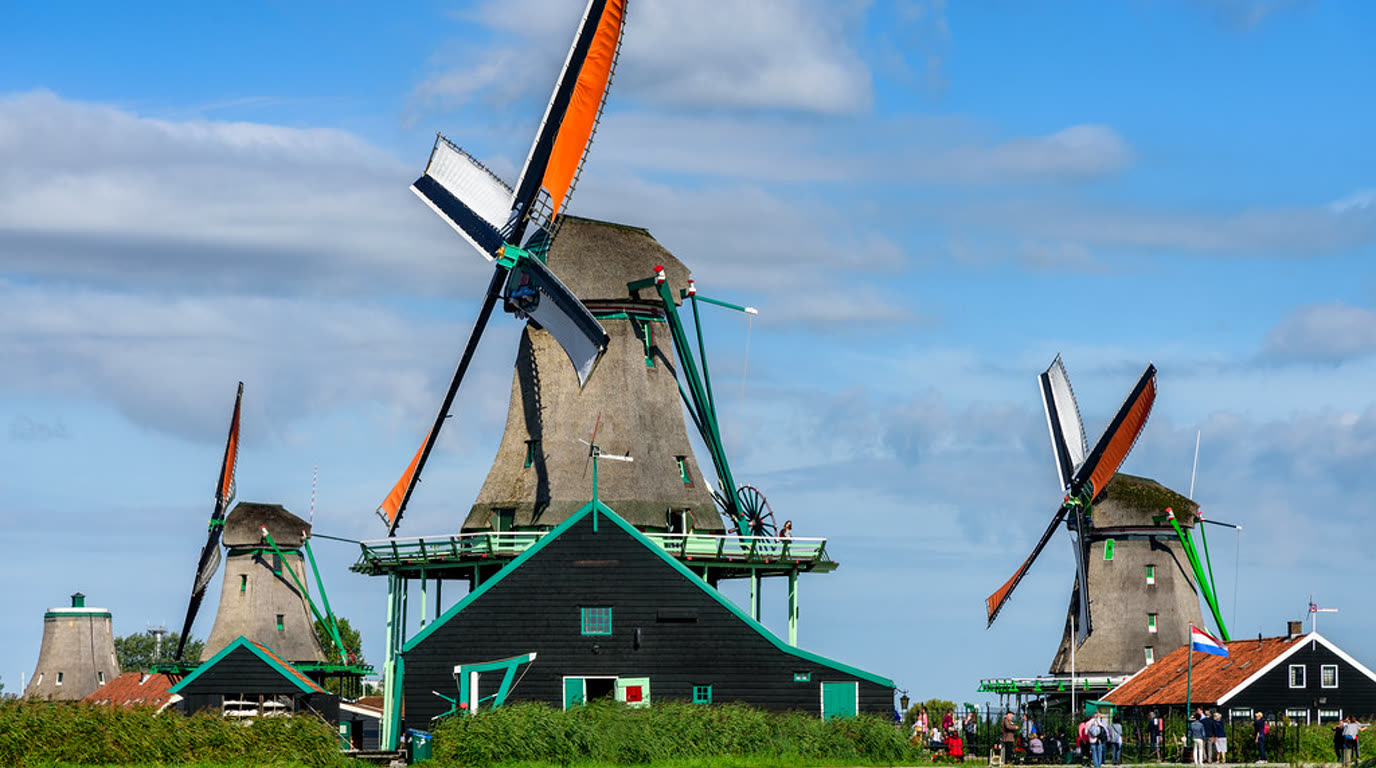
Kinderdijk is a group of nineteen mills built around 1740 to drain the Alblasserwaard polder; it is the largest concentration of old windmills in the Netherlands and a UNESCO site. Some of them are open as a museum, so you can see how the millers' families actually lived — living space smaller than in any caravan. The afternoon suits Rotterdam; a WaterShuttle runs between the city and the mills if you would rather not get behind the wheel again.
Keukenhof and the bulb belt
Moving north to Rijnsburg puts you in the middle of the bulb belt. Keukenhof is a garden of thirty-two hectares, planted every autumn with around seven million bulbs, and it opens for only about eight weeks — in 2027 from 18 March to 9 May, daily from eight in the morning. Anyone travelling later in the season will find the garden closed; in that case it is worth trading it for a circuit on the cycle paths between Lisse and Noordwijk.
Leiden and the dunes by the North Sea
The university town of Leiden is Amsterdam in miniature and without the crowds: canals, old facades and the Hortus botanicus, one of the oldest botanical gardens in Europe. In the afternoon you can ride from the campsite all the way to the dunes at Katwijk aan Zee and out to the North Sea. Sand, wind and a flat horizon — children usually appreciate that more than any gallery.
Zaanse Schans and moving on to Amsterdam
The morning takes you from the bulb belt towards Amsterdam, the afternoon belongs to Zaanse Schans — a collection of historic mills and wooden houses moved here from all over the Zaan region since the 1960s. Watch out for one thing: the car park there is designed for cars and coaches only and has no spaces for motorhomes. Leave the vehicle at the campsite and come by train to Zaandijk Zaanse Schans station, from where the mills are a short walk across the bridge.
Amsterdam without the vehicle
A whole day in the city with the vehicle left at the campsite. A tram runs into the centre from Zuider IJdijk and bike rentals are on every other corner, so you can ride around the seventeenth-century ring of canals in a morning. In the afternoon pick one museum — the Rijksmuseum, the Van Gogh Museum, or the NEMO science centre for the children — and spend the evening simply walking the waterfronts.
Giethoorn, the village without roads
A transfer north-east into Overijssel, to the lake landscape of the Weerribben-Wieden national park. The old part of Giethoorn has no roads, only canals and more than a hundred and seventy little bridges, so you cannot drive into it with a motorhome — you stop at the car park on the edge and continue on foot, by bike or in a hired boat. An electric boat that needs no licence is the standard here; allow a whole morning for a circuit of the village by water.
Crossing into Flanders and an evening in Ghent
The longest transfer of the whole trip runs via Utrecht, Rotterdam and Antwerp into Belgium, so set off early. The afternoon belongs to Gravensteen castle of 1180, built for Philip of Alsace, Count of Flanders — it stands right in the centre and from the ramparts you can see the whole old town. In the evening there is nothing better to do than sit on the Graslei and Korenlei quays and watch the water.
Bruges and turning for home
In the morning to Bruges, where everything begins on the Markt square below the Belfry. The tower is eighty-three metres high, three hundred and sixty-six steps lead to the top, and the carillon of forty-seven bells plays on Wednesday, Saturday and Sunday from eleven in the morning. After lunch it pays to head east and spend the night somewhere around Frankfurt am Main, so that the last day is not endless.
Back to Prague
The final day is a straight run across Germany back home. Set off early and you are in Prague in the afternoon, with time to spare for unpacking the vehicle. Do drain the grey and black tanks at the campsite in the morning, though, so that you are not hunting for a dump point on the German motorways along the way.
Practical motorhome information
Up to 3.5 t: there are no motorway charges in Germany, the Netherlands or Belgium and you need no vignette anywhere on the route. Over 3.5 t: under the German tolling act (BFStrMG, § 1) the toll applies only to vehicles intended or used for the carriage of goods, and a motorhome does not fall under that definition; the Belgian Viapass kilometre charge likewise targets only goods vehicles over 3.5 t. So you pay only for individual structures and attractions: in the Netherlands the Kiltunnel near Dordrecht and the tolled section of the A24 near Rotterdam (both can be driven around), in Belgium the Liefkenshoek tunnel near Antwerp, where the rate for passenger categories is roughly in the 4 to 8 € range depending on how you pay — the neighbouring Kennedy tunnel is free. Visiting Kinderdijk carries a charge of its own: motorhomes and coaches have a dedicated area at Lekdijk 432A in Nieuw-Lekkerland for 12.50 € a day, and staying overnight there is expressly forbidden. Count on the low-emission zone in Ghent as well — a vehicle with foreign plates must be registered online no later than the day after entering, otherwise a fine follows; the city publishes the rates and the registration form on its website.
Camping Recreatiepark de Oude Maas, Barendrecht — 45 motorhome pitches, open all year, a good base for both Kinderdijk and Rotterdam · Vakantiepark Koningshof, Rijnsburg (Elsgeesterweg 8) — right in the bulb belt between Leiden and Keukenhof, pitches for motorhomes and caravans · Camping Zeeburg, Amsterdam (Zuider IJdijk 20) — dedicated motorhome pitches, a tram into the centre and a cycle path along the IJ · Camping Kleine Belterwijde, Belt-Schutsloot — 20 motorhome pitches in the lake landscape a short way from Giethoorn · Camping Urban Gardens – Blaarmeersen, Ghent (Zuiderlaan 12) — 48 motorhome pitches with water and a dump station, in a recreation park on the western edge of the city · Camping Memling, Bruges (Veltemweg 109) — spacious motorhome pitches close to the historic centre, reachable by bike or on foot
Wild camping is banned in both the Netherlands and Belgium — you sleep at campsites or at official camperplaats. The Dutch network of these is dense and decently equipped; they tend to be by harbours, on the edges of towns and by lakes, you pay at a machine and the stay is usually limited to one to three nights. Belgium has far fewer of them and in tourist towns they fill up by early afternoon, so in high season a reservation makes sense. In the larger cities on the route you will not get into the centre with the vehicle anyway: in Amsterdam, Ghent and Bruges the assumption is that you park on the edge and continue by tram, train or bike.
The best equipped service point on the route is at the Urban Gardens – Blaarmeersen campsite in Ghent, where the motorhome pitches have drinking water as well as a dump station for the grey and black tanks. In the Netherlands most camperplaatsen combine water and a dump point in one place by the entrance, so between Kinderdijk and Giethoorn you will manage with a top-up every two or three days. Tap water is drinkable in both countries and at campsites you pay for it either in the pitch price or with a token. Think about gas in advance: Czech cylinders cannot be exchanged in the Benelux, so take a full spare from home or an adapter for the local system.
Stops along the route
You may also like
The map and GPX contain separate planning waypoints, not a driving route. Follow the itinerary for access to attractions and campsites.
Adria Coral XL
The Coral XL is a spacious semi-integrated motorhome with a family layout and a large rear garage that swallows bikes for the whole crew without any packing puzzle. On the flat between dykes and canals its length makes no difference at all, and every campsite on the route has pitches reserved for motorhomes.
Get road trip ideas by email
Leave us your email and we will send motorhome inspiration and stock updates.
Adria Karavany · https://www.adriakaravany.cz/en/vylety/nizozemsko-a-belgicke-flandry/